Freund Niclas, Friedli Bernhard C, Junker Therese, Zimmermann Martin, Zellweger Michael J
University Hospital Basel, Cardiology Department, Switzerland.
Kantonsspital Baden, Cardiology Department, Switzerland.
Open Cardiovasc Med J. 2015 Feb 27;9:35-9. doi: 10.2174/1874192401509010035. eCollection 2015.
"CardioTest (®) " is a tool for cardiovascular risk assessment. The aim of this study was to evaluate if this test used in Swiss pharmacies provides risk stratification and if it had impact on individual behaviour.
Individuals were evaluated (blood pressure, body waist circumference, random blood samples and coronary artery disease risk factors). The cardiovascular risk was calculated (AGLA Risk Score (ARS) a modified PROCAM Score) and participants were informed about their result. One year after the initial testing individuals were followed up by questionnaire with respect to the action they had taken based upon the ARS results. The relation between ARS results and events during follow-up were assessed. Events were defined as cardiovascular events due to chest pain, myocardial infarction or stroke.
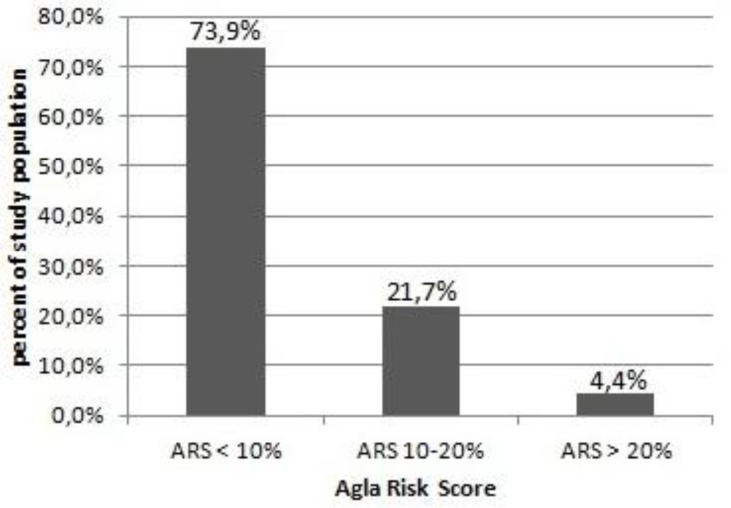
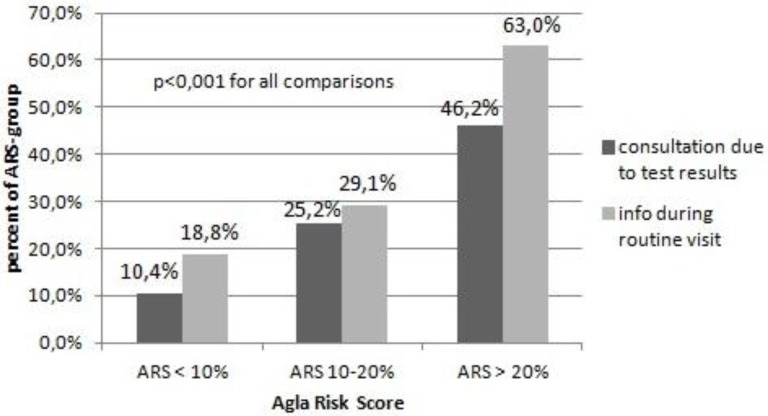
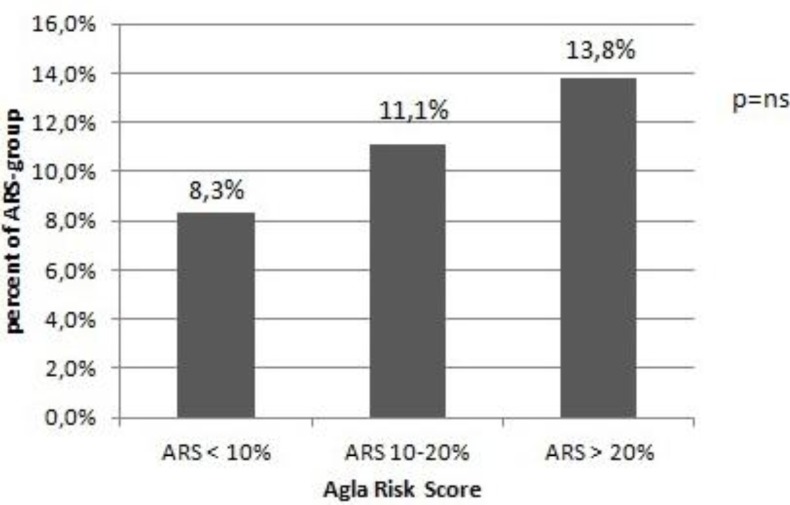
A total of 1415 individuals were contacted for follow-up, 746 (53%) with a mean age of 62.7 (±12.8) years (60% were male) returned their questionnaire. The cardiovascular risk throughout the study-population turned out to be low: 73.9% had a low ARS <10%, 21.7% an intermediate ARS 10-20% and 4.4% had a high ARS >20%. Significantly more participants with ARS >20% consulted their family doctor (46.2%) than those with ARS 10-20% (25.2%) and ARS <10% (10.4%), respectively (p<0,01 for both comparisons). Sixty-four individuals (9%) suffered a cardiovascular event. The event rates increased as a function of ARS.
The overall cardiovascular risk of individuals participating in a pharmacy based risk assessment program seems to be low. CardioTest (®) provided risk stratification with respect to future cardio-vascular events. CardioTest (®) seems to have impact on individual behavior and lifestyle modification. Other settings and locations for screening might be considered to reach higher risk individuals at an earlier stage.
“CardioTest (®) ”是一种心血管风险评估工具。本研究的目的是评估在瑞士药店使用的该测试是否能进行风险分层,以及它是否会对个体行为产生影响。
对个体进行评估(测量血压、身体腰围、采集随机血样并评估冠状动脉疾病风险因素)。计算心血管风险(AGLA风险评分(ARS),一种改良的PROCAM评分),并将结果告知参与者。在初次检测一年后,通过问卷调查对个体基于ARS结果所采取的行动进行随访。评估ARS结果与随访期间发生的事件之间的关系。事件定义为因胸痛、心肌梗死或中风导致的心血管事件。
共联系了1415名个体进行随访,746名(53%)平均年龄为62.7(±12.8)岁(60%为男性)的个体返回了问卷。整个研究人群的心血管风险较低:73.9%的个体ARS较低<10%,21.7%的个体ARS中等为10 - 20%,4.4%的个体ARS较高>20%。ARS>20%的参与者咨询家庭医生的比例(46.2%)明显高于ARS为10 - 20%(25.2%)和ARS<10%(10.4%)的参与者(两项比较p均<0.01)。64名个体(9%)发生了心血管事件。事件发生率随ARS升高而增加。
参与基于药店的风险评估项目的个体总体心血管风险似乎较低。“CardioTest (®) ”能对未来心血管事件进行风险分层。“CardioTest (®) ”似乎会对个体行为和生活方式改变产生影响。可能需要考虑在其他环境和地点进行筛查,以便更早地接触到风险较高的个体。