Broering Ellen P, Dillon Stephanie, Gale Eric M, Steiner Ramsey A, Telser Joshua, Brunold Thomas C, Harrop Todd C
†Department of Chemistry and Center for Metalloenzyme Studies, The University of Georgia, 1001 Cedar Street, Athens, Georgia 30602, United States.
‡Department of Chemistry, University of Wisconsin, Madison, Wisconsin 53706, United States.
Inorg Chem. 2015 Apr 20;54(8):3815-28. doi: 10.1021/ic503124f. Epub 2015 Apr 2.
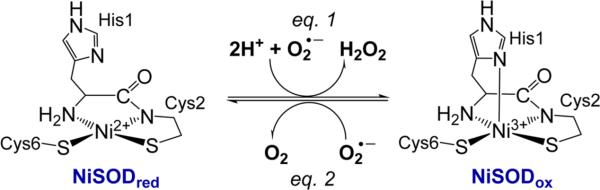
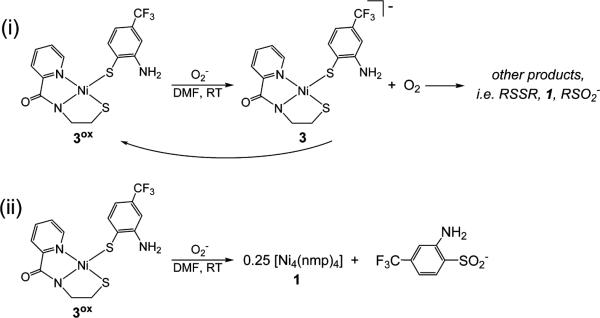
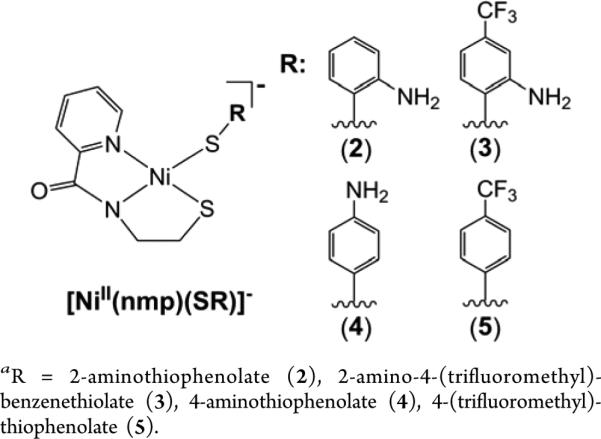
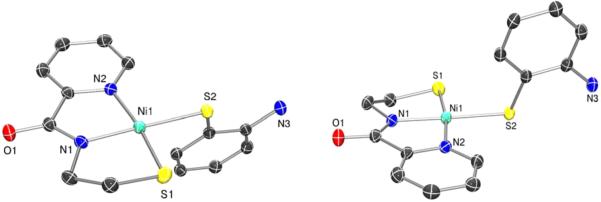
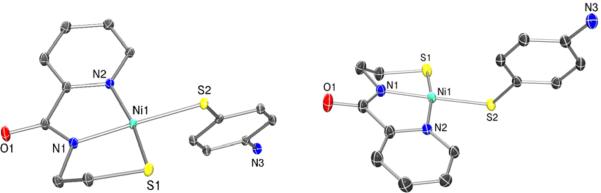
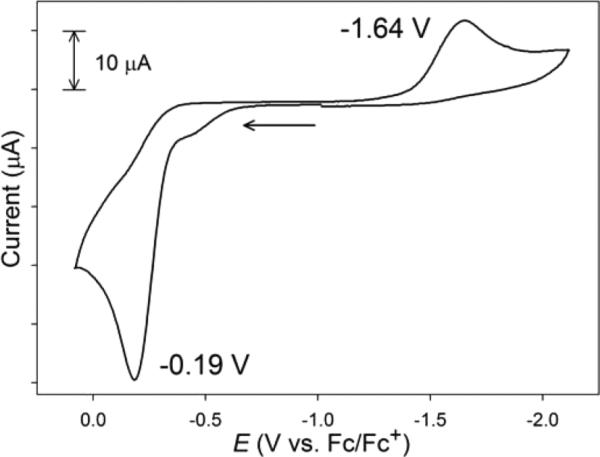
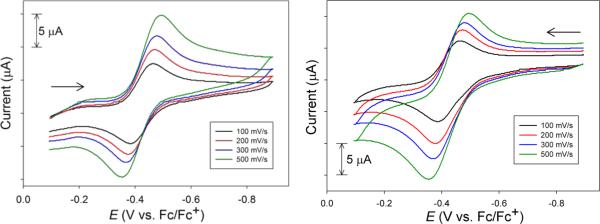
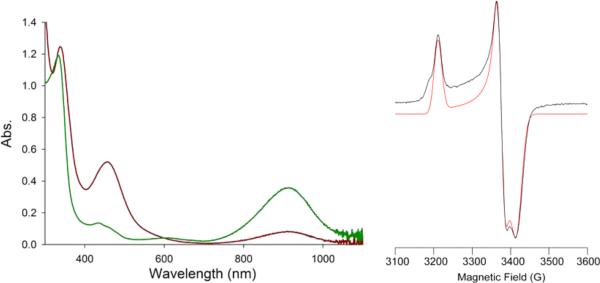
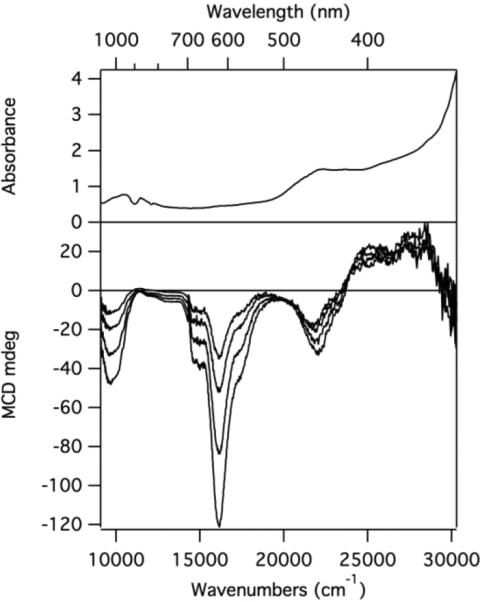
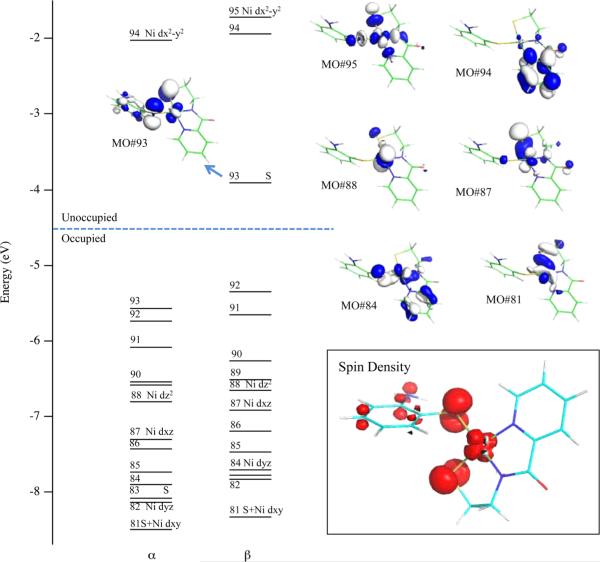
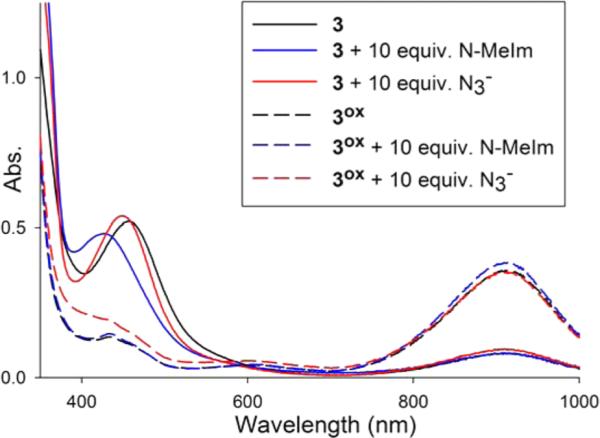
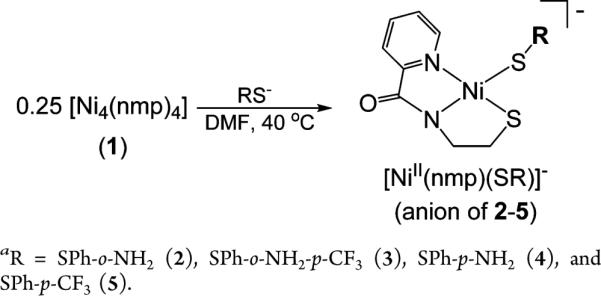
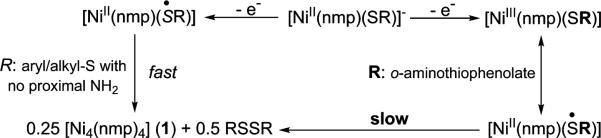
Superoxide dismutase (SOD) catalyzes the disproportionation of superoxide (O2(• -)) into H2O2 and O2(g) by toggling through different oxidation states of a first-row transition metal ion at its active site. Ni-containing SODs (NiSODs) are a distinct class of this family of metalloenzymes due to the unusual coordination sphere that is comprised of mixed N/S-ligands from peptide-N and cysteine-S donor atoms. A central goal of our research is to understand the factors that govern reactive oxygen species (ROS) stability of the Ni-S(Cys) bond in NiSOD utilizing a synthetic model approach. In light of the reactivity of metal-coordinated thiolates to ROS, several hypotheses have been proffered and include the coordination of His1-Nδ to the Ni(II) and Ni(III) forms of NiSOD, as well as hydrogen bonding or full protonation of a coordinated S(Cys). In this work, we present NiSOD analogues of the general formula Ni(N2S)(SR'), providing a variable location (SR' = aryl thiolate) in the N2S2 basal plane coordination sphere where we have introduced o-amino and/or electron-withdrawing groups to intercept an oxidized Ni species. The synthesis, structure, and properties of the NiSOD model complexes (Et4N)[Ni(nmp)(SPh-o-NH2)] (2), (Et4N)[Ni(nmp)(SPh-o-NH2-p-CF3)] (3), (Et4N)[Ni(nmp)(SPh-p-NH2)] (4), and (Et4N)[Ni(nmp)(SPh-p-CF3)] (5) (nmp(2-) = dianion of N-(2-mercaptoethyl)picolinamide) are reported. NiSOD model complexes with amino groups positioned ortho to the aryl-S in SR' (2 and 3) afford oxidized species (2(ox) and 3(ox)) that are best described as a resonance hybrid between Ni(III)-SR and Ni(II)-(•)SR based on ultraviolet-visible (UV-vis), magnetic circular dichroism (MCD), and electron paramagnetic resonance (EPR) spectroscopies, as well as density functional theory (DFT) calculations. The results presented here, demonstrating the high percentage of S(3p) character in the highest occupied molecular orbital (HOMO) of the four-coordinate reduced form of NiSOD (NiSODred), suggest that the transition from NiSODred to the five-coordinate oxidized form of NiSOD (NiSODox) may go through a four-coordinate Ni-(•)S(Cys) (NiSODox-Hisoff) that is stabilized by coordination to Ni(II).
超氧化物歧化酶(SOD)通过在其活性位点切换第一排过渡金属离子的不同氧化态,催化超氧化物(O2(• -))歧化为H2O2和O2(g)。含镍超氧化物歧化酶(NiSODs)是这类金属酶中的一个独特类别,因为其具有不寻常的配位环境,该环境由来自肽 - N和半胱氨酸 - S供体原子的混合N/S配体组成。我们研究的一个核心目标是利用合成模型方法来理解控制NiSOD中Ni - S(半胱氨酸)键的活性氧(ROS)稳定性的因素。鉴于金属配位硫醇盐对ROS的反应性,已经提出了几种假设,包括His1 - Nδ与NiSOD的Ni(II)和Ni(III)形式的配位,以及配位的S(半胱氨酸)的氢键作用或完全质子化。在这项工作中,我们展示了通式为Ni(N2S)(SR')的NiSOD类似物,在N2S2基面配位环境中提供了一个可变位置(SR' = 芳基硫醇盐),我们在其中引入了邻氨基和/或吸电子基团以捕获氧化态的Ni物种。报道了NiSOD模型配合物(Et4N)[Ni(nmp)(SPh - o - NH2)](2)、(Et4N)[Ni(nmp)(SPh - o - NH2 - p - CF3)](3)、(Et4N)[Ni(nmp)(SPh - p - NH2)](4)和(Et4N)[Ni(nmp)(SPh - p - CF3)](5)(nmp(2-) = N - (2 - 巯基乙基)吡啶酰胺的二价阴离子)的合成、结构和性质。在SR'中芳基 - S的邻位带有氨基的NiSOD模型配合物(2和3)产生的氧化物种(2(ox)和3(ox)),根据紫外 - 可见(UV - vis)、磁圆二色性(MCD)和电子顺磁共振(EPR)光谱以及密度泛函理论(DFT)计算,最好描述为Ni(III) - SR和Ni(II) - (•)SR之间的共振杂化体。此处给出的结果表明,在四配位还原形式的NiSOD(NiSODred)的最高占据分子轨道(HOMO)中S(3p)特征的高比例,这表明从NiSODred到五配位氧化形式的NiSOD(NiSODox)的转变可能通过与Ni(II)配位而稳定的四配位Ni - (•)S(半胱氨酸)(NiSODox - Hisoff)进行。