Shi Hao, Chen Xiong, Lu Cheng, Gu Changmei, Jiang Hongwei, Meng RuiWei, Niu Xun, Huang Yangxin, Lu Meixia
Department of Epidemiology and Biostatistics, and the Ministry of Education Key Lab of Environment and Health, School of Public Health, Tongji Medical College, Huazhong University of Science and Technology, Wuhan, Hubei, China.
Department of Otolaryngology, Union Hospital, Tongji Medical College, Huazhong University of Science and Technology, Wuhan, Hubei, China.
PLoS One. 2015 Apr 2;10(4):e0122302. doi: 10.1371/journal.pone.0122302. eCollection 2015.
The p16INK4a is an important tumor suppressor gene (TSG) and aberrant methylation of promoter is known to be a major inactivation mechanism of the tumor suppressor and tumor-related genes. Aberrant TSG methylation was considered an important epigenetic silencing mechanism in the progression of head and neck squamous cell carcinoma (HNSCC). However, some studies have reported differences in the methylation frequencies of P16INK4a promoter between cancer and the corresponding control group. Therefore, we conducted a meta-analysis to better identify the association.
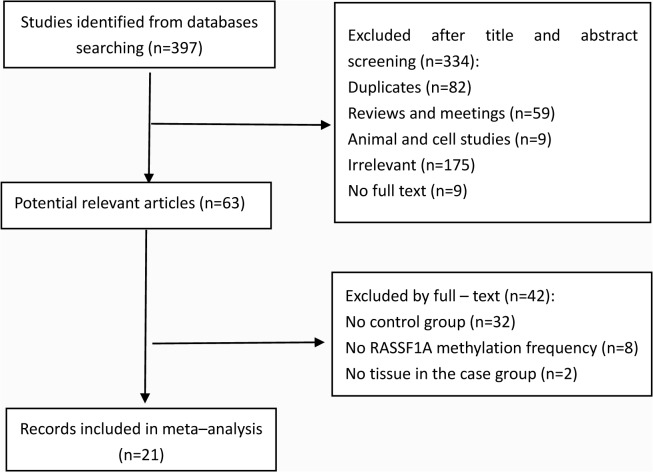
PubMed, Ovid, ISI Web of Science, and EMBASE were searched to identify eligible studies to evaluate the association of p16INK4a promoter methylation and HNSCC. Odds ratio (ORs) and 95% confidence intervals (95%CI) were calculated to evaluate the strength of association between p16INK4a promoter methylation and HNSCC.
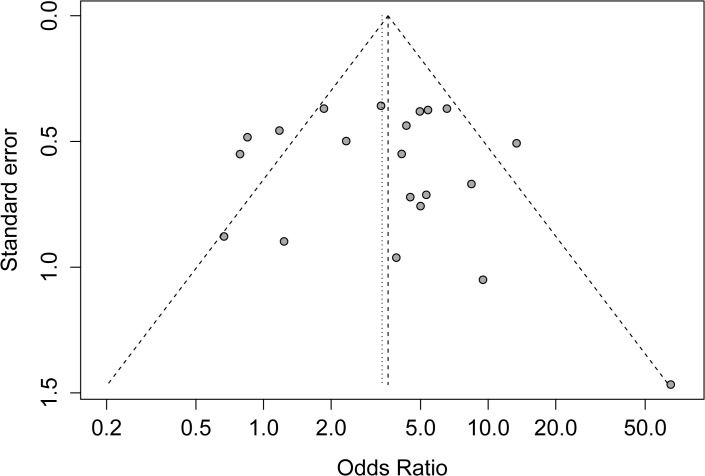
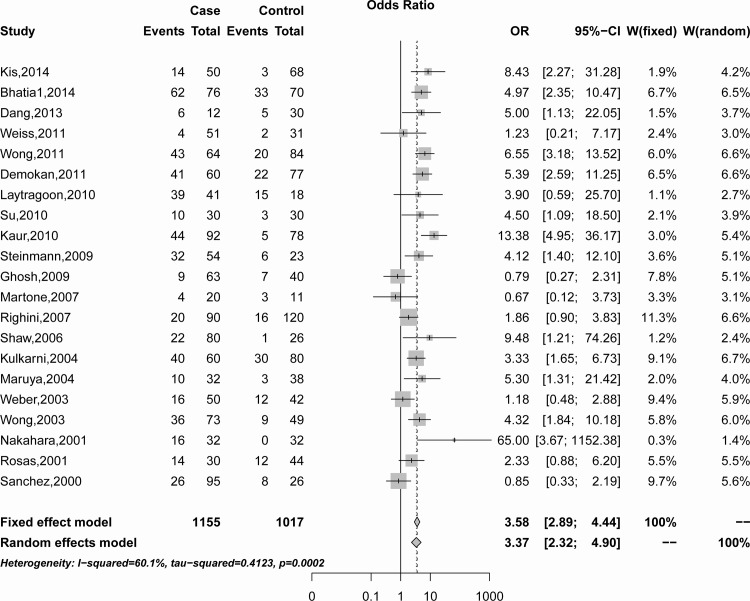
A total of twenty-one studies with 1155 cases and 1017 controls were included in the meta-analysis. The frequencies of p16INK4a promoter methylation in the cancer group were significantly higher than those in the control group (cancer group: median: 46.67%, range = 7.84%-95.12%; control group: median: 18.37%, range = 0-83.33%; respectively). The pooled odds ratio was 3.37 (95%CI = 2.32-4.90) in the cancer group versus the corresponding control group under the random-effects model.
This meta-analysis of 21 published studies identified that aberrant methylation of p16INK4a promoter was found to be significantly associated with HNSCC.
p16INK4a是一种重要的肿瘤抑制基因(TSG),已知启动子的异常甲基化是肿瘤抑制基因和肿瘤相关基因的主要失活机制。异常的TSG甲基化被认为是头颈部鳞状细胞癌(HNSCC)进展中的一种重要表观遗传沉默机制。然而,一些研究报道了癌症组与相应对照组之间P16INK4a启动子甲基化频率的差异。因此,我们进行了一项荟萃分析以更好地确定这种关联。
检索PubMed、Ovid、ISI Web of Science和EMBASE以识别评估p16INK4a启动子甲基化与HNSCC关联的合格研究。计算比值比(OR)和95%置信区间(95%CI)以评估p16INK4a启动子甲基化与HNSCC之间关联的强度。
荟萃分析共纳入21项研究,包括1155例病例和1017例对照。癌症组中p16INK4a启动子甲基化频率显著高于对照组(癌症组:中位数:46.67%,范围 = 7.84%-95.12%;对照组:中位数:18.37%,范围 = 0-83.33%)。在随机效应模型下,癌症组与相应对照组的合并比值比为3.37(95%CI = 2.32-4.90)。
这项对21项已发表研究的荟萃分析确定,p16INK4a启动子的异常甲基化与HNSCC显著相关。