Huang Hsiao-Yun, Hopper Anita K
Department of Molecular Genetics, Center for RNA Biology, The Ohio State University, Columbus, Ohio 43210, USA.
Department of Molecular Genetics, Center for RNA Biology, The Ohio State University, Columbus, Ohio 43210, USA
Genes Dev. 2015 Apr 1;29(7):772-83. doi: 10.1101/gad.258293.115.
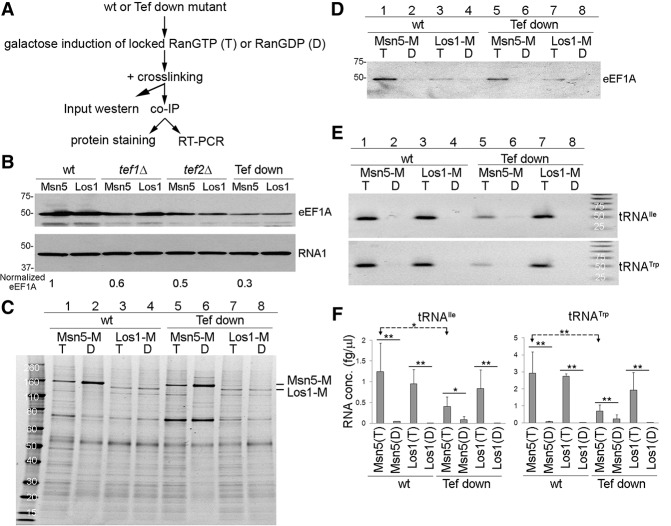
Bidirectional tRNA movement between the nucleus and the cytoplasm serves multiple biological functions. To gain a biochemical understanding of the mechanisms for tRNA subcellular dynamics, we developed in vivo β-importin complex coimmunoprecipitation (co-IP) assays using budding yeast. Our studies provide the first in vivo biochemical evidence that two β-importin family members, Los1 (exportin-t) and Msn5 (exportin-5), serve overlapping but distinct roles in tRNA nuclear export. Los1 assembles complexes with RanGTP and tRNA. Both intron-containing pre-tRNAs and spliced tRNAs, regardless of whether they are aminoacylated, assemble into Los1-RanGTP complexes, documenting that Los1 participates in both primary nuclear export and re-export of tRNAs to the cytoplasm. In contrast, β-importin Msn5 preferentially assembles with RanGTP and spliced, aminoacylated tRNAs, documenting its role in tRNA nuclear re-export. Tef1/2 (the yeast form of translation elongation factor 1α [eEF1A]) aids the specificity of Msn5 for aminoacylated tRNAs to form a quaternary complex consisting of Msn5, RanGTP, aminoacylated tRNA, and Tef1/2. Assembly and/or stability of this quaternary complex requires Tef1/2, thereby facilitating efficient re-export of aminoacylated tRNAs to the cytoplasm.
tRNA在细胞核与细胞质之间的双向移动具有多种生物学功能。为了从生化角度理解tRNA亚细胞动态变化的机制,我们利用芽殖酵母开展了体内β-输入蛋白复合体共免疫沉淀(co-IP)实验。我们的研究首次提供了体内生化证据,表明两个β-输入蛋白家族成员Los1(输出蛋白-t)和Msn5(输出蛋白-5)在tRNA核输出中发挥着重叠但不同的作用。Los1与RanGTP和tRNA组装成复合体。含内含子的前体tRNA和剪接后的tRNA,无论是否氨酰化,都能组装进Los1-RanGTP复合体,这表明Los1参与了tRNA的初级核输出以及向细胞质的再输出。相比之下,β-输入蛋白Msn5优先与RanGTP以及剪接后的氨酰化tRNA组装在一起,这表明它在tRNA核再输出中发挥作用。Tef1/2(酵母形式的翻译延伸因子1α [eEF1A])有助于Msn5对氨酰化tRNA的特异性识别,从而形成由Msn5、RanGTP、氨酰化tRNA和Tef1/2组成的四元复合体。该四元复合体的组装和/或稳定性需要Tef1/2,从而促进氨酰化tRNA高效地再输出到细胞质中。