Wang Liang, Yuan Jin, Jiang Hong, Yan Wentao, Cintrón-Colón Hector R, Perez Victor L, DeBuc Delia C, Feuer William J, Wang Jianhua
Palmer Trinity School (L.W.), Miami, FL; Bascom Palmer Eye Institute (J.Y., H.J., H.R.C.-C., V.L.P., D.C.D., W.J.F., J.W.), Department of Ophthalmology, University of Miami, Miami, FL; Zhongshan Ophthalmic Centre (J.Y.), Sun Yat-sen University, Department of Ophthalmology and Optometry, Guangzhou, China; School of Ophthalmology and Optometry (W.Y.), Wenzhou Medical College, Wenzhou, China; Departments of Neurology (H.J.), and Microbiology and Immunology (H.R.C.-C., V.L.P.), University of Miami, FL; and Statistic Division (W.J.F.), Bascom Palmer Eye Institute, University of Miami, Miami, FL.
Eye Contact Lens. 2016 Mar;42(2):135-40. doi: 10.1097/ICL.0000000000000146.
This study determined (1) how many vessels (i.e., the vessel sampling) are needed to reliably characterize the bulbar conjunctival microvasculature and (2) if characteristic information can be obtained from the distribution histogram of the blood flow velocity and vessel diameter.
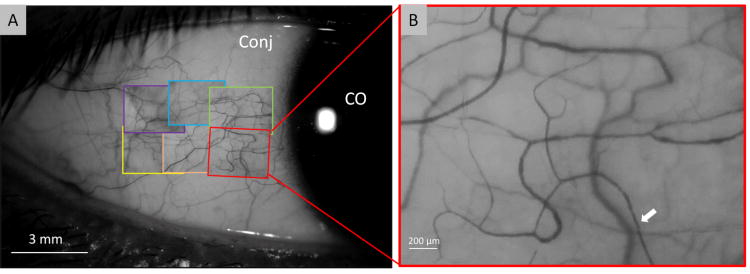
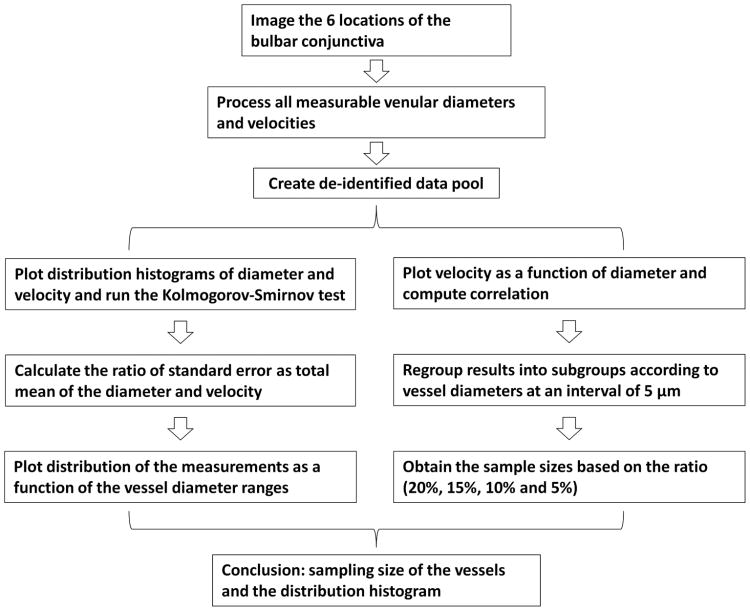
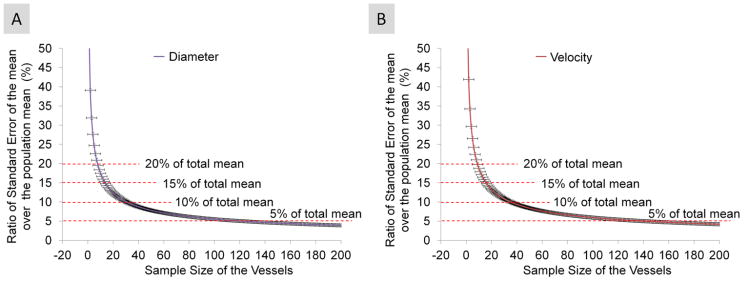
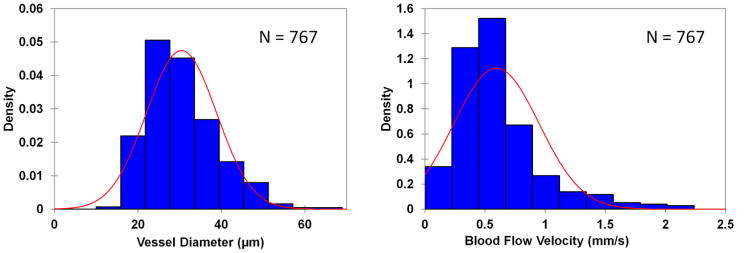
Functional slitlamp biomicroscope was used to image hundreds of venules per subject. The bulbar conjunctiva in five healthy human subjects was imaged on six different locations in the temporal bulbar conjunctiva. The histograms of the diameter and velocity were plotted to examine whether the distribution was normal. Standard errors were calculated from the standard deviation and vessel sample size. The ratio of the standard error of the mean over the population mean was used to determine the sample size cutoff. The velocity was plotted as a function of the vessel diameter to display the distribution of the diameter and velocity.
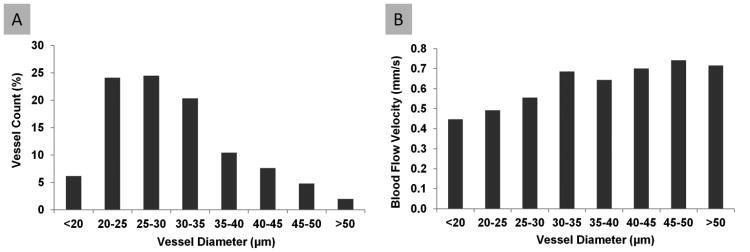
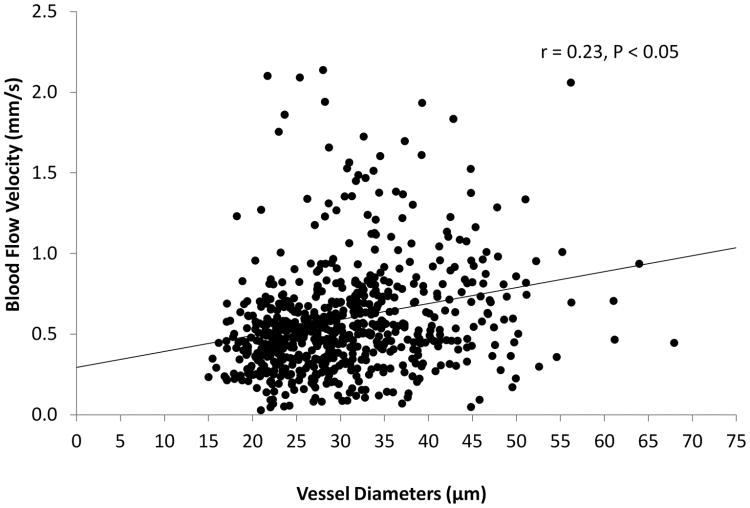
The results showed that the sampling size was approximately 15 vessels, which generated a standard error equivalent to 15% of the population mean from the total vessel population. The distributions of the diameter and velocity were not only unimodal, but also somewhat positively skewed and not normal. The blood flow velocity was related to the vessel diameter (r=0.23, P<0.05).
This was the first study to determine the sampling size of the vessels and the distribution histogram of the blood flow velocity and vessel diameter, which may lead to a better understanding of the human microvascular system of the bulbar conjunctiva.
本研究确定了(1)可靠地表征球结膜微血管系统需要多少血管(即血管采样),以及(2)是否可以从血流速度和血管直径的分布直方图中获得特征信息。
使用功能性裂隙灯生物显微镜对每位受试者的数百条小静脉进行成像。对5名健康人类受试者颞侧球结膜的6个不同位置进行球结膜成像。绘制直径和速度的直方图以检查分布是否呈正态分布。根据标准差和血管样本量计算标准误差。使用样本均值的标准误差与总体均值的比率来确定样本量截止值。绘制速度与血管直径的函数关系图以显示直径和速度的分布。
结果表明,采样大小约为15条血管,其产生的标准误差相当于总血管群体中总体均值的15%。直径和速度的分布不仅是单峰的,而且有些正偏态且不呈正态分布。血流速度与血管直径相关(r = 0.23,P < 0.05)。
这是第一项确定血管采样大小以及血流速度和血管直径分布直方图的研究,这可能有助于更好地理解球结膜的人体微血管系统。