Vu Khoan, Manjappa Shivaprasad, DiPersio John F, Gao Feng, Westervelt Peter, Vij Ravi, Stockerl-Goldstein Keith E, Uy Geoffrey L, Abboud Camille N, Schroeder Mark A, Fehniger Todd A, Cashen Amanda F, Romee Rizwan
Department of Medicine, Washington University School of Medicine, St. Louis, Missouri.
Department of Hospital Medicine, Washington University School of Medicine, St. Louis, Missouri.
Biol Blood Marrow Transplant. 2015 Aug;21(8):1425-30. doi: 10.1016/j.bbmt.2015.03.022. Epub 2015 Mar 31.
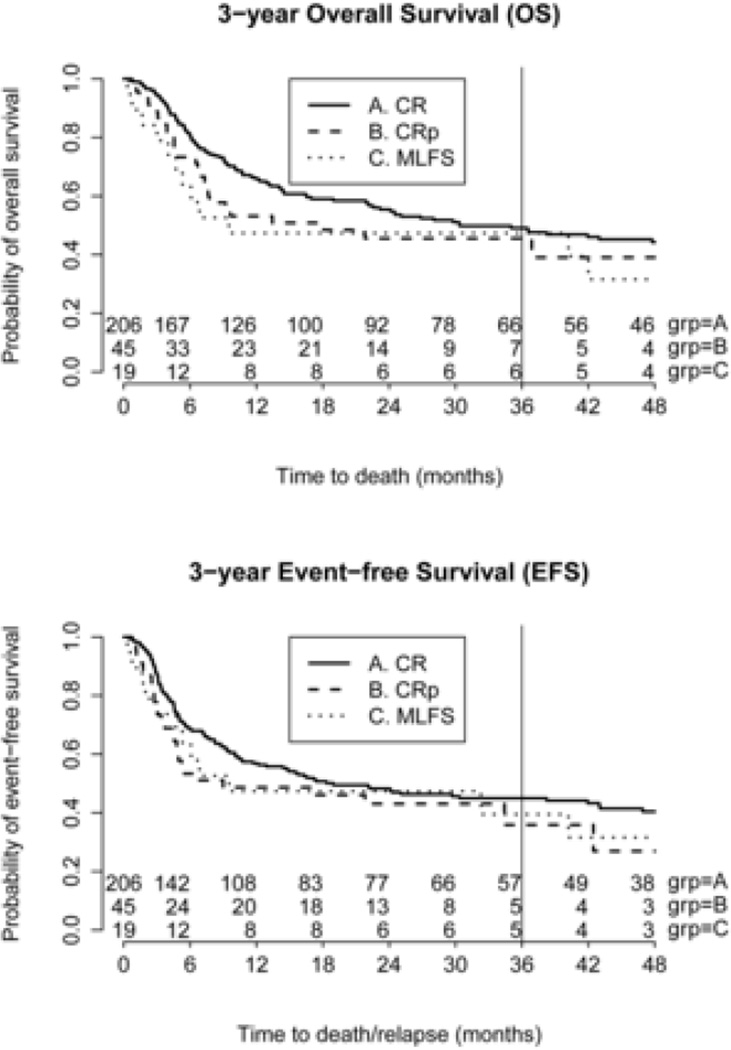
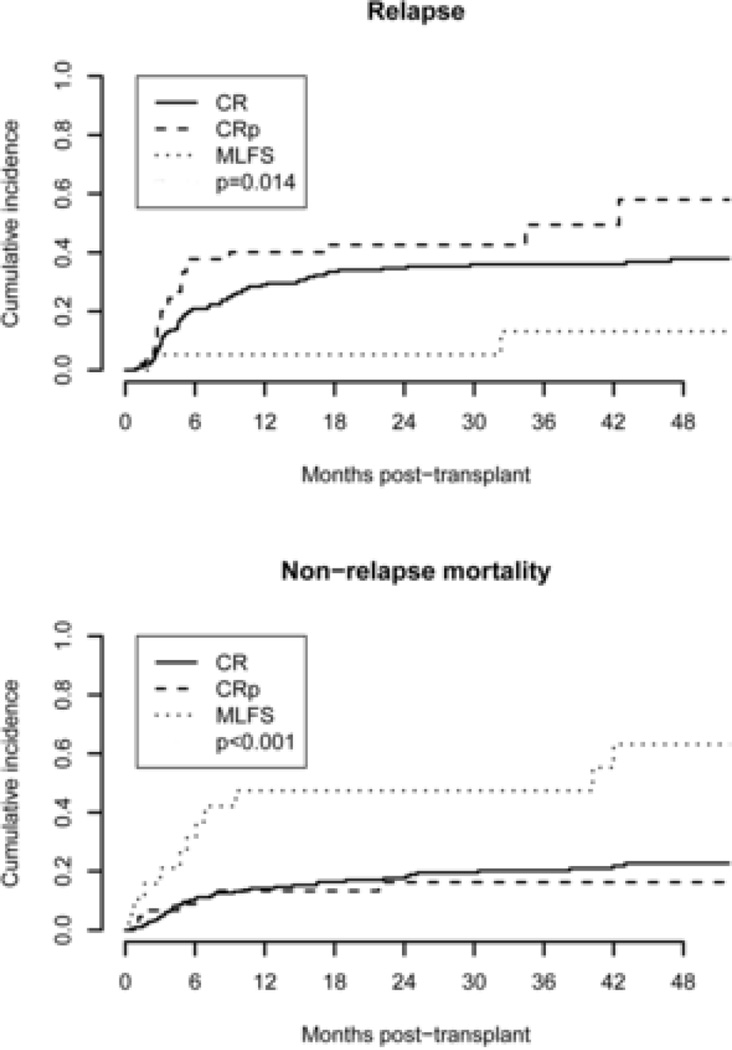
Pretransplant remission status in patients with acute myeloid leukemia (AML) is 1 of the most important factors determining their outcomes after allogeneic hematopoietic cell transplantation (allo-HCT). Most patients are in complete remission with full hematologic recovery (CR) before undergoing allo-HCT. However, some patients achieve CR without recovery of platelet count (CRp) or a morphologic leukemia-free state (MLFS), defined as meeting all CR criteria without recovery of both neutrophil and platelet counts. Currently, there is a paucity of data regarding transplant outcomes in AML patients achieving MLFS after chemotherapy. To address this question, we evaluated transplant outcomes in 270 AML patients who received 6/6 HLA-matched sibling or 10/10 HLA-matched unrelated donor transplantation at a single institution between 2006 and 2013. Of our 270 patients, 206 were in CR, 45 were in CRp, and 19 were in MLFS before allo-HCT. Patients in CR, CRp, or MLFS had similar 3-year overall survival rates (49%, 46%, and 47%, respectively; P = .88) and 3-year event-free survival rates (45%, 36%, and 40%, respectively; P = .53). However, the cumulative incidence of nonrelapse mortality was significantly higher in patients in MLFS compared with those in CR (58% versus 22%, P = .0004), whereas the cumulative incidence of relapse in patients in MLFS was significantly lower compared with those in CR (11% versus 36%, P = .03). Our results suggest that survival outcomes in AML patients are not influenced by degree of hematologic recovery before allo-HCT.
急性髓系白血病(AML)患者移植前的缓解状态是决定其异基因造血细胞移植(allo-HCT)后预后的最重要因素之一。大多数患者在接受allo-HCT前处于完全缓解且血液学完全恢复(CR)状态。然而,一些患者达到了CR但血小板计数未恢复(CRp)或处于形态学无白血病状态(MLFS),MLFS定义为满足所有CR标准但中性粒细胞和血小板计数均未恢复。目前,关于化疗后达到MLFS的AML患者移植结局的数据较少。为解决这一问题,我们评估了2006年至2013年间在单一机构接受6/6 HLA匹配同胞或10/10 HLA匹配无关供体移植的270例AML患者的移植结局。在我们的270例患者中,206例处于CR,45例处于CRp,19例在allo-HCT前处于MLFS。处于CR、CRp或MLFS的患者3年总生存率相似(分别为49%、46%和47%;P = 0.88),3年无事件生存率也相似(分别为45%、36%和40%;P = 0.53)。然而,与CR患者相比,MLFS患者的非复发死亡率累积发生率显著更高(58%对22%,P = 0.0004),而MLFS患者的复发累积发生率与CR患者相比显著更低(11%对36%,P = 0.03)。我们的结果表明,AML患者的生存结局不受allo-HCT前血液学恢复程度的影响。