Tighe Patrick J, Goldsmith Ryan C, Gravenstein Michael, Bernard H Russell, Fillingim Roger B
University of Florida College of Medicine, Department of Anesthesiology, Gainesville, FL, United States.
J Med Internet Res. 2015 Apr 2;17(4):e84. doi: 10.2196/jmir.3769.
Despite the widespread popularity of social media, little is known about the extent or context of pain-related posts by users of those media.
The aim was to examine the type, context, and dissemination of pain-related tweets.
We used content analysis of pain-related tweets from 50 cities to unobtrusively explore the meanings and patterns of communications about pain. Content was examined by location and time of day, as well as within the context of online social networks.
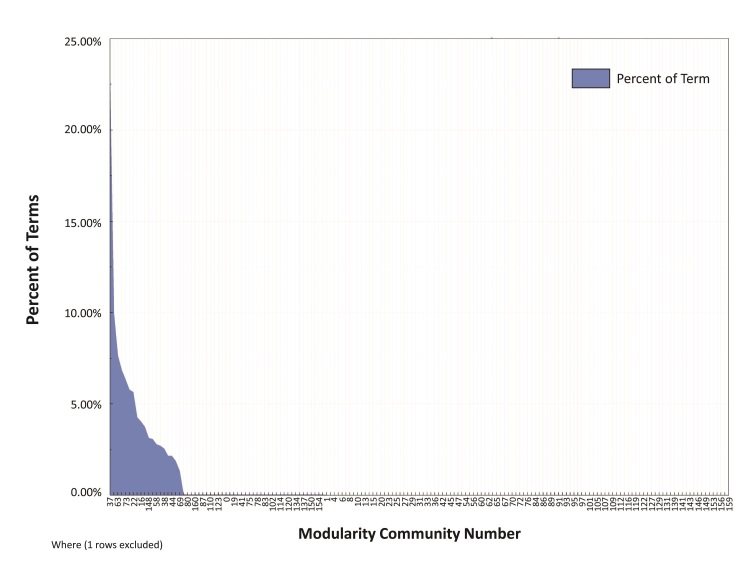
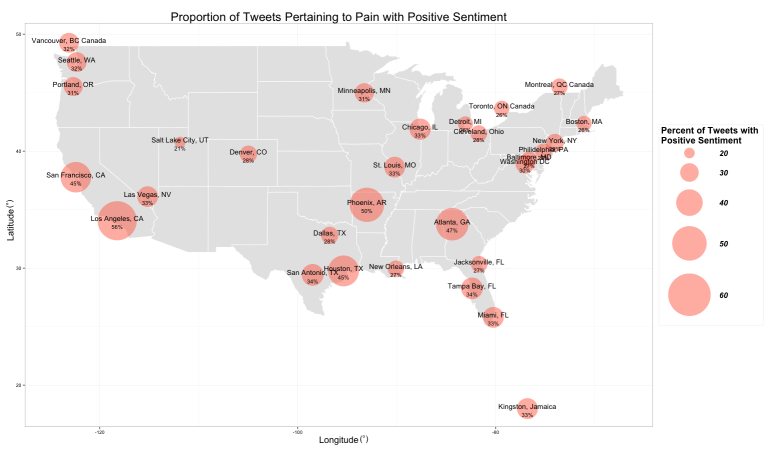
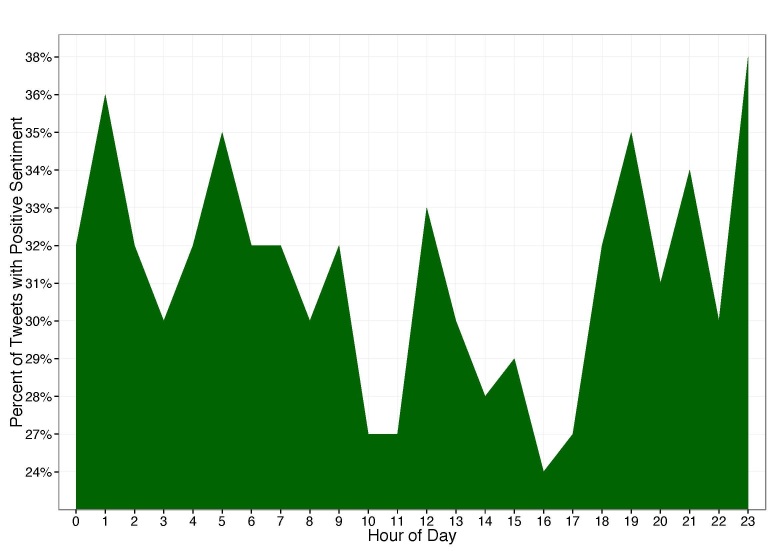
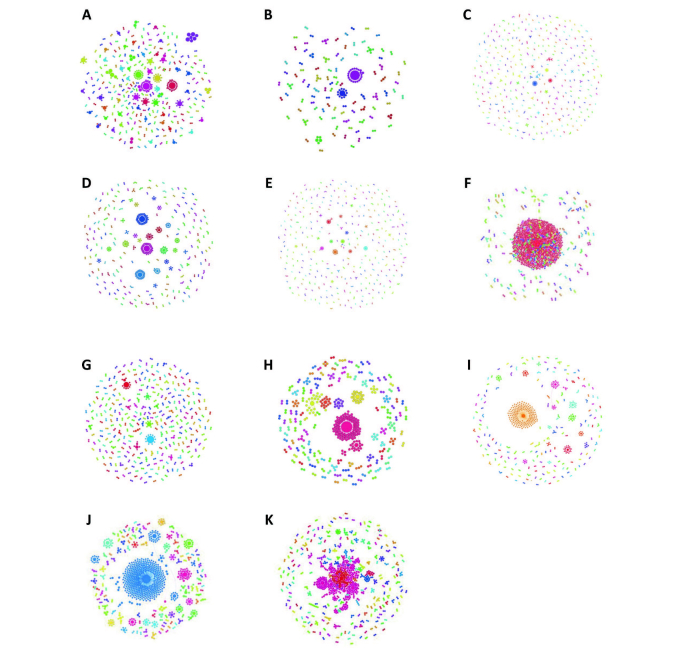
The most common terms published in conjunction with the term "pain" included feel (n=1504), don't (n=702), and love (n=649). The proportion of tweets with positive sentiment ranged from 13% in Manila to 56% in Los Angeles, CA, with a median of 29% across cities. Temporally, the proportion of tweets with positive sentiment ranged from 24% at 1600 to 38% at 2400, with a median of 32%. The Twitter-based social networks pertaining to pain exhibited greater sparsity and lower connectedness than did those social networks pertaining to common terms such as apple, Manchester United, and Obama. The number of word clusters in proportion to node count was greater for emotion terms such as tired (0.45), happy (0.43), and sad (0.4) when compared with objective terms such as apple (0.26), Manchester United (0.14), and Obama (0.25).
Taken together, our results suggest that pain-related tweets carry special characteristics reflecting unique content and their communication among tweeters. Further work will explore how geopolitical events and seasonal changes affect tweeters' perceptions of pain and how such perceptions may affect therapies for pain.
尽管社交媒体广受欢迎,但对于这些媒体用户发布的与疼痛相关帖子的范围或背景却知之甚少。
旨在研究与疼痛相关推文的类型、背景及传播情况。
我们对来自50个城市的与疼痛相关的推文进行内容分析,以不引人注意的方式探究有关疼痛交流的意义和模式。内容按照地点、一天中的时间以及在线社交网络背景进行检查。
与“疼痛”一词一同发布的最常见词汇包括“感觉”(n = 1504)、“不”(n = 702)和“爱”(n = 649)。带有积极情绪的推文比例在马尼拉为13%,在加利福尼亚州洛杉矶为56%,各城市中位数为29%。从时间上看,带有积极情绪的推文比例在16:00时为24%,在24:00时为38%,中位数为32%。与疼痛相关的基于推特的社交网络相比,与苹果、曼联和奥巴马等常见词汇相关的社交网络呈现出更大的稀疏性和更低的连通性。与诸如苹果(0.26)、曼联(0.14)和奥巴马(0.25)等客观词汇相比,诸如疲惫(0.45)、开心(0.43)和悲伤(0.4)等情感词汇的词簇数量与节点数量的比例更大。
综合来看,我们的结果表明与疼痛相关的推文具有反映独特内容及其在推特用户间交流情况的特殊特征。进一步的研究将探索地缘政治事件和季节变化如何影响推特用户对疼痛的认知,以及这种认知可能如何影响疼痛治疗。