Kim Ian, Begay Cynthia, Ma Harrison J, Orozco Francis R, Rogers Christopher J, Valente Thomas W, Unger Jennifer B
Keck School of Medicine of USC, University of Southern California, Los Angeles, California.
Dornsife Spatial Sciences Institute, University of Southern California, Los Angeles, California.
AJPM Focus. 2023 Jan 18;2(2):100067. doi: 10.1016/j.focus.2023.100067. eCollection 2023 Jun.
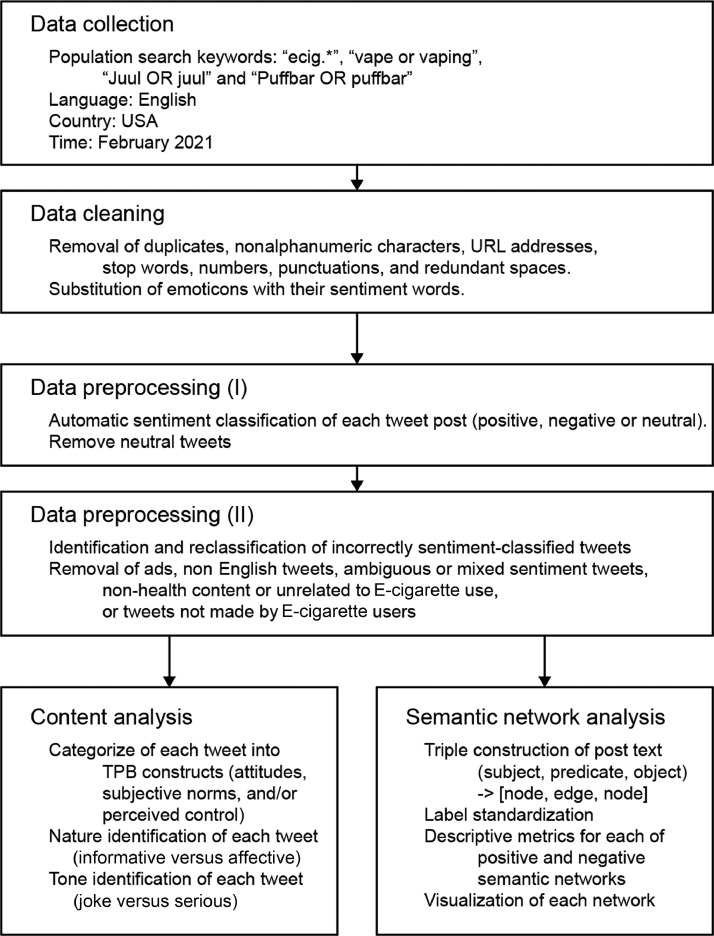
This mixed-methods study analyzed English-language U.S.-based Twitter posts related to E-cigarette use from February 2021.
Posts were manually identified as health-related or not and, if health-related, whether they were posted by an E-cigarette user. A random selection of 1,000 health-related tweets from 986 unique E-cigarette users were qualitatively content analyzed for theory of planned behavior constructs as well as nature and tone of each tweet message. Using quantitative semantic network analysis, relationships among the identified topics and sentiment-specific conversation patterns were explored.
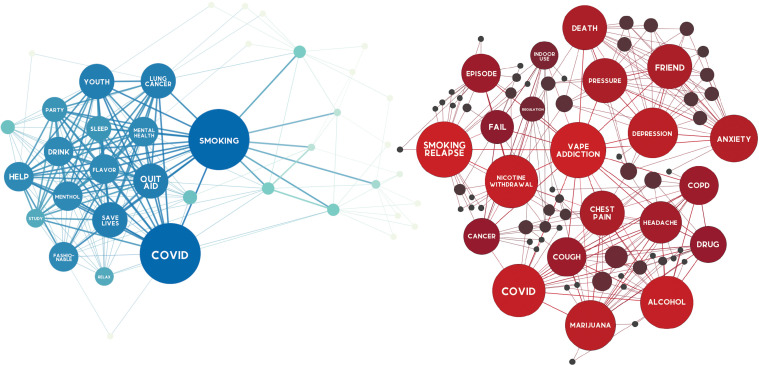
The most salient health-related conversation topics of E-cigarette users, health beliefs corresponding to each theory of planned behavior construct, and major motivational contexts of E-cigarette use were identified. Seven topics emerged in positive tweets: smoking cessation, social impact generation, controls over addiction, therapeutic effects on physical and mental health, social support, device attachment, and peer influence. Nine topics emerged in negative tweets: side effects on physical health, vaping addiction, lack of E-cigarette regulations, peer pressure, increased risk of COVID-19, side effects on mental health, no help in smoking cessation, social conflict, and polysubstance use. Most assertions for E-cigarette benefits were not substantiated. Jokes in tweets appeared to contribute to the view of vaping as an attractive, enjoyable, safe, and fun activity. Discussions about positive aspects of E-cigarette use were concentrated on a few related topics, whereas tweets discouraging E-cigarette use presented a diverse, less related set of topics.
The results provide insights into the drivers of E-cigarette use behaviors. E-cigarette user perspectives gathered from social media may inform research to guide future prevention and cessation interventions.
这项混合方法研究分析了2021年2月以来美国基于推特发布的与电子烟使用相关的英文帖子。
帖子被人工识别为与健康相关或无关,如果与健康相关,则识别是否由电子烟使用者发布。从986名不同的电子烟使用者中随机选取1000条与健康相关的推文,对计划行为理论结构以及每条推文信息的性质和语气进行定性内容分析。使用定量语义网络分析,探索已识别主题与特定情绪对话模式之间的关系。
确定了电子烟使用者最突出的与健康相关的对话主题、与计划行为理论结构相对应的健康信念以及电子烟使用的主要动机背景。在积极推文中出现了七个主题:戒烟、产生社会影响、控制成瘾、对身心健康的治疗作用、社会支持、对设备的依恋以及同伴影响。在消极推文中出现了九个主题:对身体健康的副作用、电子烟成瘾、缺乏电子烟监管、同伴压力、感染新冠病毒的风险增加、对心理健康的副作用、对戒烟无帮助、社会冲突以及多物质使用。关于电子烟益处的大多数断言都没有得到证实。推文中的笑话似乎促成了将吸电子烟视为一种有吸引力、令人愉快、安全且有趣的活动的观点。关于电子烟使用积极方面的讨论集中在几个相关主题上,而劝阻使用电子烟的推文则呈现出一系列多样且相关性较低的主题。
研究结果为电子烟使用行为的驱动因素提供了见解。从社交媒体收集的电子烟使用者观点可能为研究提供信息,以指导未来的预防和戒烟干预措施。