Khaddouma Alexander, Gordon Kristina Coop, Fish Laura J, Bilheimer Alicia, Gonzalez Alicia, Pollak Kathryn I
Department of Psychology, University of Tennessee-Knoxville.
Duke Cancer Institute.
Health Psychol. 2015 Oct;34(10):1038-42. doi: 10.1037/hea0000224. Epub 2015 Apr 6.
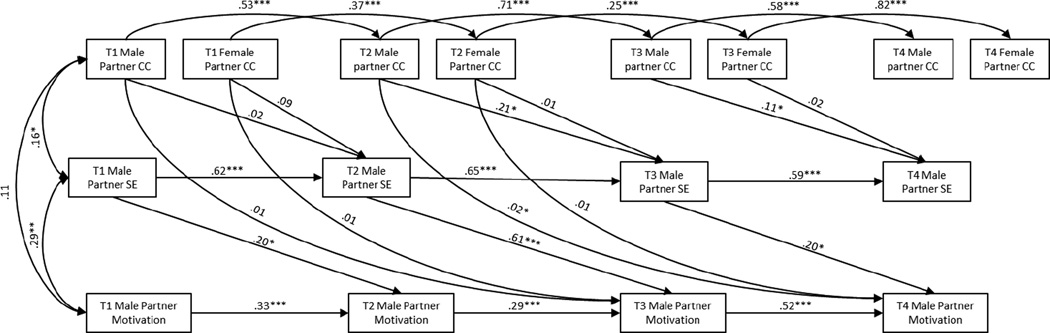
Cigarette smoking is a prevalent problem among Latinos, yet little is known about what factors motivate them to quit smoking or make them feel more confident that they can. Given cultural emphases on familial bonds among Latinos (e.g., familismo), it is possible that communication processes among Latino spouses play an important role. The present study tested a mechanistic model in which perceived spousal constructive communication patterns predicted changes in level of motivation for smoking cessation through changes in self-efficacy among Latino expectant fathers.
Latino males (n = 173) and their pregnant partners participated in a couple-based intervention targeting males' smoking. Couples completed self-report measures of constructive communication, self-efficacy (male partners only), and motivation to quit (male partners only) at 4 time points throughout the intervention.
Higher levels of perceived constructive communication among Latino male partners predicted subsequent increases in male partners' self-efficacy and, to a lesser degree, motivation to quit smoking; however, self-efficacy did not mediate associations between constructive communication and motivation to quit smoking. Furthermore, positive relationships with communication were only significant at measurements taken after completion of the intervention. Female partners' level of perceived constructive communication did not predict male partners' outcomes.
These results provide preliminary evidence to support the utility of couple-based interventions for Latino men who smoke. Findings also suggest that perceptions of communication processes among Latino partners (particularly male partners) may be an important target for interventions aimed at increasing desire and perceived ability to quit smoking among Latino men. (PsycINFO Database Record
吸烟在拉丁裔人群中是一个普遍存在的问题,但对于促使他们戒烟或让他们更有信心戒烟的因素却知之甚少。鉴于拉丁裔文化对家庭纽带的重视(例如,家庭主义),拉丁裔配偶之间的沟通可能起着重要作用。本研究测试了一个机制模型,即拉丁裔准父亲们通过自我效能感的变化,感知到的配偶建设性沟通模式预测戒烟动机水平的变化。
173名拉丁裔男性及其怀孕伴侣参与了一项针对男性吸烟问题的夫妻干预项目。在整个干预过程中的4个时间点,夫妻双方完成了关于建设性沟通、自我效能感(仅男性伴侣)和戒烟动机(仅男性伴侣)的自我报告测量。
拉丁裔男性伴侣间更高水平的建设性沟通预测了男性伴侣随后自我效能感的增加,以及在较小程度上戒烟动机的增加;然而,自我效能感并未在建设性沟通与戒烟动机之间起中介作用。此外,与沟通的积极关系仅在干预结束后的测量中显著。女性伴侣的建设性沟通感知水平并不能预测男性伴侣的结果。
这些结果提供了初步证据,支持针对吸烟拉丁裔男性的夫妻干预措施的效用。研究结果还表明,拉丁裔伴侣(特别是男性伴侣)对沟通的感知可能是旨在增强拉丁裔男性戒烟意愿和感知能力的干预措施的重要目标。(PsycINFO数据库记录)