Ben-Zeev Dror, Scherer Emily A, Wang Rui, Xie Haiyi, Campbell Andrew T
Dartmouth Psychiatric Research Center, Department of Psychiatry, Geisel School of Medicine at Dartmouth, Dartmouth College.
Division of Biostatistics, Department of Community and Family Medicine, Geisel School of Medicine at Dartmouth, Dartmouth College.
Psychiatr Rehabil J. 2015 Sep;38(3):218-226. doi: 10.1037/prj0000130. Epub 2015 Apr 6.
Optimal mental health care is dependent upon sensitive and early detection of mental health problems. We have introduced a state-of-the-art method for the current study for remote behavioral monitoring that transports assessment out of the clinic and into the environments in which individuals negotiate their daily lives. The objective of this study was to examine whether the information captured with multimodal smartphone sensors can serve as behavioral markers for one's mental health. We hypothesized that (a) unobtrusively collected smartphone sensor data would be associated with individuals' daily levels of stress, and (b) sensor data would be associated with changes in depression, stress, and subjective loneliness over time.
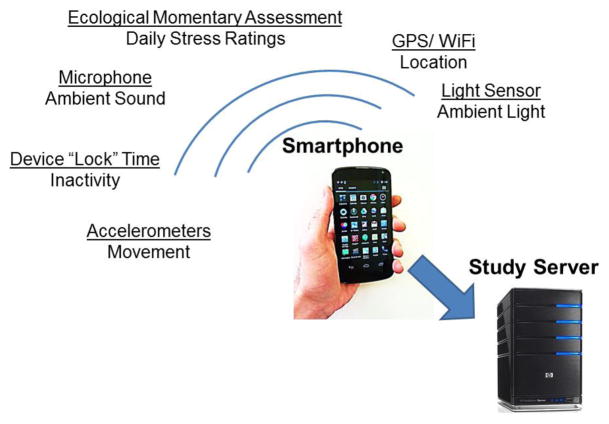
A total of 47 young adults (age range: 19-30 years) were recruited for the study. Individuals were enrolled as a single cohort and participated in the study over a 10-week period. Participants were provided with smartphones embedded with a range of sensors and software that enabled continuous tracking of their geospatial activity (using the Global Positioning System and wireless fidelity), kinesthetic activity (using multiaxial accelerometers), sleep duration (modeled using device-usage data, accelerometer inferences, ambient sound features, and ambient light levels), and time spent proximal to human speech (i.e., speech duration using microphone and speech detection algorithms). Participants completed daily ratings of stress, as well as pre- and postmeasures of depression (Patient Health Questionnaire-9; Spitzer, Kroenke, & Williams, 1999), stress (Perceived Stress Scale; Cohen et al., 1983), and loneliness (Revised UCLA Loneliness Scale; Russell, Peplau, & Cutrona, 1980).
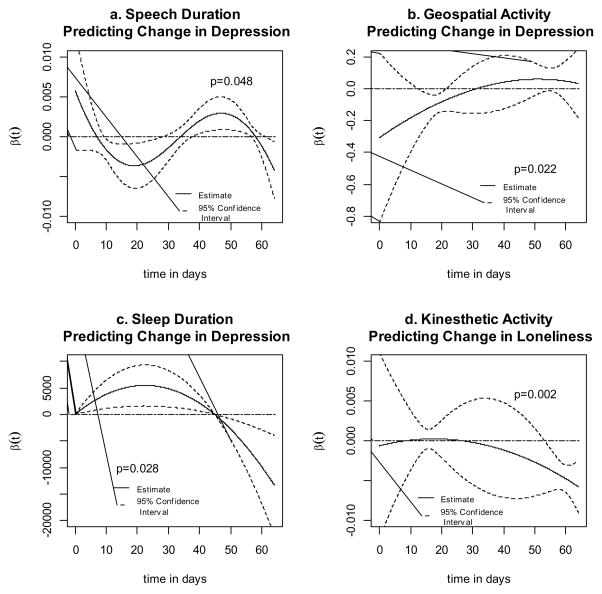
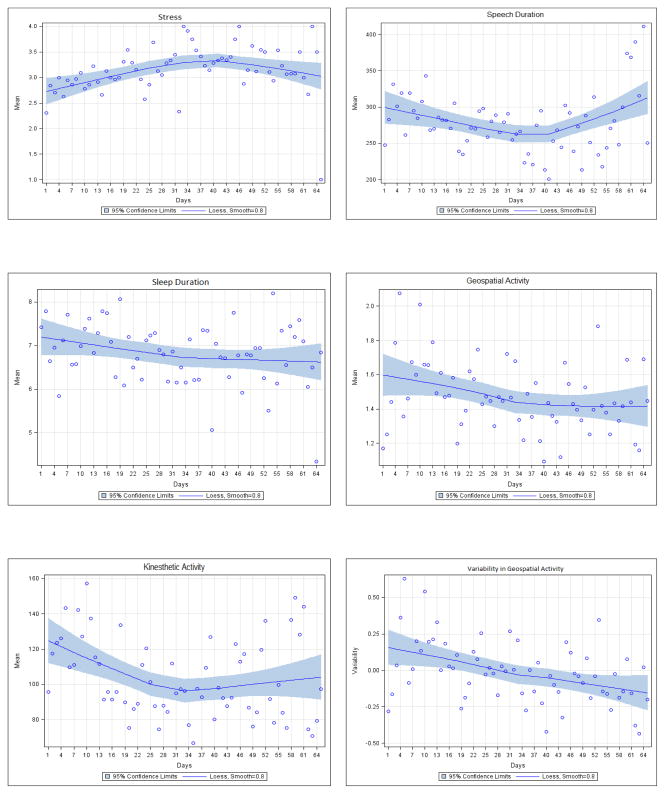
Mixed-effects linear modeling showed that sensor-derived geospatial activity (p < .05), sleep duration (p < .05), and variability in geospatial activity (p < .05), were associated with daily stress levels. Penalized functional regression showed associations between changes in depression and sensor-derived speech duration (p < .05), geospatial activity (p < .05), and sleep duration (p < .05). Changes in loneliness were associated with sensor-derived kinesthetic activity (p < .01).
Smartphones can be harnessed as instruments for unobtrusive monitoring of several behavioral indicators of mental health. Creative leveraging of smartphone sensing could provide novel opportunities for close-to-invisible psychiatric assessment at a scale and efficiency that far exceeds what is currently feasible with existing assessment technologies.
最佳心理健康护理依赖于对心理健康问题的敏感且早期的检测。我们为当前研究引入了一种先进的远程行为监测方法,该方法将评估从诊所转移到个体日常生活的环境中。本研究的目的是检验通过多模式智能手机传感器捕获的信息是否可作为个体心理健康的行为标志物。我们假设:(a)以不引人注意的方式收集的智能手机传感器数据将与个体的日常压力水平相关;(b)传感器数据将与抑郁、压力和主观孤独感随时间的变化相关。
共招募了47名年轻成年人(年龄范围:19 - 30岁)参与本研究。个体作为一个单一队列入组,并在10周的时间内参与研究。为参与者提供了嵌入一系列传感器和软件的智能手机,这些设备能够持续跟踪他们的地理空间活动(使用全球定位系统和无线保真)、动觉活动(使用多轴加速度计)、睡眠时间(使用设备使用数据、加速度计推断、环境声音特征和环境光水平进行建模)以及与人类语音接近的时间(即使用麦克风和语音检测算法的语音持续时间)。参与者完成每日压力评分,以及抑郁(患者健康问卷 - 9;斯皮策、克罗恩克和威廉姆斯,1999年)、压力(感知压力量表;科恩等人,1983年)和孤独感(修订的加州大学洛杉矶分校孤独量表;拉塞尔、佩普劳和卡特罗纳,1980年)的前后测量。
混合效应线性模型显示,源自传感器的地理空间活动(p < .05)、睡眠时间(p < .05)以及地理空间活动的变异性(p < .05)与每日压力水平相关。惩罚函数回归显示抑郁变化与源自传感器的语音持续时间(p < .05)、地理空间活动(p < .05)和睡眠时间(p < .05)之间存在关联。孤独感的变化与源自传感器的动觉活动相关(p < .01)。
智能手机可被用作对心理健康的多个行为指标进行不引人注意监测的工具。对智能手机传感技术的创造性利用可为近乎无形的精神病学评估提供新机会,其规模和效率远远超过现有评估技术目前所能达到的水平。