• 文献检索
  • 文档翻译
  • 深度研究
  • 学术资讯
  • Suppr Zotero 插件Zotero 插件
  • 邀请有礼
  • 套餐&价格
  • 历史记录
应用&插件
Suppr Zotero 插件Zotero 插件浏览器插件Mac 客户端Windows 客户端微信小程序
定价
高级版会员购买积分包购买API积分包
服务
文献检索文档翻译深度研究API 文档MCP 服务
关于我们
关于 Suppr公司介绍联系我们用户协议隐私条款
关注我们

Suppr 超能文献

核心技术专利:CN118964589B侵权必究
粤ICP备2023148730 号-1Suppr @ 2026

文献检索

告别复杂PubMed语法,用中文像聊天一样搜索,搜遍4000万医学文献。AI智能推荐,让科研检索更轻松。

立即免费搜索

文件翻译

保留排版,准确专业,支持PDF/Word/PPT等文件格式,支持 12+语言互译。

免费翻译文档

深度研究

AI帮你快速写综述,25分钟生成高质量综述,智能提取关键信息,辅助科研写作。

立即免费体验

数字化表型用于压力、焦虑和轻度抑郁的评估:系统文献综述。

Digital Phenotyping for Stress, Anxiety, and Mild Depression: Systematic Literature Review.

机构信息

School of Computer Science, Faculty of Science, University of Auckland, Auckland, New Zealand.

出版信息

JMIR Mhealth Uhealth. 2024 May 23;12:e40689. doi: 10.2196/40689.

DOI:10.2196/40689
PMID:38780995
原文链接:https://pmc.ncbi.nlm.nih.gov/articles/PMC11157179/
Abstract

BACKGROUND

Unaddressed early-stage mental health issues, including stress, anxiety, and mild depression, can become a burden for individuals in the long term. Digital phenotyping involves capturing continuous behavioral data via digital smartphone devices to monitor human behavior and can potentially identify milder symptoms before they become serious.

OBJECTIVE

This systematic literature review aimed to answer the following questions: (1) what is the evidence of the effectiveness of digital phenotyping using smartphones in identifying behavioral patterns related to stress, anxiety, and mild depression? and (2) in particular, which smartphone sensors are found to be effective, and what are the associated challenges?

METHODS

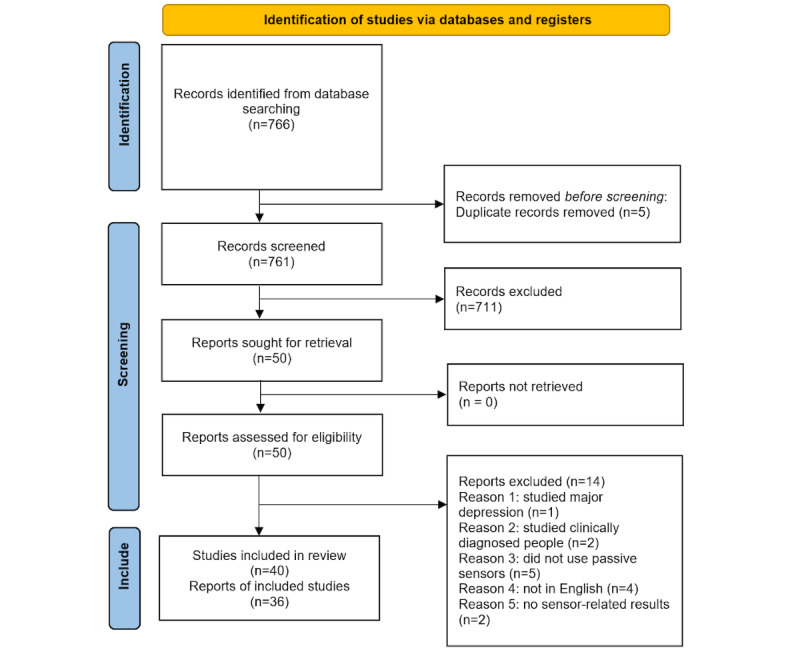
We used the PRISMA (Preferred Reporting Items for Systematic Reviews and Meta-Analyses) process to identify 36 papers (reporting on 40 studies) to assess the key smartphone sensors related to stress, anxiety, and mild depression. We excluded studies conducted with nonadult participants (eg, teenagers and children) and clinical populations, as well as personality measurement and phobia studies. As we focused on the effectiveness of digital phenotyping using smartphones, results related to wearable devices were excluded.

RESULTS

We categorized the studies into 3 major groups based on the recruited participants: studies with students enrolled in universities, studies with adults who were unaffiliated to any particular organization, and studies with employees employed in an organization. The study length varied from 10 days to 3 years. A range of passive sensors were used in the studies, including GPS, Bluetooth, accelerometer, microphone, illuminance, gyroscope, and Wi-Fi. These were used to assess locations visited; mobility; speech patterns; phone use, such as screen checking; time spent in bed; physical activity; sleep; and aspects of social interactions, such as the number of interactions and response time. Of the 40 included studies, 31 (78%) used machine learning models for prediction; most others (n=8, 20%) used descriptive statistics. Students and adults who experienced stress, anxiety, or depression visited fewer locations, were more sedentary, had irregular sleep, and accrued increased phone use. In contrast to students and adults, less mobility was seen as positive for employees because less mobility in workplaces was associated with higher performance. Overall, travel, physical activity, sleep, social interaction, and phone use were related to stress, anxiety, and mild depression.

CONCLUSIONS

This study focused on understanding whether smartphone sensors can be effectively used to detect behavioral patterns associated with stress, anxiety, and mild depression in nonclinical participants. The reviewed studies provided evidence that smartphone sensors are effective in identifying behavioral patterns associated with stress, anxiety, and mild depression.
https://cdn.ncbi.nlm.nih.gov/pmc/blobs/503a/11157179/95fa9c2add6d/mhealth_v12i1e40689_fig1.jpg
摘要

背景

未得到解决的早期心理健康问题,包括压力、焦虑和轻度抑郁,从长远来看可能会成为个人的负担。数字表型学通过智能手机等数字设备采集连续的行为数据,以监测人类行为,并有可能在症状变得严重之前发现更轻微的症状。

目的

本系统文献综述旨在回答以下问题:(1)使用智能手机进行数字表型学识别与压力、焦虑和轻度抑郁相关的行为模式的有效性有哪些证据?(2)特别是,哪些智能手机传感器被发现是有效的,以及相关的挑战有哪些?

方法

我们使用 PRISMA(系统评价和荟萃分析的首选报告项目)流程确定了 36 篇论文(报告了 40 项研究),以评估与压力、焦虑和轻度抑郁相关的关键智能手机传感器。我们排除了非成年参与者(例如青少年和儿童)和临床人群的研究,以及人格测量和恐惧症研究。由于我们专注于使用智能手机进行数字表型学的有效性,因此排除了与可穿戴设备相关的结果。

结果

我们根据招募的参与者将研究分为 3 大组:在大学注册的学生、与任何特定组织无关的成年人以及在组织中工作的员工。研究时间从 10 天到 3 年不等。研究中使用了一系列被动传感器,包括 GPS、蓝牙、加速度计、麦克风、照度、陀螺仪和 Wi-Fi。这些传感器用于评估访问的地点、移动性、语音模式、手机使用情况(如屏幕检查)、卧床时间、身体活动、睡眠以及社交互动的方面,例如互动次数和响应时间。在纳入的 40 项研究中,31 项(78%)使用机器学习模型进行预测;其余大多数(n=8,20%)使用描述性统计。经历压力、焦虑或抑郁的学生和成年人访问的地点较少,久坐不动,睡眠不规律,手机使用时间增加。与学生和成年人不同,员工的活动量减少被视为积极的,因为工作场所的活动量减少与更高的绩效相关。总体而言,旅行、身体活动、睡眠、社交互动和手机使用与压力、焦虑和轻度抑郁有关。

结论

本研究重点关注智能手机传感器是否可有效用于检测非临床参与者与压力、焦虑和轻度抑郁相关的行为模式。综述研究提供了证据表明,智能手机传感器可有效识别与压力、焦虑和轻度抑郁相关的行为模式。

相似文献

1
Digital Phenotyping for Stress, Anxiety, and Mild Depression: Systematic Literature Review.数字化表型用于压力、焦虑和轻度抑郁的评估:系统文献综述。
JMIR Mhealth Uhealth. 2024 May 23;12:e40689. doi: 10.2196/40689.
2
Signs and symptoms to determine if a patient presenting in primary care or hospital outpatient settings has COVID-19.在基层医疗机构或医院门诊环境中,如果患者出现以下症状和体征,可判断其是否患有 COVID-19。
Cochrane Database Syst Rev. 2022 May 20;5(5):CD013665. doi: 10.1002/14651858.CD013665.pub3.
3
Sexual Harassment and Prevention Training性骚扰与预防培训
4
Development of prediction models for screening depression and anxiety using smartphone and wearable-based digital phenotyping: protocol for the Smartphone and Wearable Assessment for Real-Time Screening of Depression and Anxiety (SWARTS-DA) observational study in Korea.利用智能手机和可穿戴设备的数字表型开发抑郁症和焦虑症筛查预测模型:韩国抑郁症和焦虑症实时筛查智能手机与可穿戴设备评估(SWARTS-DA)观察性研究方案
BMJ Open. 2025 Jun 20;15(6):e096773. doi: 10.1136/bmjopen-2024-096773.
5
Comparison of self-administered survey questionnaire responses collected using mobile apps versus other methods.使用移动应用程序与其他方法收集的自我管理调查问卷回复的比较。
Cochrane Database Syst Rev. 2015 Jul 27;2015(7):MR000042. doi: 10.1002/14651858.MR000042.pub2.
6
Falls prevention interventions for community-dwelling older adults: systematic review and meta-analysis of benefits, harms, and patient values and preferences.社区居住的老年人跌倒预防干预措施:系统评价和荟萃分析的益处、危害以及患者的价值观和偏好。
Syst Rev. 2024 Nov 26;13(1):289. doi: 10.1186/s13643-024-02681-3.
7
E-Health interventions for anxiety and depression in children and adolescents with long-term physical conditions.针对患有长期身体疾病的儿童和青少年焦虑与抑郁的电子健康干预措施。
Cochrane Database Syst Rev. 2018 Aug 15;8(8):CD012489. doi: 10.1002/14651858.CD012489.pub2.
8
Drugs for preventing postoperative nausea and vomiting in adults after general anaesthesia: a network meta-analysis.成人全身麻醉后预防术后恶心呕吐的药物:网状Meta分析
Cochrane Database Syst Rev. 2020 Oct 19;10(10):CD012859. doi: 10.1002/14651858.CD012859.pub2.
9
Digital Phenotyping for Monitoring Mental Disorders: Systematic Review.数字表型监测精神障碍:系统评价。
J Med Internet Res. 2023 Dec 13;25:e46778. doi: 10.2196/46778.
10
Physical activity and exercise for chronic pain in adults: an overview of Cochrane Reviews.成人慢性疼痛的体力活动与锻炼:Cochrane系统评价综述
Cochrane Database Syst Rev. 2017 Apr 24;4(4):CD011279. doi: 10.1002/14651858.CD011279.pub3.

引用本文的文献

1
Harnessing Digital Phenotyping for Early Self-Detection of Psychological Distress.利用数字表型进行心理困扰的早期自我检测。
Healthcare (Basel). 2025 Aug 15;13(16):2008. doi: 10.3390/healthcare13162008.
2
Passive Sensing for Mental Health Monitoring Using Machine Learning With Wearables and Smartphones: Scoping Review.使用可穿戴设备和智能手机通过机器学习进行心理健康监测的被动传感:范围综述
J Med Internet Res. 2025 Aug 14;27:e77066. doi: 10.2196/77066.
3
Cross-Platform Availability of Smartphone Sensors for Depression Indication Systems: Mixed-Methods Umbrella Review.

本文引用的文献

1
Tracking Depression Dynamics in College Students Using Mobile Phone and Wearable Sensing.利用手机和可穿戴传感技术追踪大学生的抑郁动态
Proc ACM Interact Mob Wearable Ubiquitous Technol. 2018 Mar;2(1). doi: 10.1145/3191775. Epub 2018 Mar 26.
2
COVID Student Study: A Year in the Life of College Students during the COVID-19 Pandemic Through the Lens of Mobile Phone Sensing.新冠疫情下的大学生研究:通过手机传感视角看新冠疫情期间大学生的一年生活
Proc SIGCHI Conf Hum Factor Comput Syst. 2022 Apr;2022. doi: 10.1145/3491102.3502043. Epub 2022 Apr 28.
3
Digital Phenotyping Models of Symptom Improvement in College Mental Health: Generalizability Across Two Cohorts.
用于抑郁症指示系统的智能手机传感器的跨平台可用性:混合方法综合评价
Interact J Med Res. 2025 Aug 7;14:e69686. doi: 10.2196/69686.
4
Passive Smartphone Sensors for Detecting Psychopathology.用于检测精神病理学的被动式智能手机传感器
JAMA Netw Open. 2025 Jul 1;8(7):e2519047. doi: 10.1001/jamanetworkopen.2025.19047.
5
Machine-learning detection of stress severity expressed on a continuous scale using acoustic, verbal, visual, and physiological data: lessons learned.使用声学、言语、视觉和生理数据对连续量表上表达的应激严重程度进行机器学习检测:经验教训。
Front Psychiatry. 2025 Jun 13;16:1548287. doi: 10.3389/fpsyt.2025.1548287. eCollection 2025.
6
Feasibility of Collecting and Linking Digital Phenotyping, Clinical, and Genetics Data for Mental Health Research: Pilot Observational Study.收集和关联数字表型、临床及遗传学数据用于心理健康研究的可行性:试点观察性研究
JMIR Form Res. 2025 Jun 23;9:e71377. doi: 10.2196/71377.
7
The evolving field of digital mental health: current evidence and implementation issues for smartphone apps, generative artificial intelligence, and virtual reality.数字心理健康的发展领域:智能手机应用程序、生成式人工智能和虚拟现实的当前证据及实施问题
World Psychiatry. 2025 Jun;24(2):156-174. doi: 10.1002/wps.21299.
8
Digital measures of activity and motivation impact depression and anxiety in the real world.在现实世界中,活动和动机的数字测量会影响抑郁和焦虑。
NPJ Digit Med. 2025 May 10;8(1):268. doi: 10.1038/s41746-025-01669-0.
9
Associations between smartphone GPS data and changes in psychological health and burden outcomes among family caregivers and patients with advanced cancer: an exploratory longitudinal cohort study.智能手机GPS数据与晚期癌症家庭照料者及患者心理健康和负担结果变化之间的关联:一项探索性纵向队列研究。
BMC Cancer. 2025 Apr 4;25(1):614. doi: 10.1186/s12885-025-14009-y.
10
Perioperative Anxiety: Current Status and Future Perspectives.围手术期焦虑:现状与未来展望
J Clin Med. 2025 Feb 20;14(5):1422. doi: 10.3390/jcm14051422.
大学生心理健康症状改善的数字表型模型:两个队列的可推广性
J Technol Behav Sci. 2023 Mar 2:1-14. doi: 10.1007/s41347-023-00310-9.
4
Digital phenotyping correlations in larger mental health samples: analysis and replication.更大规模心理健康样本中的数字表型相关性:分析与复制
BJPsych Open. 2022 Jun 3;8(4):e106. doi: 10.1192/bjo.2022.507.
5
Evaluation of Changes in Depression, Anxiety, and Social Anxiety Using Smartphone Sensor Features: Longitudinal Cohort Study.使用智能手机传感器特征评估抑郁、焦虑和社交焦虑的变化:纵向队列研究。
J Med Internet Res. 2021 Sep 3;23(9):e22844. doi: 10.2196/22844.
6
Automated Screening for Social Anxiety, Generalized Anxiety, and Depression From Objective Smartphone-Collected Data: Cross-sectional Study.基于客观智能手机采集数据的社交焦虑症、广泛性焦虑症和抑郁症的自动筛查:横断面研究。
J Med Internet Res. 2021 Aug 13;23(8):e28918. doi: 10.2196/28918.
7
Passively-sensed Behavioral Correlates of Discrimination Events in College Students.大学生歧视事件的被动感知行为关联
Proc ACM Hum Comput Interact. 2019 Nov;3(CSCW):1-29. doi: 10.1145/3359216. Epub 2019 Nov 7.
8
Mental Health and Behavior of College Students During the COVID-19 Pandemic: Longitudinal Mobile Smartphone and Ecological Momentary Assessment Study, Part II.新冠疫情期间大学生的心理健康与行为:纵向移动智能手机与生态瞬时评估研究,第二部分
J Med Internet Res. 2021 Jun 4;23(6):e28892. doi: 10.2196/28892.
9
Passive sensing on mobile devices to improve mental health services with adolescent and young mothers in low-resource settings: the role of families in feasibility and acceptability.移动设备上的被动感知,以改善资源匮乏环境中青少年和年轻母亲的心理健康服务:家庭在可行性和可接受性方面的作用。
BMC Med Inform Decis Mak. 2021 Apr 7;21(1):117. doi: 10.1186/s12911-021-01473-2.
10
Digital phenotyping of student mental health during COVID-19: an observational study of 100 college students.新冠疫情期间学生心理健康的数字化表型分析:对 100 名大学生的观察性研究。
J Am Coll Health. 2023 Apr;71(3):736-748. doi: 10.1080/07448481.2021.1905650. Epub 2021 Mar 26.