• 文献检索
  • 文档翻译
  • 深度研究
  • 学术资讯
  • Suppr Zotero 插件Zotero 插件
  • 邀请有礼
  • 套餐&价格
  • 历史记录
应用&插件
Suppr Zotero 插件Zotero 插件浏览器插件Mac 客户端Windows 客户端微信小程序
定价
高级版会员购买积分包购买API积分包
服务
文献检索文档翻译深度研究API 文档MCP 服务
关于我们
关于 Suppr公司介绍联系我们用户协议隐私条款
关注我们

Suppr 超能文献

核心技术专利:CN118964589B侵权必究
粤ICP备2023148730 号-1Suppr @ 2026

文献检索

告别复杂PubMed语法,用中文像聊天一样搜索,搜遍4000万医学文献。AI智能推荐,让科研检索更轻松。

立即免费搜索

文件翻译

保留排版,准确专业,支持PDF/Word/PPT等文件格式,支持 12+语言互译。

免费翻译文档

深度研究

AI帮你快速写综述,25分钟生成高质量综述,智能提取关键信息,辅助科研写作。

立即免费体验

利用被动感知技术识别孤独和社会隔离的行为表现:智能手机和 Fitbit 数据的统计分析、数据挖掘和机器学习。

Identifying Behavioral Phenotypes of Loneliness and Social Isolation with Passive Sensing: Statistical Analysis, Data Mining and Machine Learning of Smartphone and Fitbit Data.

机构信息

School of Computer Science, Carnegie Mellon University, Pittsburgh, PA, United States.

School of Engineering and Applied Sciences, The University of Virginia, Charlottesville, VA, United States.

出版信息

JMIR Mhealth Uhealth. 2019 Jul 24;7(7):e13209. doi: 10.2196/13209.

DOI:10.2196/13209
PMID:31342903
原文链接:https://pmc.ncbi.nlm.nih.gov/articles/PMC6685126/
Abstract

BACKGROUND

Feelings of loneliness are associated with poor physical and mental health. Detection of loneliness through passive sensing on personal devices can lead to the development of interventions aimed at decreasing rates of loneliness.

OBJECTIVE

The aim of this study was to explore the potential of using passive sensing to infer levels of loneliness and to identify the corresponding behavioral patterns.

METHODS

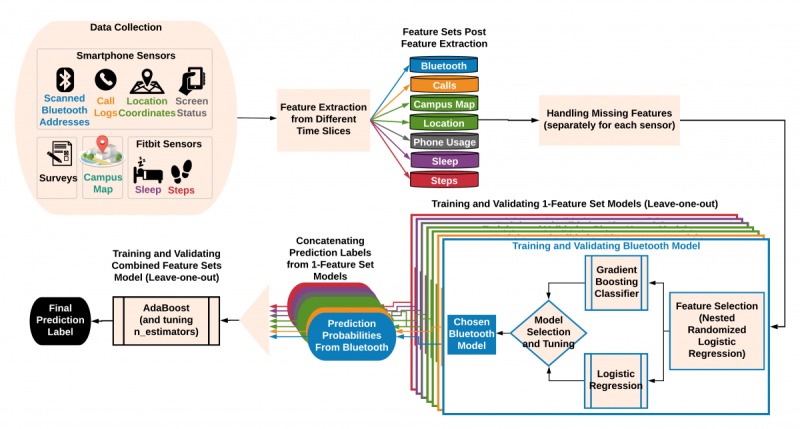
Data were collected from smartphones and Fitbits (Flex 2) of 160 college students over a semester. The participants completed the University of California, Los Angeles (UCLA) loneliness questionnaire at the beginning and end of the semester. For a classification purpose, the scores were categorized into high (questionnaire score>40) and low (≤40) levels of loneliness. Daily features were extracted from both devices to capture activity and mobility, communication and phone usage, and sleep behaviors. The features were then averaged to generate semester-level features. We used 3 analytic methods: (1) statistical analysis to provide an overview of loneliness in college students, (2) data mining using the Apriori algorithm to extract behavior patterns associated with loneliness, and (3) machine learning classification to infer the level of loneliness and the change in levels of loneliness using an ensemble of gradient boosting and logistic regression algorithms with feature selection in a leave-one-student-out cross-validation manner.

RESULTS

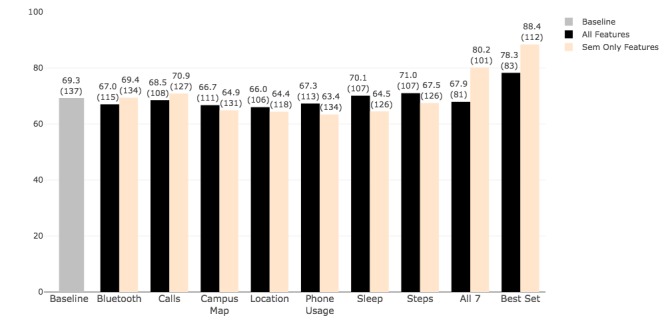
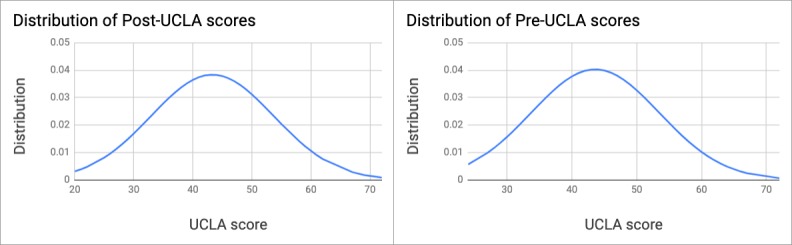
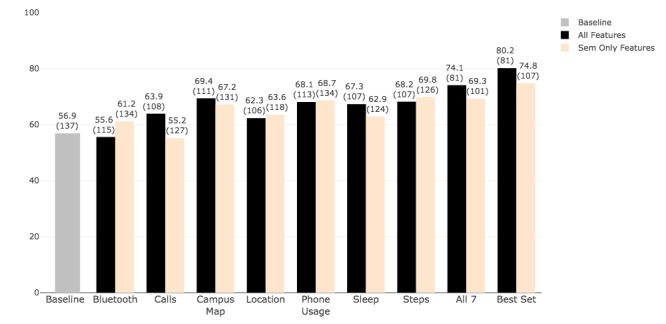
The average loneliness score from the presurveys and postsurveys was above 43 (presurvey SD 9.4 and postsurvey SD 10.4), and the majority of participants fell into the high loneliness category (scores above 40) with 63.8% (102/160) in the presurvey and 58.8% (94/160) in the postsurvey. Scores greater than 1 standard deviation above the mean were observed in 12.5% (20/160) of the participants in both pre- and postsurvey scores. The majority of scores, however, fell between 1 standard deviation below and above the mean (pre=66.9% [107/160] and post=73.1% [117/160]). Our machine learning pipeline achieved an accuracy of 80.2% in detecting the binary level of loneliness and an 88.4% accuracy in detecting change in the loneliness level. The mining of associations between classifier-selected behavioral features and loneliness indicated that compared with students with low loneliness, students with high levels of loneliness were spending less time outside of campus during evening hours on weekends and spending less time in places for social events in the evening on weekdays (support=17% and confidence=92%). The analysis also indicated that more activity and less sedentary behavior, especially in the evening, was associated with a decrease in levels of loneliness from the beginning of the semester to the end of it (support=31% and confidence=92%).

CONCLUSIONS

Passive sensing has the potential for detecting loneliness in college students and identifying the associated behavioral patterns. These findings highlight intervention opportunities through mobile technology to reduce the impact of loneliness on individuals' health and well-being.

摘要

背景

孤独感与身心健康不良有关。通过个人设备进行被动感知可以检测到孤独感,从而开发出旨在降低孤独感发生率的干预措施。

目的

本研究旨在探索使用被动感知推断孤独感水平并识别相应行为模式的潜力。

方法

在一学期内,从 160 名大学生的智能手机和 Fitbits(Flex 2)中收集数据。参与者在学期开始和结束时完成了加利福尼亚大学洛杉矶分校(UCLA)的孤独感问卷。为了分类目的,将分数分为高分(问卷得分>40)和低分(≤40)两个孤独感水平。从两个设备中提取日常特征,以捕捉活动和移动性、通信和电话使用以及睡眠行为。然后将特征平均生成学期水平特征。我们使用了 3 种分析方法:(1)统计分析,提供大学生孤独感的概述;(2)使用 Apriori 算法的数据挖掘,提取与孤独感相关的行为模式;(3)机器学习分类,使用梯度提升和逻辑回归算法的集成,通过特征选择在留一学生交叉验证方式下推断孤独感水平和孤独感水平的变化。

结果

预调查和后调查的平均孤独感评分均高于 43(预调查标准差 9.4,后调查标准差 10.4),大多数参与者属于高分孤独感类别(评分高于 40),其中 63.8%(102/160)在预调查中,58.8%(94/160)在后调查中。在前测和后测中,有 12.5%(20/160)的参与者的得分均高于平均值一个标准差。然而,大多数得分都在平均值一个标准差以下和以上(前测=66.9%[107/160],后测=73.1%[117/160])。我们的机器学习管道在检测孤独感的二进制水平方面达到了 80.2%的准确率,在检测孤独感水平变化方面达到了 88.4%的准确率。对分类器选择的行为特征与孤独感之间的关联进行挖掘表明,与孤独感水平较低的学生相比,孤独感水平较高的学生在周末晚上校园外的时间较少,在工作日晚上社交活动场所的时间也较少(支持=17%,置信度=92%)。分析还表明,从学期开始到结束,更多的活动和更少的久坐行为,尤其是在晚上,与孤独感水平的降低有关(支持=31%,置信度=92%)。

结论

被动感知具有检测大学生孤独感并识别相关行为模式的潜力。这些发现突出了通过移动技术进行干预的机会,以减轻孤独感对个人健康和幸福的影响。
https://cdn.ncbi.nlm.nih.gov/pmc/blobs/d107/6685126/6586fbc89228/mhealth_v7i7e13209_fig7.jpg
https://cdn.ncbi.nlm.nih.gov/pmc/blobs/d107/6685126/55329749eae2/mhealth_v7i7e13209_fig1.jpg
https://cdn.ncbi.nlm.nih.gov/pmc/blobs/d107/6685126/78ebc3bd11d5/mhealth_v7i7e13209_fig2.jpg
https://cdn.ncbi.nlm.nih.gov/pmc/blobs/d107/6685126/46ef9283ee81/mhealth_v7i7e13209_fig3.jpg
https://cdn.ncbi.nlm.nih.gov/pmc/blobs/d107/6685126/21553ee85a3f/mhealth_v7i7e13209_fig4.jpg
https://cdn.ncbi.nlm.nih.gov/pmc/blobs/d107/6685126/b8b436a179c9/mhealth_v7i7e13209_fig5.jpg
https://cdn.ncbi.nlm.nih.gov/pmc/blobs/d107/6685126/ab4c190b62d3/mhealth_v7i7e13209_fig6.jpg
https://cdn.ncbi.nlm.nih.gov/pmc/blobs/d107/6685126/6586fbc89228/mhealth_v7i7e13209_fig7.jpg
https://cdn.ncbi.nlm.nih.gov/pmc/blobs/d107/6685126/55329749eae2/mhealth_v7i7e13209_fig1.jpg
https://cdn.ncbi.nlm.nih.gov/pmc/blobs/d107/6685126/78ebc3bd11d5/mhealth_v7i7e13209_fig2.jpg
https://cdn.ncbi.nlm.nih.gov/pmc/blobs/d107/6685126/46ef9283ee81/mhealth_v7i7e13209_fig3.jpg
https://cdn.ncbi.nlm.nih.gov/pmc/blobs/d107/6685126/21553ee85a3f/mhealth_v7i7e13209_fig4.jpg
https://cdn.ncbi.nlm.nih.gov/pmc/blobs/d107/6685126/b8b436a179c9/mhealth_v7i7e13209_fig5.jpg
https://cdn.ncbi.nlm.nih.gov/pmc/blobs/d107/6685126/ab4c190b62d3/mhealth_v7i7e13209_fig6.jpg
https://cdn.ncbi.nlm.nih.gov/pmc/blobs/d107/6685126/6586fbc89228/mhealth_v7i7e13209_fig7.jpg

相似文献

1
Identifying Behavioral Phenotypes of Loneliness and Social Isolation with Passive Sensing: Statistical Analysis, Data Mining and Machine Learning of Smartphone and Fitbit Data.利用被动感知技术识别孤独和社会隔离的行为表现:智能手机和 Fitbit 数据的统计分析、数据挖掘和机器学习。
JMIR Mhealth Uhealth. 2019 Jul 24;7(7):e13209. doi: 10.2196/13209.
2
Using Passive Smartphone Sensing for Improved Risk Stratification of Patients With Depression and Diabetes: Cross-Sectional Observational Study.利用被动智能手机感应提高抑郁和糖尿病患者的风险分层:横断面观察性研究。
JMIR Mhealth Uhealth. 2019 Jan 29;7(1):e11041. doi: 10.2196/11041.
3
Objective monitoring of loneliness levels using smart devices: A multi-device approach for mental health applications.使用智能设备对孤独程度进行客观监测:面向心理健康应用的多设备方法。
PLoS One. 2024 Jun 20;19(6):e0298949. doi: 10.1371/journal.pone.0298949. eCollection 2024.
4
Maternal Social Loneliness Detection Using Passive Sensing Through Continuous Monitoring in Everyday Settings: Longitudinal Study.在日常环境中通过持续监测利用被动感知检测孕产妇社交孤独感:纵向研究
JMIR Form Res. 2023 Aug 9;7:e47950. doi: 10.2196/47950.
5
Identifying Objective Physiological Markers and Modifiable Behaviors for Self-Reported Stress and Mental Health Status Using Wearable Sensors and Mobile Phones: Observational Study.使用可穿戴传感器和手机识别自我报告的压力和心理健康状况的客观生理标志物及可改变行为:观察性研究
J Med Internet Res. 2018 Jun 8;20(6):e210. doi: 10.2196/jmir.9410.
6
Mental Health and Behavior of College Students During the COVID-19 Pandemic: Longitudinal Mobile Smartphone and Ecological Momentary Assessment Study, Part II.新冠疫情期间大学生的心理健康与行为:纵向移动智能手机与生态瞬时评估研究,第二部分
J Med Internet Res. 2021 Jun 4;23(6):e28892. doi: 10.2196/28892.
7
Loneliness and Social Isolation Detection Using Passive Sensing Techniques: Scoping Review.利用被动感知技术检测孤独和社交隔离:范围综述。
JMIR Mhealth Uhealth. 2022 Apr 12;10(4):e34638. doi: 10.2196/34638.
8
The relationship between loneliness and depression among college students: Mining data derived from passive sensing.大学生孤独感与抑郁之间的关系:挖掘来自被动感知的数据。
Digit Health. 2023 Nov 6;9:20552076231211104. doi: 10.1177/20552076231211104. eCollection 2023 Jan-Dec.
9
How smartphone usage correlates with social anxiety and loneliness.智能手机的使用与社交焦虑和孤独感之间的关联。
PeerJ. 2016 Jul 12;4:e2197. doi: 10.7717/peerj.2197. eCollection 2016.
10
Associations between social isolation, loneliness, and objective physical activity in older men and women.老年男性和女性的社会隔离、孤独感与客观身体活动之间的关联。
BMC Public Health. 2019 Jan 16;19(1):74. doi: 10.1186/s12889-019-6424-y.

引用本文的文献

1
Objective risk and protective factors for momentary and daily loneliness:using digital phenotyping and temporal analysis.瞬时和日常孤独感的客观风险与保护因素:运用数字表型分析和时间分析
Npj Ment Health Res. 2025 Sep 7;4(1):42. doi: 10.1038/s44184-025-00148-4.
2
Current challenges and opportunities in active and passive data collection for mobile health sensing: a scoping review.移动健康传感中主动和被动数据收集的当前挑战与机遇:一项范围综述
JAMIA Open. 2025 Jul 18;8(4):ooaf025. doi: 10.1093/jamiaopen/ooaf025. eCollection 2025 Aug.
3
Older Adults' Perceptions and Attitudes Toward Passive Sensors to Measure Loneliness: A Qualitative Study.

本文引用的文献

1
Accuracy of Fitbit Devices: Systematic Review and Narrative Syntheses of Quantitative Data.Fitbit设备的准确性:定量数据的系统评价与叙述性综合分析
JMIR Mhealth Uhealth. 2018 Aug 9;6(8):e10527. doi: 10.2196/10527.
2
How smartphone usage correlates with social anxiety and loneliness.智能手机的使用与社交焦虑和孤独感之间的关联。
PeerJ. 2016 Jul 12;4:e2197. doi: 10.7717/peerj.2197. eCollection 2016.
3
Mobile Phone Sensor Correlates of Depressive Symptom Severity in Daily-Life Behavior: An Exploratory Study.日常生活行为中手机传感器与抑郁症状严重程度的相关性:一项探索性研究。
老年人对用于测量孤独感的被动传感器的认知与态度:一项定性研究
Sage Open Aging. 2025 Apr 29;11:30495334251325607. doi: 10.1177/30495334251325607. eCollection 2025 Jan-Dec.
4
Ecological Momentary Assessment to Measure Social Connectedness in Older Adults: Integrative Review.用于测量老年人社会联系的生态瞬时评估:综合综述。
J Med Internet Res. 2025 Jun 17;27:e66324. doi: 10.2196/66324.
5
Integrating Artificial Intelligence and Smartphone Technology to Enhance Personalized Assessment and Treatment for Eating Disorders.整合人工智能与智能手机技术以加强饮食失调的个性化评估与治疗。
Int J Eat Disord. 2025 May 21. doi: 10.1002/eat.24468.
6
Associations between smartphone GPS data and changes in psychological health and burden outcomes among family caregivers and patients with advanced cancer: an exploratory longitudinal cohort study.智能手机GPS数据与晚期癌症家庭照料者及患者心理健康和负担结果变化之间的关联:一项探索性纵向队列研究。
BMC Cancer. 2025 Apr 4;25(1):614. doi: 10.1186/s12885-025-14009-y.
7
Applying AI in the Context of the Association Between Device-Based Assessment of Physical Activity and Mental Health: Systematic Review.在基于设备的身体活动评估与心理健康之间的关联背景下应用人工智能:系统评价
JMIR Mhealth Uhealth. 2025 Mar 6;13:e59660. doi: 10.2196/59660.
8
A translationally informed approach to vital signs for psychiatry: a preliminary proof of concept.一种用于精神病学生命体征的基于翻译信息的方法:初步概念验证。
NPP Digit Psychiatry Neurosci. 2024;2. doi: 10.1038/s44277-024-00015-8. Epub 2024 Aug 26.
9
Design Guidelines for Improving Mobile Sensing Data Collection: Prospective Mixed Methods Study.改善移动感知数据采集的设计指南:前瞻性混合方法研究。
J Med Internet Res. 2024 Nov 18;26:e55694. doi: 10.2196/55694.
10
Canadian perspectives on loneliness; digital communication as meaningful connection.加拿大视角下的孤独;数字沟通作为有意义的联系。
Front Public Health. 2024 Oct 22;12:1389099. doi: 10.3389/fpubh.2024.1389099. eCollection 2024.
J Med Internet Res. 2015 Jul 15;17(7):e175. doi: 10.2196/jmir.4273.
4
Loneliness and social isolation as risk factors for mortality: a meta-analytic review.孤独感和社会隔离作为死亡风险因素:一项荟萃分析综述。
Perspect Psychol Sci. 2015 Mar;10(2):227-37. doi: 10.1177/1745691614568352.
5
Next-generation psychiatric assessment: Using smartphone sensors to monitor behavior and mental health.下一代精神病学评估:利用智能手机传感器监测行为和心理健康。
Psychiatr Rehabil J. 2015 Sep;38(3):218-226. doi: 10.1037/prj0000130. Epub 2015 Apr 6.
6
Evolutionary mechanisms for loneliness.孤独的进化机制。
Cogn Emot. 2014;28(1):3-21. doi: 10.1080/02699931.2013.837379. Epub 2013 Sep 25.
7
A meta-analysis of interventions to reduce loneliness.孤独感干预措施的荟萃分析。
Pers Soc Psychol Rev. 2011 Aug;15(3):219-66. doi: 10.1177/1088868310377394. Epub 2010 Aug 17.
8
Social relationships and mortality risk: a meta-analytic review.社会关系与死亡风险:一项荟萃分析研究。
PLoS Med. 2010 Jul 27;7(7):e1000316. doi: 10.1371/journal.pmed.1000316.
9
The effects of sense of belonging, social support, conflict, and loneliness on depression.归属感、社会支持、冲突和孤独感对抑郁症的影响。
Nurs Res. 1999 Jul-Aug;48(4):215-9. doi: 10.1097/00006199-199907000-00004.
10
UCLA Loneliness Scale (Version 3): reliability, validity, and factor structure.加州大学洛杉矶分校孤独感量表(第3版):信度、效度和因子结构。
J Pers Assess. 1996 Feb;66(1):20-40. doi: 10.1207/s15327752jpa6601_2.