Eisenberg Dan, Hwa Kimberly, Wren Sherry M
Department of Surgery, Palo Alto Veterans Affairs Health Care System, Palo Alto, CA, USA.
JSLS. 2015 Jan-Mar;19(1):e2014.00205. doi: 10.4293/JSLS.2014.00205.
The need for more cost- and time-efficient provision of medical care has prompted an interest in remote or telehealth approaches to delivery of health care. We present a study examining the feasibility and outcomes of implementation of a telephone follow-up program for laparoscopic inguinal hernia repair.
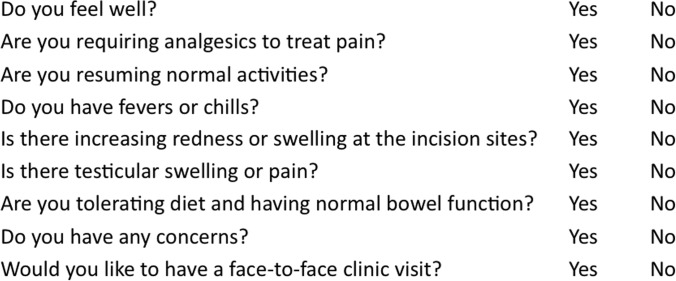
This is a retrospective review of consecutive patients who prospectively agreed to undergo telephone follow-up after laparoscopic inguinal hernia repair instead of standard face-to-face clinic visits. Patients received a telephone call from a dedicated physician assistant 2 to 3 weeks after surgery and answered a predetermined questionnaire. A face-to-face clinic visit was scheduled based on the results of the call or on patient request.
Of 62 patients who underwent surgery, all agreed to telephone follow-up instead of face-to-face clinic visits. Their mean round-trip distance to the hospital was 122 miles. Fifty-five patients (88.7%) successfully completed planned telephone follow-up. Three patients (4.8%) were lost to follow-up, and 4 (6.5%) were erroneously scheduled for a clinic appointment. Of the 55 patients who were reached by telephone, 50 (90.9%) were satisfied and declined an in-person clinic visit. Five patients (9.1%) returned for a clinic appointment based on concerns raised during the telephone call. Of these, 1 was found to have an early hernia recurrence and 1 had a seroma.
Telephone follow-up by a midlevel provider after laparoscopic inguinal hernia repair is feasible and effective and is well received by patients.
对更具成本效益和时间效率的医疗服务的需求引发了人们对远程或远程医疗保健方式的兴趣。我们开展了一项研究,以检验腹腔镜腹股沟疝修补术后电话随访项目实施的可行性和结果。
这是一项对连续患者的回顾性研究,这些患者前瞻性地同意在腹腔镜腹股沟疝修补术后接受电话随访,而非标准的面对面门诊就诊。患者在术后2至3周会接到一名专门的医师助理打来的电话,并回答一份预先确定的问卷。根据电话结果或患者要求安排面对面门诊就诊。
在接受手术的62例患者中,所有人都同意接受电话随访而非面对面门诊就诊。他们到医院的平均往返距离为122英里。55例患者(88.7%)成功完成了计划的电话随访。3例患者(4.8%)失访,4例(6.5%)被错误地安排了门诊预约。在通过电话联系到的55例患者中,50例(90.9%)表示满意并拒绝了面对面门诊就诊。5例患者(9.1%)因电话随访中提出的问题而返回门诊就诊。其中,1例发现有早期疝复发,1例有血清肿。
腹腔镜腹股沟疝修补术后由中级医疗人员进行电话随访是可行且有效的,并且患者接受度良好。