Lim Jun Pei, Leung Bernard P, Ding Yew Yoong, Tay Laura, Ismail Noor Hafizah, Yeo Audrey, Yew Suzanne, Chong Mei Sian
Department of Geriatric Medicine, Tan Tock Seng Hospital, Singapore ; Institute of Geriatrics and Active Ageing, Tan Tock Seng Hospital, Singapore.
Department of Rheumatology, Allergy and Immunology, Tan Tock Seng Hospital, Singapore.
Clin Interv Aging. 2015 Mar 25;10:605-9. doi: 10.2147/CIA.S78901. eCollection 2015.
Sarcopenic obesity (SO) is associated with poorer physical outcomes and functional status in the older adult. A proinflammatory milieu associated with central obesity is postulated to enhance muscle catabolism. We set out to examine associations of the chemokine monocyte chemoattractant protein-1 (MCP-1) in groups of older adults, with sarcopenia, obesity, and the SO phenotypes.
A total of 143 community dwelling, well, older adults were recruited. Cross-sectional clinical data, physical performance, and muscle mass measurements were collected. Obesity and sarcopenia were defined using revised National Cholesterol Education Program (NCEP) obesity guidelines and those of the Asian Working Group for Sarcopenia. Serum levels of MCP-1 were measured by enzyme-linked immunosorbent assay (ELISA).
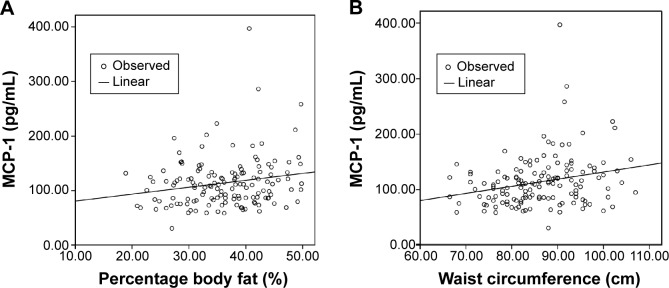
In all, 25.2% of subjects were normal, 15.4% sarcopenic, 48.3% obese, and 11.2% were SO. The SO groups had the lowest appendicular lean mass, highest percentage body fat, and lowest performance scores on the Short Physical Performance Battery and grip strength. The MCP-1 levels were significantly different, with the highest levels found in SO participants (P<0.05).
Significantly raised MCP-1 levels in obese and SO subjects support the theory of chronic inflammation due to excess adiposity. Longitudinal studies will reveal whether SO represents a continuum of obesity causing accelerated sarcopenia and cardiovascular events, or the coexistence of two separate conditions with synergistic effects affecting functional performance.
肌肉减少性肥胖(SO)与老年人较差的身体状况和功能状态相关。据推测,与中心性肥胖相关的促炎环境会增强肌肉分解代谢。我们着手研究老年人群中趋化因子单核细胞趋化蛋白-1(MCP-1)与肌肉减少症、肥胖症及SO表型之间的关联。
共招募了143名居住在社区、健康的老年人。收集了横断面临床数据、身体性能和肌肉质量测量数据。使用修订后的美国国家胆固醇教育计划(NCEP)肥胖指南和亚洲肌肉减少症工作组的指南来定义肥胖症和肌肉减少症。通过酶联免疫吸附测定(ELISA)测量血清MCP-1水平。
总体而言,25.2%的受试者正常,15.4%患有肌肉减少症,48.3%肥胖,11.2%为SO。SO组的四肢瘦体重最低,体脂百分比最高,在简短身体性能测试和握力测试中的表现得分最低。MCP-1水平存在显著差异,SO参与者中的水平最高(P<0.05)。
肥胖和SO受试者中MCP-1水平显著升高支持了因肥胖过多导致慢性炎症的理论。纵向研究将揭示SO是代表肥胖导致肌肉减少症和心血管事件加速的连续过程,还是两种具有协同作用影响功能表现的独立病症的共存。