Harrold Leslie, Pascal Scott, Lewis Courtland, O'Keefe Regis, Pellegrini Vincent, Allison Jeroan, Ayers David, Franklin Patricia
University of Massachusetts Medical School.
Hartford Hospital.
EGEMS (Wash DC). 2014 Oct 22;2(1):1107. doi: 10.13063/2327-9214.1107. eCollection 2014.
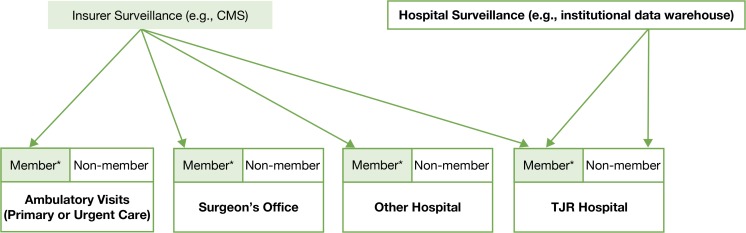
Current approaches to quantifying total posthospital complications and readmissions following surgical procedures are limited because the United States does not have a single health care payer. Patients seek posthospital care in varied locations, yet hospitals can only quantify those returning to the same facility. Seeking information directly from patients about health care utilization following hospital discharge holds promise to provide data that is missing for surgeons and health care systems.
Because total joint replacement (TJR) is the most common and costly elective surgical hospitalization, we examined the concordance between patients' self-report of potential short-term complications and their readmissions and our review of medical records in the initial hospital and surrounding facilities.
Patients undergoing primary total hip or knee replacement from July 1, 2011, through December 3, 2012, at a large site participating in a national cohort of TJR patients were identified. Patients completed a six-month postoperative survey regarding emergency department (ED), day surgery (DS), or inpatient care for possible medical or mechanical post-TJR complications. We reviewed inpatient and outpatient medical records from all regional facilities and examined the sensitivity, specificity, and positive- and negative predictive values for patient self-report and medical records.
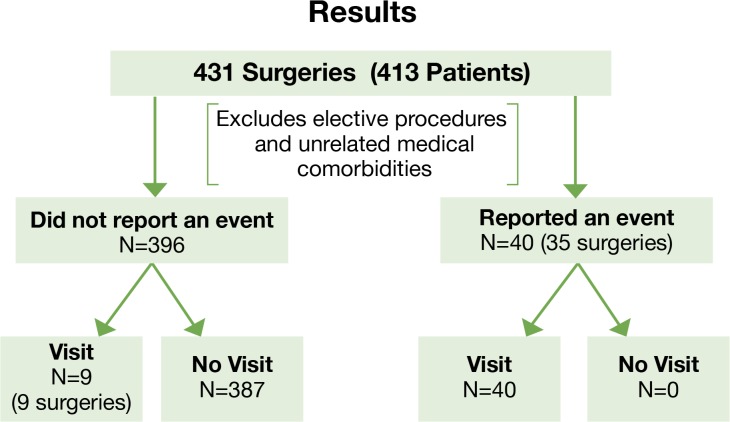
There were 413 patients who had 431 surgeries and completed the six-month questionnaire. Patients reported 40 medical encounters (9 percent) including ED, DS or inpatient care, of which 20 percent occurred at hospitals different from the initial surgery. Review of medical records revealed 9 additional medical encounters that patients had not mentioned including five hospitalizations following surgery and four ED visits. Overall patient self-report of ED, DS, and inpatient care for possible complications was both sensitive (82 percent) and specific (100 percent). The positive predictive value was 100 percent and negative predictive value 98 percent.
Patient self-report of posthospital events was accurate. Substantial numbers of patients required care at outlying hospitals (not where the TJR occurred).
Methods that directly engage patients can augment current posthospital utilization surveillance to assure complete data.
目前用于量化外科手术后医院总并发症和再入院情况的方法存在局限性,因为美国没有单一的医疗保健支付方。患者在不同地点寻求出院后的护理,但医院只能量化那些返回同一机构的患者情况。直接从患者那里获取有关出院后医疗保健利用情况的信息有望提供外科医生和医疗保健系统所缺失的数据。
由于全关节置换术(TJR)是最常见且成本最高的择期手术住院治疗,我们研究了患者对潜在短期并发症及其再入院情况的自我报告与我们对初始医院及周边机构病历审查之间的一致性。
确定了2011年7月1日至2012年12月3日期间在一个参与全国TJR患者队列的大型机构接受初次全髋关节或膝关节置换术的患者。患者完成了一项关于因TJR术后可能的医疗或机械并发症而到急诊科(ED)、日间手术(DS)或住院治疗的六个月术后调查。我们审查了所有区域机构的住院和门诊病历,并检查了患者自我报告和病历的敏感性、特异性以及阳性和阴性预测值。
有413例患者接受了431次手术并完成了六个月的问卷调查。患者报告了40次医疗就诊(9%),包括到急诊科、日间手术或住院治疗,其中20%发生在与初次手术不同的医院。病历审查发现了另外9次患者未提及的医疗就诊,包括术后5次住院和4次急诊科就诊。总体而言,患者对因可能并发症而到急诊科、日间手术和住院治疗的自我报告既敏感(82%)又特异(100%)。阳性预测值为100%,阴性预测值为98%。
患者对出院后事件的自我报告是准确的。大量患者需要在偏远医院(非TJR手术发生的医院)接受护理。
直接让患者参与的方法可以增强当前出院后利用情况监测,以确保获得完整数据。