Jensen Tina Kold, Andersen Louise Bjørkholt, Kyhl Henriette Boye, Nielsen Flemming, Christesen Henrik Thybo, Grandjean Philippe
Department of Environmental Medicine, University of Southern Denmark, Odense, Denmark; Odense Child Cohort, Hans Christian Andersen Children's Hospital, Odense, Denmark; OPEN (Odense Patient data Explorative Network), Odense University Hospital, Odense, Denmark.
Hans Christian Andersen Children's Hospital, Odense University Hospital, Odense, Denmark; Institute of Clinical Research, University of Southern Denmark, Odense, Denmark.
PLoS One. 2015 Apr 7;10(4):e0123496. doi: 10.1371/journal.pone.0123496. eCollection 2015.
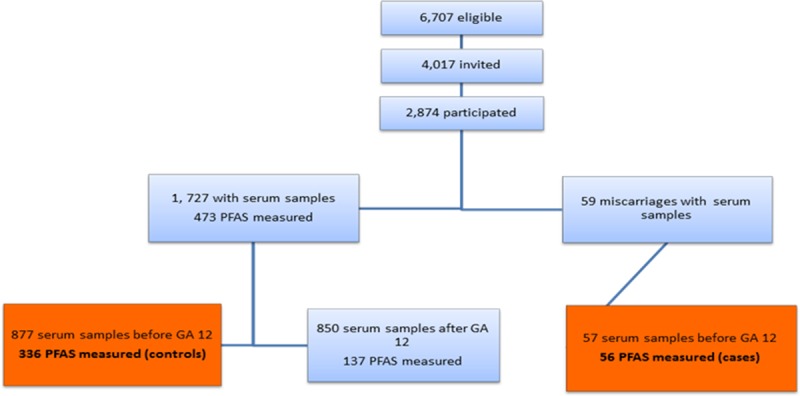
Perfluorinated alkylated substances (PFAS) have been extensively used in consumer products and humans are widely exposed to these persistent compounds. A recent study found no association between exposure to perfluorooctanoic acid (PFOA) and perfluorooctanesulfonic acid (PFOS) and miscarriage, but no studies have examined adverse effect of the more recently introduced PFASs. We therefore conducted a case-control study within a population-based, prospective cohort during 2010-2012. Newly pregnant women residing in the Municipality of Odense, Denmark were invited to enroll in the Odense Child Cohort at their first antenatal visit before pregnancy week 12. Among a total of 2,874 participating women, 88 suffered a miscarriage and 59 had stored serum samples, of which 56 occurred before gestational week 12. They were compared to a random sample (N=336) of delivering women, who had also donated serum samples before week 12. Using a case-control design, 51 of the women suffering a miscarriage were matched on parity and gestational day of serum sampling with 204 delivering women. In a multiple logistic regression with adjustment for age, BMI, parity and gestational age at serum sampling, women with the highest tertile of exposure to perfluorononanoic acid (PFNA) and perfluorodecanoic acid (PFDA) in pregnancy had odds ratios for miscarriage of 16.5 (95% CI 7.4-36.6-36.5) and 2.67 (1.31-5.44), respectively, as compared to the lowest tertile. In the matched data set, the OR were 37.9 (9.9-145.2) and 3.71 (1.60-8.60), respectively. The association with perfluorohexane sulfonic acid (PFHxS) was in the same direction, but not statistically significant, while no association was found with PFOA and PFOS. Our findings require confirmation due to the possible public health importance, given that all pregnant women are exposed to these widely used compounds.
全氟烷基化物质(PFAS)已被广泛应用于消费品中,人类也广泛接触这些持久性化合物。最近的一项研究发现,接触全氟辛酸(PFOA)和全氟辛烷磺酸(PFOS)与流产之间没有关联,但尚未有研究考察最近引入的PFAS的不良影响。因此,我们在2010年至2012年期间,在一个基于人群的前瞻性队列中开展了一项病例对照研究。居住在丹麦欧登塞市的新怀孕妇女在怀孕第12周之前的首次产前检查时被邀请加入欧登塞儿童队列。在总共2874名参与研究的妇女中,88人流产,59人保存了血清样本,其中56例发生在妊娠第12周之前。将她们与同样在第12周之前捐献了血清样本的分娩妇女的随机样本(N = 336)进行比较。采用病例对照设计,51名流产妇女在产次和血清采样的孕周方面与204名分娩妇女进行匹配。在对年龄、体重指数、产次和血清采样时的孕周进行调整的多元逻辑回归分析中,孕期全氟壬酸(PFNA)和全氟癸酸(PFDA)暴露处于最高三分位数的妇女流产的比值比分别为16.5(95%可信区间7.4 - 36.6)和2.67(1.31 - 5.44),与最低三分位数相比。在匹配数据集中,比值比分别为37.9(9.9 - 145.2)和3.71(1.60 - 8.60)。与全氟己烷磺酸(PFHxS)的关联方向相同,但无统计学意义,而未发现与PFOA和PFOS有关联。鉴于所有孕妇都接触这些广泛使用的化合物,考虑到其可能的公共卫生重要性,我们的研究结果需要得到证实。