Division of Laboratory Sciences, National Center for Environmental Health, Centers for Disease Control and Prevention, Atlanta, Georgia, USA.
Environ Sci Technol. 2011 Feb 1;45(3):1121-6. doi: 10.1021/es1019614. Epub 2010 Dec 17.
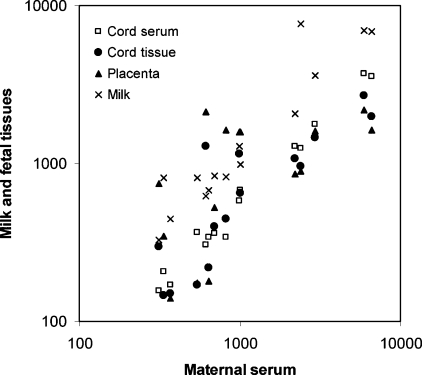
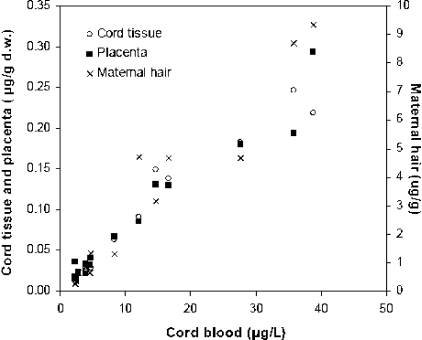
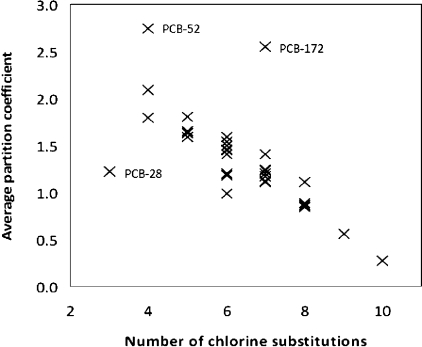
Passage of environmental chemicals across the placenta has important toxicological consequences, as well as for choosing samples for analysis and for interpreting the results. To obtain systematic data, we collected in 2000 maternal and cord blood, cord tissue, placenta, and milk in connection with births in the Faroe Islands, where exposures to marine contaminants is increased. In 15 sample sets, we measured a total of 87 environmental chemicals, almost all of which were detected both in maternal and fetal tissues. The maternal serum lipid-based concentrations of organohalogen compounds averaged 1.7 times those of cord serum, 2.8 times those of cord tissue and placenta, and 0.7 those of milk. For organohalogen compounds detectable in all matrices, a high degree of correlation between concentrations in maternal serum and the other tissues investigated was generally observed (r(2) > 0.5). Greater degree of chlorination resulted in lower transfer from maternal serum into milk. Concentrations of pentachlorbenzene, γ-hexachlorocyclohexane, and several polychlorinated biphenyl congeners with low chlorination were higher in fetal samples and showed poor correlation with maternal levels. Perfluorinated compounds occurred in lower concentrations in cord serum than in maternal serum. Cadmium, lead, mercury, and selenium were all detected in fetal samples, but only mercury showed close correlations among concentrations in different matrices. Although the environmental chemicals examined pass through the placenta and are excreted into milk, partitions between maternal and fetal samples are not uniform.
环境化学物质穿过胎盘具有重要的毒理学后果,无论是在选择分析样本还是解释结果方面都是如此。为了获得系统的数据,我们在 2000 年收集了法罗群岛出生时的母亲和脐带血、脐带组织、胎盘和母乳,这些地方的海洋污染物暴露水平增加。在 15 个样本组中,我们共测量了 87 种环境化学物质,几乎所有这些物质都在母亲和胎儿组织中被检测到。母体血清中有机卤化合物的脂基浓度平均是脐带血清的 1.7 倍,是脐带组织和胎盘的 2.8 倍,是母乳的 0.7 倍。对于所有基质中都能检测到的有机卤化合物,母体血清与其他研究组织之间的浓度相关性通常很高(r²>0.5)。氯化程度越高,从母体血清向母乳的转移就越低。五氯苯、γ-六氯环己烷和几种低氯化程度的多氯联苯同系物在胎儿样本中的浓度更高,与母体水平相关性较差。全氟化合物在脐带血清中的浓度低于母体血清。镉、铅、汞和硒都在胎儿样本中被检测到,但只有汞在不同基质中的浓度之间存在密切相关性。尽管研究中的环境化学物质穿过胎盘并排泄到母乳中,但母体和胎儿样本之间的分配并不均匀。