Kangasniemi Anu Maarit, Lappalainen Raimo, Kankaanpää Anna, Tolvanen Asko, Tammelin Tuija
BMC Public Health. 2015 Mar 18;15:260. doi: 10.1186/s12889-015-1604-x.
The high prevalence of physical inactivity has led to a search for novel and feasible interventions that will enhance physical activity, especially among the least physically active individuals. This randomized controlled trial aimed to determine the effectiveness of a value-based intervention to promote a physically more active lifestyle among physically inactive adults. The framework of the study was based on Acceptance and Commitment Therapy (ACT).
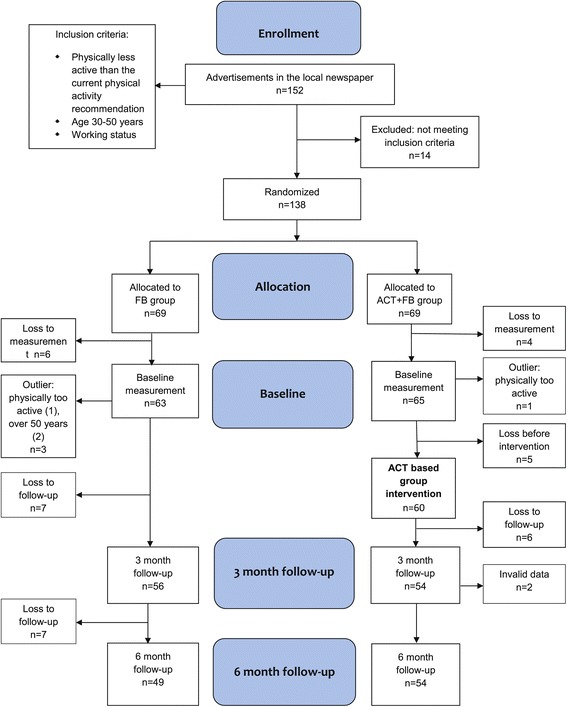
Physically inactive participants aged 30 to 50 years (n = 138) were randomly allocated to a feedback (FB, n = 69) or an acceptance- and commitment-based group (ACT + FB, n = 69). Both groups received written feedback about their objectively measured physical activity and were offered a body composition analysis. In addition, the participants in the ACT + FB group attended six group sessions and were given a pedometer for self-monitoring their physical activity during the nine-week intervention. The primary outcome was physical activity. In addition, participants' cognitions related to exercise and physical activity were evaluated at baseline and at three- and six-month follow-ups. The changes in mean physical activity level were analysed using multilevel random regression and rank order stability, using the structural equation model.
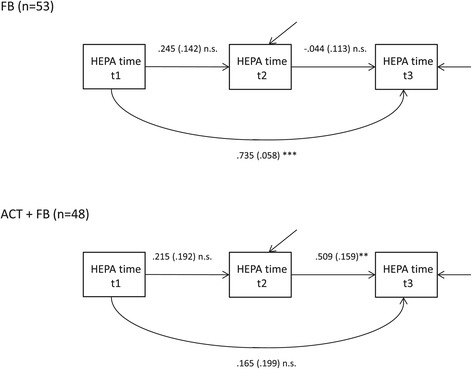
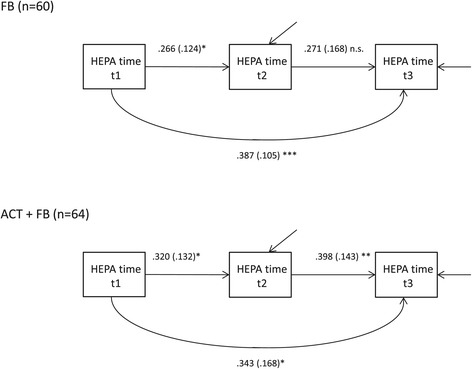
Participants in both groups increased their objectively measured and self-reported physical activity with high individual differences. No difference was observed in the change of physical activity level between the FB and ACT + FB groups over time. However, the cognitions related to physical activity and exercise improved more in the ACT + FB group than in the FB group. In addition, after re-analyzing the data among the non-depressive participants, higher stability was observed in objectively measured physical activity at the individual level between the three- and six-month follow-ups in the ACT + FB group as compared to FB group.
Acceptance- and commitment-based group intervention, combined with the self-monitoring of physical activity, was beneficial in supporting the cognition related to exercise and physical activity, and brought more stability to the individual level physical activity behaviour change, especially among the non-depressive participants.
ClinicalTrials.gov, number NCT01796990. Registered in February 2013.
身体活动不足的高患病率促使人们寻找新颖且可行的干预措施来增加身体活动,尤其是在身体活动最少的人群中。这项随机对照试验旨在确定一种基于价值观的干预措施在促进身体活动不足的成年人养成更积极的生活方式方面的有效性。该研究框架基于接纳与承诺疗法(ACT)。
年龄在30至50岁之间的身体活动不足参与者(n = 138)被随机分配到反馈组(FB,n = 69)或基于接纳与承诺的组(ACT + FB,n = 69)。两组均收到关于其客观测量的身体活动的书面反馈,并接受了身体成分分析。此外,ACT + FB组的参与者参加了六次小组会议,并获得了一个计步器,用于在为期九周的干预期间自我监测身体活动。主要结局是身体活动。此外,在基线以及三个月和六个月随访时评估了参与者与运动和身体活动相关的认知。使用多级随机回归和等级顺序稳定性,并通过结构方程模型分析平均身体活动水平的变化。
两组参与者的客观测量和自我报告的身体活动均有所增加,个体差异很大。随着时间的推移,FB组和ACT + FB组之间的身体活动水平变化未观察到差异。然而,与身体活动和运动相关的认知在ACT + FB组中比在FB组中改善得更多。此外,在对非抑郁参与者的数据进行重新分析后,与FB组相比,ACT + FB组在三个月和六个月随访之间在个体水平上客观测量的身体活动具有更高的稳定性。
基于接纳与承诺的小组干预,结合身体活动的自我监测,有利于支持与运动和身体活动相关的认知,并为个体水平的身体活动行为改变带来更多稳定性,尤其是在非抑郁参与者中。
ClinicalTrials.gov,编号NCT01796990。于2013年2月注册。