Dossus Laure, Benusiglio Patrick R
Breast Cancer Res. 2015 Mar 13;17:37. doi: 10.1186/s13058-015-0546-7.
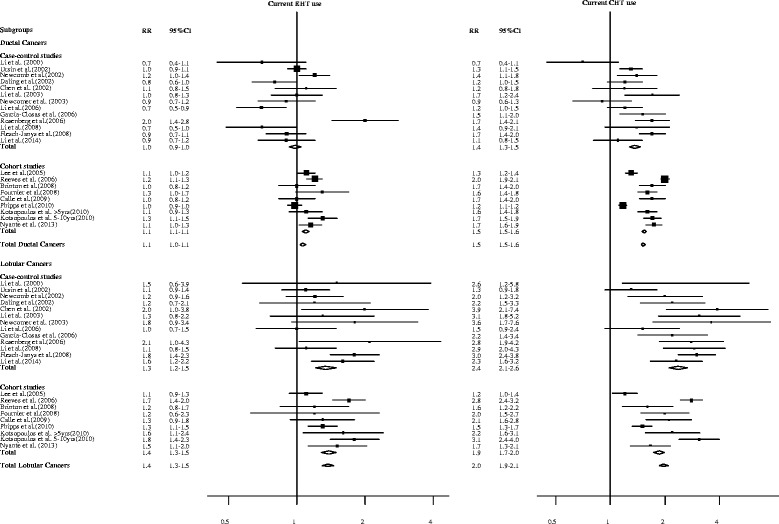
While most invasive breast cancers consist of carcinomas of the ductal type, about 10% are invasive lobular carcinomas. Invasive lobular and ductal carcinomas differ with respect to risk factors. Invasive lobular carcinoma is more strongly associated with exposure to female hormones, and therefore its incidence is more subject to variation. This is illustrated by US figures during the 1987 to 2004 period: after 12 years of increases, breast cancer incidence declined steadily from 1999 to 2004, reflecting among other causes the decreasing use of menopausal hormone therapy, and these variations were stronger for invasive lobular than for invasive ductal carcinoma. Similarly, invasive lobular carcinoma is more strongly associated with early menarche, late menopause and late age at first birth. As for genetic risk factors, four high-penetrance genes are tested in clinical practice when genetic susceptibility to breast cancer is suspected, BRCA1, BRCA2, TP53 and CDH1. Germline mutations in BRCA1 and TP53 are predominantly associated with invasive ductal carcinoma, while BRCA2 mutations are associated with both ductal and lobular cancers. CDH1, the gene coding for the E-cadherin adhesion protein, is of special interest as mutations are associated with invasive lobular carcinoma, but never with ductal carcinoma. It was initially known as the main susceptibility gene for gastric cancer of the diffuse type, but the excess of breast cancers of the lobular type in CDH1 families led researchers to identify it also as a susceptibility gene for invasive lobular carcinoma. The risk of invasive lobular carcinoma is high in female mutation carriers, as about 50% are expected to develop the disease. Carriers must therefore undergo intensive breast cancer screening, with, for example, yearly magnetic resonance imaging and mammogram starting at age 30 years.
虽然大多数浸润性乳腺癌是导管型癌,但约10%是浸润性小叶癌。浸润性小叶癌和导管癌在风险因素方面存在差异。浸润性小叶癌与接触女性激素的关联更强,因此其发病率更容易发生变化。1987年至2004年期间美国的数据说明了这一点:在经历了12年的上升之后,乳腺癌发病率从1999年至2004年稳步下降,这在其他原因中反映出绝经激素治疗的使用减少,而且这些变化在浸润性小叶癌中比浸润性导管癌更为明显。同样,浸润性小叶癌与初潮早、绝经晚和初产年龄晚的关联更强。至于遗传风险因素,当怀疑存在乳腺癌遗传易感性时,临床实践中会检测四个高 penetrance 基因,即BRCA1、BRCA2、TP53和CDH1。BRCA1和TP53的种系突变主要与浸润性导管癌相关,而BRCA2突变与导管癌和小叶癌均相关。CDH1是编码E-钙黏蛋白黏附蛋白的基因,特别值得关注,因为其突变与浸润性小叶癌相关,但从不与导管癌相关。它最初被认为是弥漫型胃癌的主要易感基因,但CDH1家族中小叶型乳腺癌的过量情况促使研究人员也将其确定为浸润性小叶癌的易感基因。女性突变携带者发生浸润性小叶癌的风险很高,因为预计约50%的携带者会患上这种疾病。因此,携带者必须接受强化的乳腺癌筛查,例如从30岁开始每年进行磁共振成像和乳房X线摄影。