Ibinda Fredrick, Bauni Evasius, Kariuki Symon M, Fegan Greg, Lewa Joy, Mwikamba Monica, Boga Mwanamvua, Odhiambo Rachael, Mwagandi Kiponda, Seale Anna C, Berkley James A, Dorfman Jeffrey R, Newton Charles R J C
KEMRI-Wellcome Trust Research Programme, Centre for Geographic Medicine Research (Coast), Kilifi, Kenya.
KEMRI-Wellcome Trust Research Programme, Centre for Geographic Medicine Research (Coast), Kilifi, Kenya; Centre for Tropical Medicine and Global Health, Nuffield Department of Clinical Medicine, University of Oxford, Oxford, United Kingdom.
PLoS One. 2015 Apr 7;10(4):e0122606. doi: 10.1371/journal.pone.0122606. eCollection 2015.
Neonatal Tetanus (NT) is a preventable cause of mortality and neurological sequelae that occurs at higher incidence in resource-poor countries, presumably because of low maternal immunisation rates and unhygienic cord care practices. We aimed to determine changes in the incidence of NT, characterize and investigate the associated risk factors and mortality in a prospective cohort study including all admissions over a 15-year period at a County hospital on the Kenyan coast, a region with relatively high historical NT rates within Kenya.
We assessed all neonatal admissions to Kilifi County Hospital in Kenya (1999-2013) and identified cases of NT (standard clinical case definition) admitted during this time. Poisson regression was used to examine change in incidence of NT using accurate denominator data from an area of active demographic surveillance. Logistic regression was used to investigate the risk factors for NT and factors associated with mortality in NT amongst neonatal admissions. A subset of sera from mothers (n = 61) and neonates (n = 47) were tested for anti-tetanus antibodies.
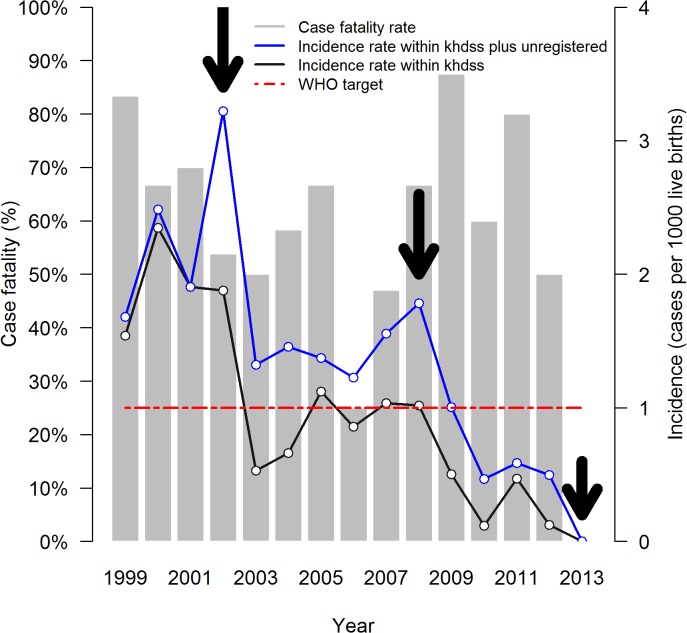
There were 191 NT admissions, of whom 187 (98%) were home deliveries. Incidence of NT declined significantly (Incidence Rate Ratio: 0.85 (95% Confidence interval 0.81-0.89), P<0.001) but the case fatality (62%) did not change over the study period (P = 0.536). Younger infant age at admission (P = 0.001) was the only independent predictor of mortality. Compared to neonatal hospital admittee controls, the proportion of home births was higher among the cases. Sera tested for antitetanus antibodies showed most mothers (50/61, 82%) had undetectable levels of antitetanus antibodies, and most (8/9, 89%) mothers with detectable antibodies had a neonate without protective levels.
Incidence of NT in Kilifi County has significantly reduced, with reductions following immunisation campaigns. Our results suggest immunisation efforts are effective if sustained and efforts should continue to expand coverage.
新生儿破伤风(NT)是一种可预防的死亡和神经后遗症原因,在资源匮乏国家发病率较高,可能是由于孕产妇免疫率低和脐带护理不卫生。我们旨在通过一项前瞻性队列研究确定NT发病率的变化,描述并调查相关危险因素及死亡率,该研究纳入了肯尼亚海岸一家县医院15年间所有入院病例,该地区在肯尼亚历史上NT发病率相对较高。
我们评估了肯尼亚基利菲县医院(1999 - 2013年)所有新生儿入院病例,并确定了在此期间入院的NT病例(标准临床病例定义)。使用来自活跃人口监测地区的准确分母数据,通过泊松回归分析来检查NT发病率的变化。使用逻辑回归分析来调查NT的危险因素以及新生儿入院病例中NT患者的死亡相关因素。对一部分母亲(n = 61)和新生儿(n = 47)的血清进行抗破伤风抗体检测。
有191例NT入院病例,其中187例(98%)为在家分娩。NT发病率显著下降(发病率比:0.85(95%置信区间0.81 - 0.89),P < 0.001),但在研究期间病死率(62%)没有变化(P = 0.536)。入院时婴儿年龄较小(P = 0.001)是唯一的死亡独立预测因素。与新生儿医院入院对照相比,病例中在家分娩的比例更高。检测抗破伤风抗体的血清显示,大多数母亲(50/61,82%)抗破伤风抗体水平检测不到,大多数(8/9,89%)抗体可检测到的母亲所生新生儿没有保护性抗体水平。
基利菲县的NT发病率显著降低,免疫接种活动后发病率下降。我们的结果表明,如果持续进行免疫接种努力是有效的,应继续扩大覆盖范围。