Oxford University Clinical Research Unit, Ho Chi Minh City, Viet Nam; Centre for Global Health and Tropical Medicine, University of Oxford, UK.
Oxford University Clinical Research Unit, Ho Chi Minh City, Viet Nam.
Vaccine. 2023 Mar 24;41(13):2208-2213. doi: 10.1016/j.vaccine.2023.02.036. Epub 2023 Feb 26.
Ongoing tetanus cases and sporadic outbreaks of vaccine-preventable diseases associated with routine vaccination programmes remain problems in many low and middle-income countries, including Vietnam. With no human-to-human transmission or natural immunity, tetanus antibody levels indicate both individual risk of tetanus and gaps in vaccination programmes.
To investigate gaps in immunity to tetanus in Vietnam, a country with a historically high level of tetanus vaccination coverage, tetanus antibodies were measure by ELISA from samples selected from a long-term serum bank, established for the purposes of general-population seroepidemiological investigations in southern Vietnam. Samples were selected from 10 provinces, focussing on age-groups targeted by national vaccination programmes for infants and pregnant women (Expanded Programme on Immunization, EPI, and Maternal and Neonatal Tetanus, MNT).
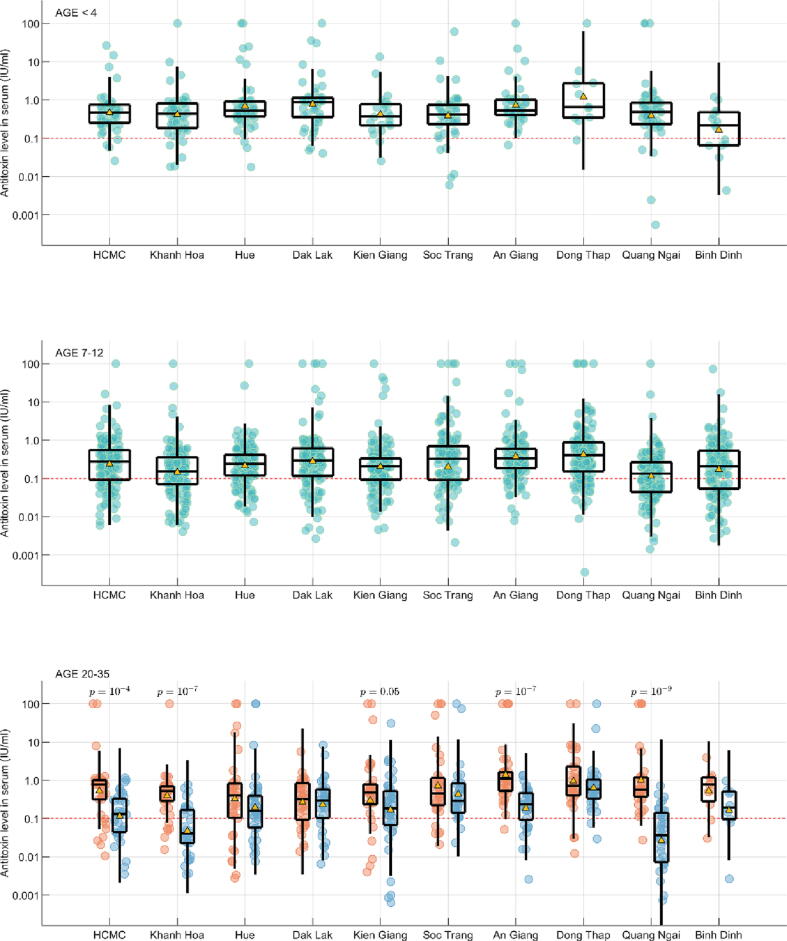
Antibodies were measured from a total of 3864 samples. Highest tetanus antibody concentrations occurred in children under 4 years old, over 90 % of whom had protective levels. Approximately 70 % of children aged 7-12 years had protective antibody concentrations although there was variation among provinces. For infants and children, there were no significant differences in tetanus protection between males and females, but for adults aged 20-35 years, in five of the ten provinces surveyed, protection against tetanus was higher in females (p < 0.05) who are eligible for booster doses under the MNT programme. In seven of ten provinces, antibody concentrations were inversely related to age (p < 0.01) and protection of older individuals was generally low.
Widespread immunity to tetanus toxoid is seen in infants and young children consistent with the high coverage rates reported for diptheria tetanus toxoid and pertussis (DTP) in Vietnam. However, the lower antibody concentrations seen in older children and men suggest reduced immunity to tetanus in populations not targeted by EPI and MNT programmes.
在包括越南在内的许多低收入和中等收入国家,持续发生的破伤风病例和与常规疫苗接种计划相关的偶发性疫苗可预防疾病暴发仍是问题。由于没有人与人之间的传播或自然免疫力,破伤风抗体水平既表明了个体患破伤风的风险,也表明了疫苗接种计划存在差距。
为了调查越南破伤风免疫方面的差距,该国曾有很高的破伤风疫苗接种覆盖率,通过酶联免疫吸附试验(ELISA)从长期血清库中选择的样本中测量破伤风抗体,该血清库是为越南南部进行一般人群血清流行病学调查而建立的。从 10 个省份中选择了样本,重点关注国家免疫规划针对婴儿和孕妇(扩大免疫规划(EPI)和孕产妇及新生儿破伤风(MNT))的目标年龄组。
共测量了 3864 个样本的抗体。抗体浓度最高的是 4 岁以下的儿童,其中超过 90%的儿童具有保护性水平。约 70%的 7-12 岁儿童具有保护性抗体浓度,但各省之间存在差异。对于婴儿和儿童,男性和女性的破伤风保护没有显著差异,但在调查的十个省份中的五个中,符合 MNT 计划加强剂量条件的 20-35 岁成年女性破伤风保护更高(p<0.05)。在十个省份中的七个中,抗体浓度与年龄呈反比(p<0.01),且老年人的保护作用普遍较低。
广泛的破伤风类毒素免疫见于婴儿和幼儿,这与越南报告的白喉、破伤风类毒素和百日咳(DTP)高覆盖率一致。然而,在年龄较大的儿童和男性中观察到的较低抗体浓度表明,未被 EPI 和 MNT 计划覆盖的人群对破伤风的免疫力降低。