Hashimoto Motomu, Yamazaki Toru, Hamaguchi Masahide, Morimoto Takeshi, Yamori Masashi, Asai Keita, Isobe Yu, Furu Moritoshi, Ito Hiromu, Fujii Takao, Terao Chikashi, Mori Masato, Matsuo Takashi, Yoshitomi Hiroyuki, Yamamoto Keiichi, Yamamoto Wataru, Bessho Kazuhisa, Mimori Tsuneyo
Department of the Control for Rheumatic Diseases, Graduate School of Medicine, Kyoto University, Kyoto, Japan.
Department of Oral and Maxillofacial Surgery, Graduate School of Medicine, Kyoto University, Kyoto, Japan.
PLoS One. 2015 Apr 7;10(4):e0122121. doi: 10.1371/journal.pone.0122121. eCollection 2015.
To determine whether the presence of periodontitis (PD) and Porphyromonas gingivalis (Pg) in the subgingival biofilm associates with the development of rheumatoid arthritis (RA) in treatment naïve preclinical stage of arthritis patients.
We conducted a prospective cohort study of 72 consecutive patients with arthralgia who had never been treated with any anti-rheumatic drugs or glucocorticoids. Periodontal status at baseline was assessed by dentists. PD was defined stringently by the maximal probing depth≧4 mm, or by the classification by the 5th European Workshop in Periodontology (EWP) in 2005 using attachment loss. Up to eight plaque samples were obtained from each patient and the presence of Pg was determined by Taqman PCR. The patients were followed up for 2 years and introduction rate of methotrexate (MTX) treatment on the diagnosis of RA was compared in patients with or without PD or Pg.
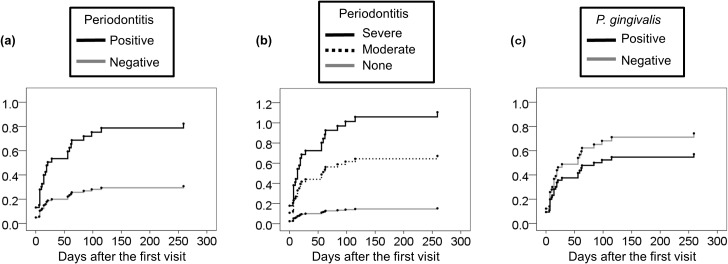
Patients with PD (probing depth≧4mm) had higher arthritis activity (p = 0.02) and higher risk for future introduction of MTX treatment on the diagnosis of RA during the follow up than patients without PD (Hazard ratio 2.68, p = 0.03). Arthritis activity and risk for MTX introduction increased with the severity of PD assessed by EWP, although not statistically significant. On the other hand, presence of Pg was not associated with arthritis activity (p = 0.72) or the risk for MTX introduction (p = 0.45).
In treatment naïve arthralgia patients, PD, but not the presence of Pg, associates with arthritis activity and future requirement of MTX treatment on the diagnosis of RA.
确定在未经治疗的关节炎患者临床前期龈下生物膜中牙周炎(PD)和牙龈卟啉单胞菌(Pg)的存在是否与类风湿关节炎(RA)的发生相关。
我们对72例从未接受过任何抗风湿药物或糖皮质激素治疗的关节痛患者进行了一项前瞻性队列研究。由牙医评估基线时的牙周状况。PD严格定义为最大探诊深度≧4mm,或根据2005年第5届欧洲牙周病学研讨会(EWP)使用附着丧失进行分类。从每位患者获取多达8个菌斑样本,通过Taqman PCR检测Pg的存在。对患者进行2年随访,比较有无PD或Pg的患者在RA诊断时甲氨蝶呤(MTX)治疗的引入率。
与无PD的患者相比,PD(探诊深度≧4mm)患者在随访期间关节炎活动度更高(p = 0.02),且在RA诊断时未来引入MTX治疗的风险更高(风险比为2.68,p = 0.03)。根据EWP评估,关节炎活动度和MTX引入风险随PD严重程度增加,尽管无统计学意义。另一方面,Pg的存在与关节炎活动度(p = 0.72)或MTX引入风险(p = 0.45)无关。
在未经治疗的关节痛患者中,PD而非Pg的存在与关节炎活动度以及RA诊断时MTX治疗的未来需求相关。