Lee Joo Youn, Choi In Ah, Kim Jin-Hee, Kim Kyoung-Hwa, Lee Eun Young, Lee Eun Bong, Lee Yong-Moo, Song Yeong Wook
Department of Molecular Medicine and Biopharmaceutical Sciences, Graduate School of Convergence Science and Technology and College of Medicine, Medical Research Center, Seoul National University, Seoul, South Korea.
Division of Rheumatology, Department of Internal Medicine, College of Medicine, Seoul National University, Seoul, South Korea.
BMC Musculoskelet Disord. 2015 Aug 12;16:190. doi: 10.1186/s12891-015-0647-6.
Periodontitis (PD) has been reported to be associated with rheumatoid arthritis (RA). Porphyromonas gingivalis (P. gingivalis) is a gram-negative anaerobic bacterium that is recognized as one of the major pathogenic organisms in PD and is the only bacterium known to express peptidylarginine deiminase (PAD). Antibody against human α-enolase (ENO1) is one of the autoantibodies in RA. ENO1 is a highly conserved protein, and could be a candidate molecule for molecular mimicry between bacterial and human proteins. In the present study, we measured serum antibody against P. gingivalis and human ENO1 in patients with RA and investigated their association with the severity of PD or disease activity of RA.
Two hundred, forty-eight patients with RA and 85 age- and sex-matched healthy controls were evaluated by rheumatologic and periodontal examinations. The serum levels of anti-P. gingivalis and anti-ENO1 antibodies were measured by an enzyme-linked immunosorbent assay (ELISA).
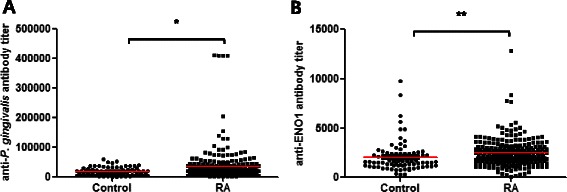
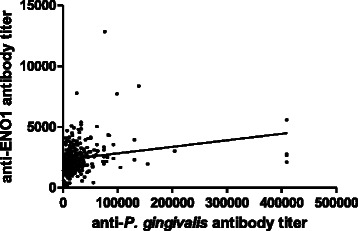
Patients with RA had significantly higher levels of anti-P. gingivalis and anti-ENO1 antibody titers than the controls (p = 0.002 and 0.0001, respectively). Anti-P. gingivalis antibody titers significantly correlated with anti-ENO1 antibody titers in RA patients (r = 0.30, p < 0.0001). There were significant correlations between anti-P. gingivalis antibody titers and the gingival index (GI), probing pocket depth (PPD), bleeding on probing (BOP) and clinical attachment level (CAL) (p = 0.038, 0.004, 0.004 and 0.002, respectively) in RA. Anti-P. gingivalis antibody titers were not correlated with disease activity score 28 (DAS28) or anti-CCP titer. However, anti-ENO1 antibody titers were significantly correlated not only with the periodontal indices, such as PPD, BOP, and CAL (p = 0.013, 0.023 and 0.017, respectively), but also RA clinical characteristics, such as DAS28, anti-CCP titer, and ESR (p = 0.009, 0.015 and 0.001, respectively).
Anti-P. gingivalis and anti-ENO1 antibody titers were correlated with the severity of PD in RA. Anti-ENO1 antibody titers, but not anti-P. gingivalis antibody titers, were further associated with RA disease activity.
据报道,牙周炎(PD)与类风湿关节炎(RA)有关。牙龈卟啉单胞菌(牙龈卟啉单胞菌)是一种革兰氏阴性厌氧菌,被认为是PD的主要致病微生物之一,并且是已知唯一表达肽基精氨酸脱氨酶(PAD)的细菌。抗人α-烯醇化酶(ENO1)抗体是RA中的自身抗体之一。ENO1是一种高度保守的蛋白质,可能是细菌和人类蛋白质之间分子模拟的候选分子。在本研究中,我们测量了RA患者血清中抗牙龈卟啉单胞菌和人ENO1的抗体,并研究了它们与PD严重程度或RA疾病活动的相关性。
通过风湿病学和牙周检查对248例RA患者和85例年龄和性别匹配的健康对照进行评估。采用酶联免疫吸附试验(ELISA)检测血清抗牙龈卟啉单胞菌和抗ENO1抗体水平。
RA患者的抗牙龈卟啉单胞菌和抗ENO1抗体滴度显著高于对照组(分别为p = 0.002和0.0001)。RA患者中,抗牙龈卟啉单胞菌抗体滴度与抗ENO1抗体滴度显著相关(r = 0.30,p < 0.0001)。在RA中,抗牙龈卟啉单胞菌抗体滴度与牙龈指数(GI)、探诊袋深度(PPD)、探诊出血(BOP)和临床附着水平(CAL)之间存在显著相关性(分别为p = 0.038、0.004、0.004和0.002)。抗牙龈卟啉单胞菌抗体滴度与疾病活动评分28(DAS28)或抗CCP滴度无关。然而,抗ENO1抗体滴度不仅与牙周指数如PPD、BOP和CAL显著相关(分别为p = 0.013、0.023和0.017),而且与RA临床特征如DAS28、抗CCP滴度和红细胞沉降率(ESR)显著相关(分别为p = 0.009、0.015和0.001)。
RA患者中,抗牙龈卟啉单胞菌和抗ENO1抗体滴度与PD严重程度相关。抗ENO1抗体滴度而非抗牙龈卟啉单胞菌抗体滴度与RA疾病活动进一步相关。