Jin Peiyao, Peng Jinjuan, Zou Haidong, Wang Weiwei, Fu Jiong, Shen Binjie, Bai Xuelin, Xu Xun, Zhang Xi
Department of Ophthalmology, Shanghai First People's Hospital, Shanghai Jiao Tong University, Shanghai, 20080, China.
Department of Ophthalmology, Shanghai First People's Hospital, Shanghai Jiao Tong University, Shanghai, 20080, China; Department of Preventative Ophthalmology, Shanghai Eye Disease Prevention and Treatment Center, Shanghai, 200040, China.
PLoS One. 2015 Apr 7;10(4):e0123449. doi: 10.1371/journal.pone.0123449. eCollection 2015.
To determine the progression rate and risk factors for diabetic retinopathy (DR) in Chinese type 2 diabetic patients who have reached the target hemoglobin A1c (HbA1c) level recommended by the American Diabetes Association.
This was a 5-year community-based prospective study. The study population consisted of patients with type 2 diabetes with HbA1c less than 7.0%. Demographic information, systemic examination results and ophthalmological test results for each participant were collected. The outcome of this study was the progression of DR, which was defined as an increase in DR grade in one or both eyes at the final visit in comparison to the baseline status. The association between each potential risk factor and DR progression was studied.
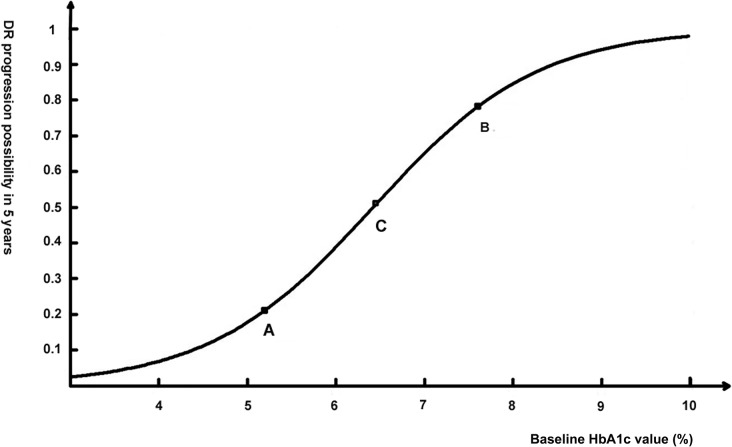
A total of 453 patients with HbA1c less than 7.0% were included in the study group. In 146 patients (32.22%), DR developed or progressed during the five-year follow-up. Baseline HbA1c level was the only independent risk factor for DR progression (p<0.01, OR = 2.84, 95%CI: 2.11~3.82). The logistic regression function suggested that the possibility of DR progression increased fastest when baseline HbA1c increased from 5.2% to 6.4%. The 5-year DR progression rate in patients with baseline HbA1c less than 5.2%, between 5.2% and 6.4%, and over 6.4% were 19.62%, 24.41%, and 76.83%, respectively.
To slow the progression of DR in Chinese patients with type 2 diabetes, more intensive glucose control is recommended.
确定已达到美国糖尿病协会推荐的糖化血红蛋白(HbA1c)目标水平的中国2型糖尿病患者糖尿病视网膜病变(DR)的进展率及危险因素。
这是一项基于社区的5年前瞻性研究。研究人群包括HbA1c低于7.0%的2型糖尿病患者。收集了每位参与者的人口统计学信息、全身检查结果和眼科检查结果。本研究的结局是DR的进展,定义为与基线状态相比,最后一次随访时一只或两只眼睛的DR分级增加。研究了每个潜在危险因素与DR进展之间的关联。
研究组共纳入453例HbA1c低于7.0%的患者。在146例患者(32.22%)中,DR在五年随访期间发生或进展。基线HbA1c水平是DR进展的唯一独立危险因素(p<0.01,OR = 2.84,95%CI:2.11~3.82)。逻辑回归函数表明,当基线HbA1c从5.2%增加到6.4%时,DR进展的可能性增加最快。基线HbA1c低于5.2%、在5.2%至6.4%之间以及超过6.4%的患者的5年DR进展率分别为19.62%、24.41%和76.83%。
为减缓中国2型糖尿病患者DR的进展,建议更严格地控制血糖。