Mølgaard Bjarke, Viitanen Anna-Kaisa, Kangas Anneli, Huhtiniemi Marika, Larsen Søren Thor, Vanhala Esa, Hussein Tareq, Boor Brandon E, Hämeri Kaarle, Koivisto Antti Joonas
Department of Physics, University of Helsinki, P.O. Box 48, FI-00014 Helsinki, Finland.
Nanosafety Research Centre, Finnish Institute of Occupational Health, Topeliuksenkatu 41 a A, FI-00250 Helsinki, Finland.
Int J Environ Res Public Health. 2015 Apr 2;12(4):3756-73. doi: 10.3390/ijerph120403756.
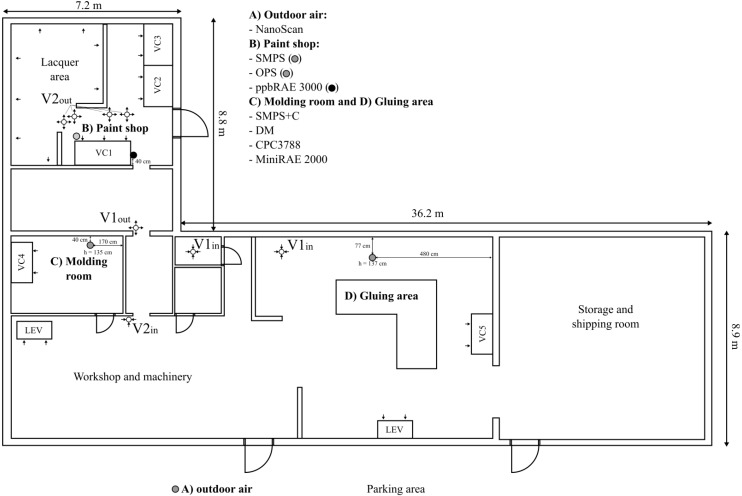
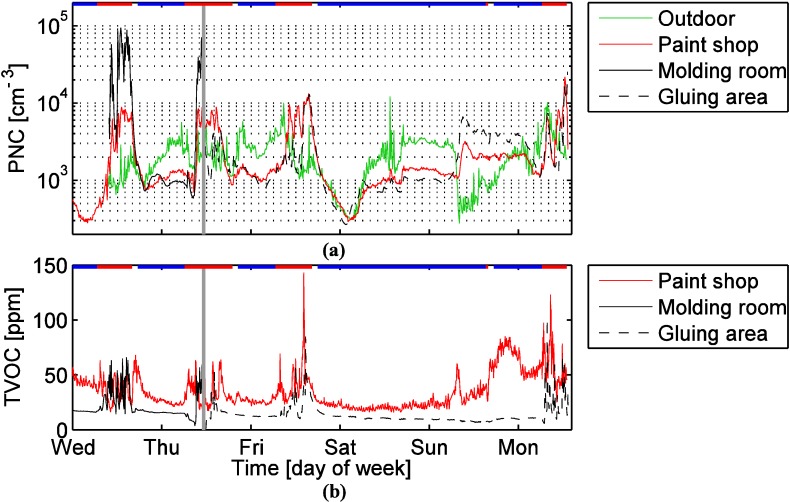
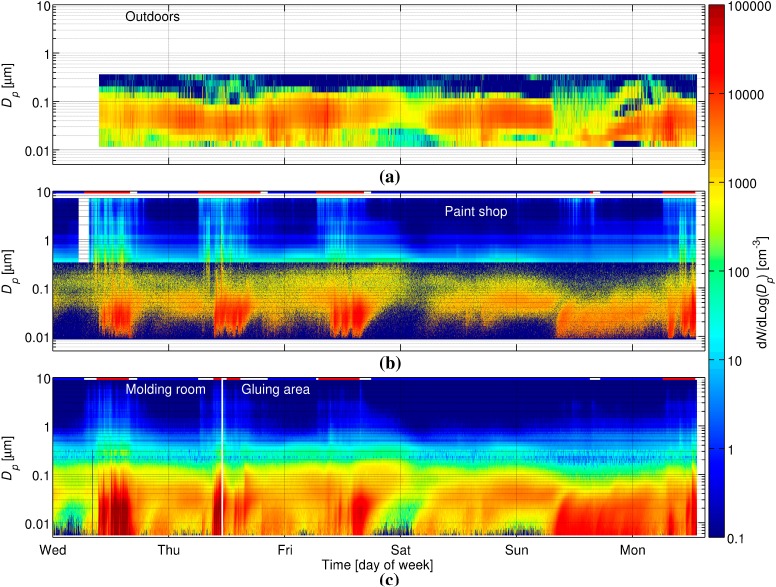
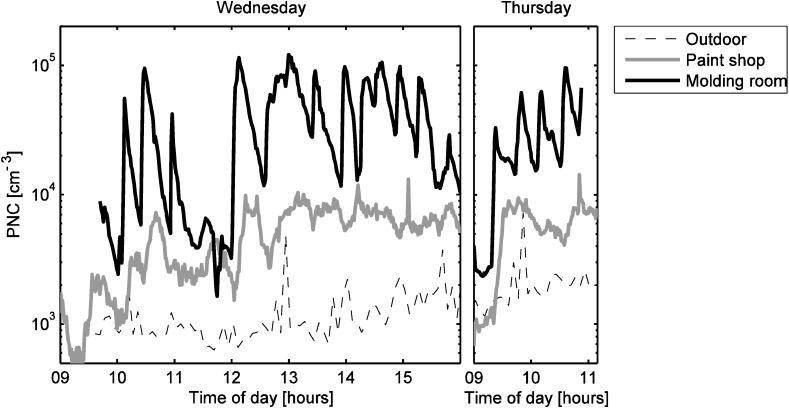
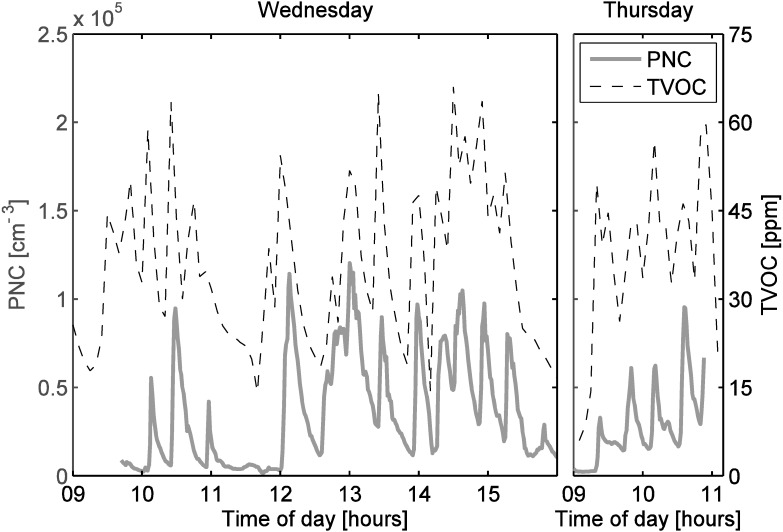
Due to the health risk related to occupational air pollution exposure, we assessed concentrations and identified sources of particles and volatile organic compounds (VOCs) in a handcraft workshop producing fishing lures. The work processes in the site included polyurethane molding, spray painting, lacquering, and gluing. We measured total VOC (TVOC) concentrations and particle size distributions at three locations representing the various phases of the manufacturing and assembly process. The mean working-hour TVOC concentrations in three locations studied were 41, 37, and 24 ppm according to photo-ionization detector measurements. The mean working-hour particle number concentration varied between locations from 3000 to 36,000 cm-3. Analysis of temporal and spatial variations of TVOC concentrations revealed that there were at least four substantial VOC sources: spray gluing, mold-release agent spraying, continuous evaporation from various lacquer and paint containers, and either spray painting or lacquering (probably both). The mold-release agent spray was indirectly also a major source of ultrafine particles. The workers' exposure can be reduced by improving the local exhaust ventilation at the known sources and by increasing the ventilation rate in the area with the continuous source.
由于职业性接触空气污染存在健康风险,我们对一家生产鱼饵的手工作坊中的颗粒物和挥发性有机化合物(VOCs)浓度进行了评估,并确定了其来源。该场所的工作流程包括聚氨酯成型、喷漆、涂漆和胶合。我们在代表制造和组装过程不同阶段的三个位置测量了总挥发性有机化合物(TVOC)浓度和粒径分布。根据光离子化探测器的测量结果,在所研究的三个位置,平均工作小时TVOC浓度分别为41、37和24 ppm。平均工作小时颗粒物数量浓度在不同位置之间从3000至36,000 cm-3不等。对TVOC浓度的时空变化分析表明,至少有四个主要的VOC来源:喷雾胶合、脱模剂喷涂、各种漆和涂料容器的持续蒸发,以及喷漆或涂漆(可能两者皆是)。脱模剂喷雾间接也是超细颗粒物的主要来源。通过改善已知来源处的局部排气通风以及提高连续源所在区域的通风率,可以降低工人的接触风险。