Knight Gwenan M, Dodd Peter J, Grant Alison D, Fielding Katherine L, Churchyard Gavin J, White Richard G
TB Modelling Group, Centre for the Mathematical Modelling of Infectious Diseases, London School of Hygiene and Tropical Medicine, London, United Kingdom; TB Centre, London School of Hygiene and Tropical Medicine, London, United Kingdom.
School of Health and Related Research, University of Sheffield, Sheffield, United Kingdom.
PLoS One. 2015 Apr 7;10(4):e0122514. doi: 10.1371/journal.pone.0122514. eCollection 2015.
South Africa has one of the highest per capita rates of tuberculosis (TB) incidence in the world. In 2012, the South African government produced a National Strategic Plan (NSP) to control the spread of TB with the ambitious aim of zero new TB infections and deaths by 2032, and a halving of the 2012 rates by 2016.
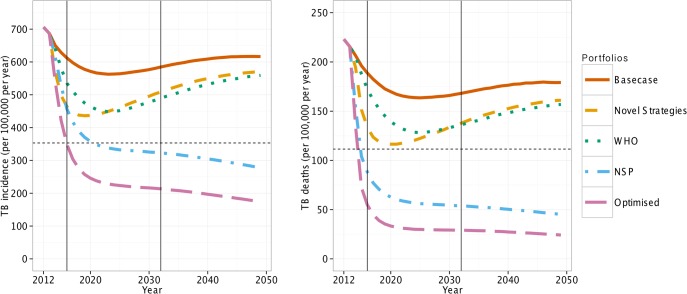
We used a transmission model to investigate whether the NSP targets could be reached if immediate scale up of control methods had happened in 2014. We explored the potential impact of four intervention portfolios; 1) "NSP" represents the NSP strategy, 2) "WHO" investigates increasing antiretroviral therapy eligibility, 3) "Novel Strategies" considers new isoniazid preventive therapy strategies and HIV "Universal Test and Treat" and 4) "Optimised" contains the most effective interventions.
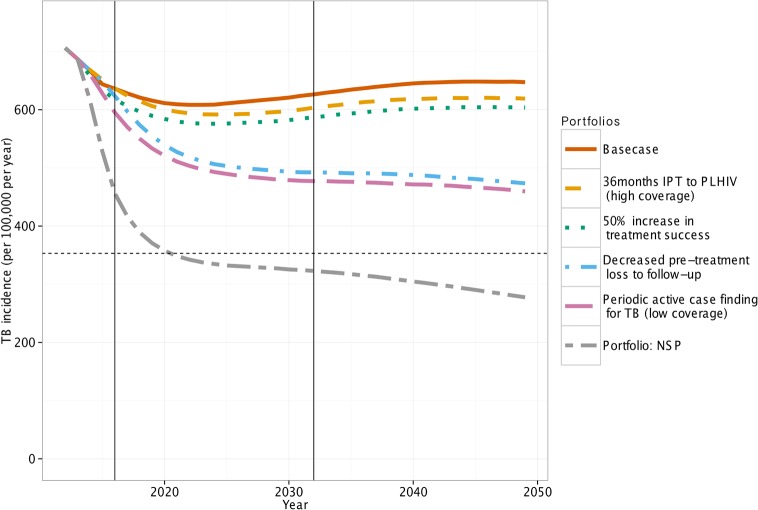
We find that even with this scale-up, the NSP targets are unlikely to be achieved. The portfolio that achieved the greatest impact was "Optimised", followed closely by "NSP". The "WHO" and "Novel Strategies" had little impact on TB incidence by 2050. Of the individual interventions explored, the most effective were active case finding and reductions in pre-treatment loss to follow up which would have a large impact on TB burden.
Use of existing control strategies has the potential to have a large impact on TB disease burden in South Africa. However, our results suggest that the South African TB targets are unlikely to be reached without new technologies. Despite this, TB incidence could be dramatically reduced by finding and starting more TB cases on treatment.
南非是世界上人均结核病发病率最高的国家之一。2012年,南非政府制定了一项国家战略计划(NSP)以控制结核病的传播,其宏伟目标是到2032年实现结核病新感染和死亡人数为零,并在2016年前将2012年的发病率减半。
我们使用了一种传播模型来调查如果在2014年立即扩大控制方法的规模,NSP目标是否能够实现。我们探讨了四种干预组合的潜在影响;1)“NSP”代表NSP策略,2)“WHO”研究增加抗逆转录病毒治疗的资格,3)“新策略”考虑新的异烟肼预防性治疗策略和艾滋病毒“普遍检测和治疗”,4)“优化”包含最有效的干预措施。
我们发现,即使进行了这种规模扩大,NSP目标也不太可能实现。产生最大影响的组合是“优化”,紧随其后的是“NSP”。到2050年,“WHO”和“新策略”对结核病发病率几乎没有影响。在所探讨的个体干预措施中,最有效的是主动病例发现和减少治疗前失访,这将对结核病负担产生重大影响。
使用现有的控制策略有可能对南非的结核病负担产生重大影响。然而,我们的结果表明,如果没有新技术,南非的结核病目标不太可能实现。尽管如此,通过发现并使更多结核病病例开始接受治疗,结核病发病率可以大幅降低。