Mazan-Mamczarz Krystyna, Peroutka Raymond J, Steinhardt James J, Gidoni Moriah, Zhang Yongqing, Lehrmann Elin, Landon Ari L, Dai Bojie, Houng Simone, Muniandy Parameswary A, Efroni Sol, Becker Kevin G, Gartenhaus Ronald B
Cell Commun Signal. 2015 Mar 1;13:15. doi: 10.1186/s12964-015-0091-0.
The mechanistic target of rapamycin, (mTOR) kinase plays a pivotal role in controlling critical cellular growth and survival pathways, and its aberrant induction is implicated in cancer pathogenesis. Therefore, suppression of active mTOR signaling has been of great interest to researchers; several mTOR inhibitors have been discovered to date. Ethanol (EtOH), similar to pharmacologic mTOR inhibitors, has been shown to suppress the mTOR signaling pathway, though in a non-catalytic manner. Despite population studies showing that the consumption of EtOH has a protective effect against hematological malignancies, the mechanisms behind EtOH's modulation of mTOR activity in cells and its downstream consequences are largely unknown. Here we evaluated the effects of EtOH on the mTOR pathway, in comparison to the active-site mTOR inhibitor INK128, and compared translatome analysis of their downstream effects in diffuse large B-cell lymphoma (DLBCL).
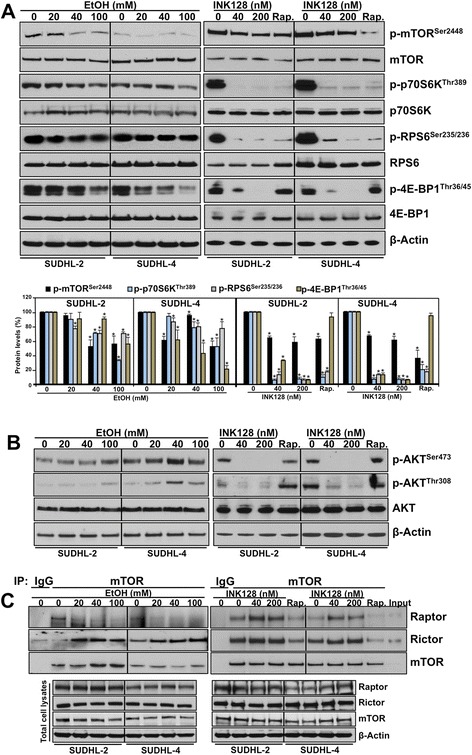
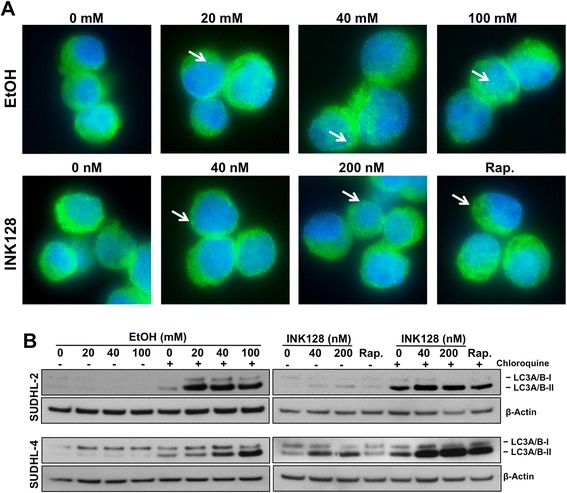
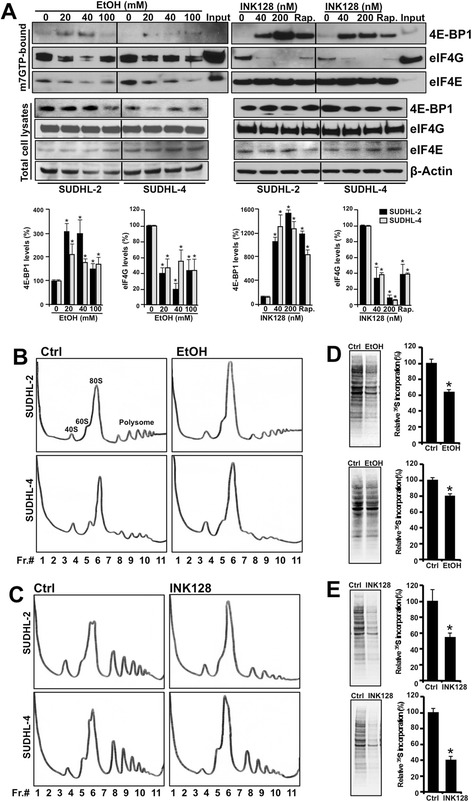
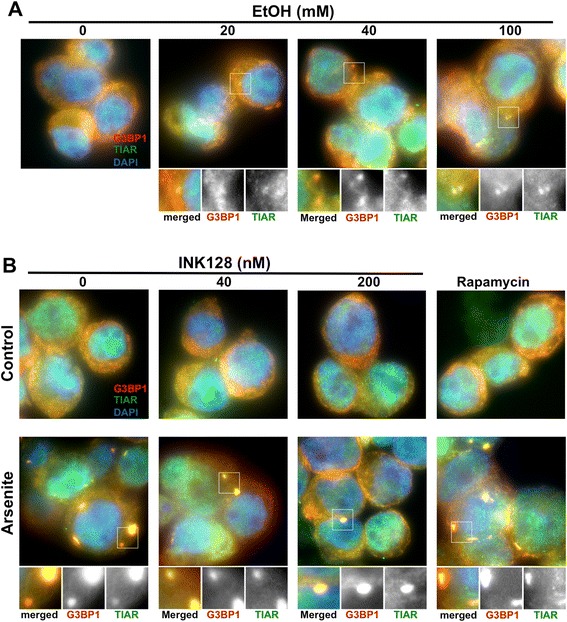
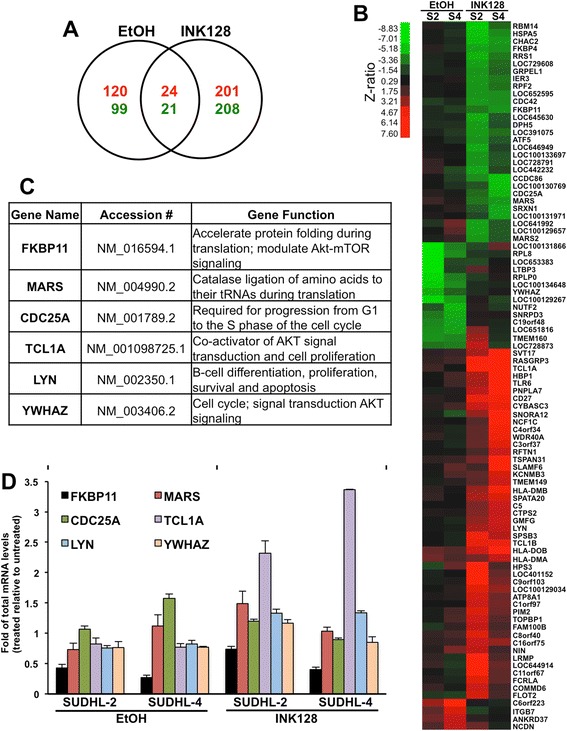
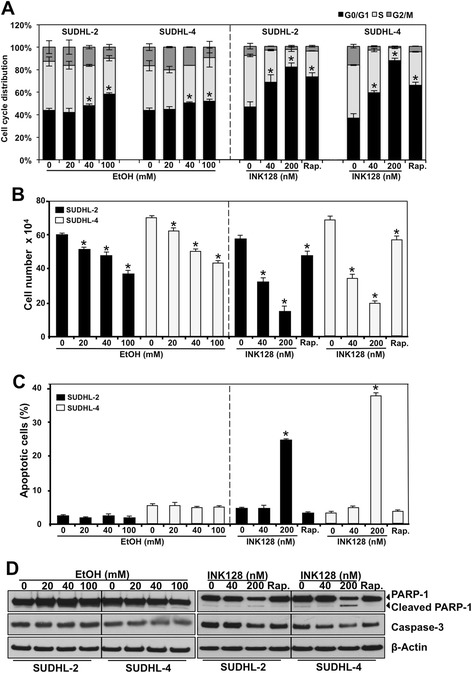
Treatment of DLBCL cells with EtOH suppressed mTORC1 complex formation while increasing AKT phosphorylation and mTORC2 complex assembly. INK128 completely abrogated AKT phosphorylation without affecting the structure of mTORC1/2 complexes. Accordingly, EtOH less profoundly suppressed cap-dependent translation and global protein synthesis, compared to a remarkable inhibitory effect of INK128 treatment. Importantly, EtOH treatment induced the formation of stress granules, while INK128 suppressed their formation. Microarray analysis of polysomal RNA revealed that although both agents primarily affected cell growth and survival, EtOH and INK128 regulated the synthesis of mostly distinct genes involved in these processes. Though both EtOH and INK128 inhibited cell cycle, proliferation and autophagy, EtOH, in contrast to INK128, did not induce cell apoptosis.
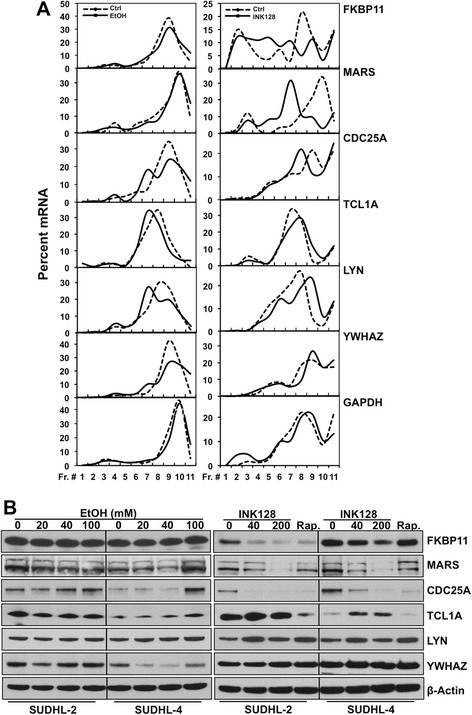
Given that EtOH, similar to pharmacologic mTOR inhibitors, inhibits mTOR signaling, we systematically explored the effect of EtOH and INK128 on mTOR signal transduction, components of the mTORC1/2 interaction and their downstream effectors in DLBCL malignancy. We found that EtOH partially inhibits mTOR signaling and protein translation, compared to INK128's complete mTOR inhibition. Translatome analysis of mTOR downstream target genes established that differential inhibition of mTOR by EtOH and INK128 distinctly modulates translation of specific subsets of mRNAs involved in cell growth and survival, leading to differential cellular response and survival.
雷帕霉素的机制性靶点(mTOR)激酶在控制关键的细胞生长和存活途径中起关键作用,其异常诱导与癌症发病机制有关。因此,抑制活性mTOR信号传导一直是研究人员非常感兴趣的;迄今为止已经发现了几种mTOR抑制剂。乙醇(EtOH)与药理学mTOR抑制剂类似,已被证明可抑制mTOR信号通路,尽管是以非催化方式。尽管人群研究表明,乙醇的摄入对血液系统恶性肿瘤有保护作用,但乙醇在细胞中调节mTOR活性的机制及其下游后果在很大程度上尚不清楚。在这里,我们评估了乙醇对mTOR通路的影响,并与活性位点mTOR抑制剂INK128进行了比较,并比较了它们在弥漫性大B细胞淋巴瘤(DLBCL)中对下游效应的翻译组分析。
用乙醇处理DLBCL细胞可抑制mTORC1复合物的形成,同时增加AKT磷酸化和mTORC2复合物的组装。INK128完全消除了AKT磷酸化,而不影响mTORC1/2复合物的结构。因此,与INK128处理的显著抑制作用相比,乙醇对帽依赖性翻译和整体蛋白质合成的抑制作用较小。重要的是,乙醇处理诱导了应激颗粒的形成,而INK128抑制了它们的形成。对多聚体RNA的微阵列分析表明,尽管两种药物主要影响细胞生长和存活,但乙醇和INK128调节了参与这些过程的大多数不同基因的合成。尽管乙醇和INK128都抑制细胞周期、增殖和自噬,但与INK128不同,乙醇不会诱导细胞凋亡。
鉴于乙醇与药理学mTOR抑制剂类似,可抑制mTOR信号传导,我们系统地探讨了乙醇和INK128对DLBCL恶性肿瘤中mTOR信号转导、mTORC1/2相互作用成分及其下游效应器的影响。我们发现,与INK128对mTOR的完全抑制相比,乙醇部分抑制mTOR信号传导和蛋白质翻译。对mTOR下游靶基因的翻译组分析表明,乙醇和INK128对mTOR的差异抑制明显调节了参与细胞生长和存活mRNA特定子集的翻译,导致不同的细胞反应和存活。