McClay Joseph L, Vunck Sarah A, Batman Angela M, Crowley James J, Vann Robert E, Beardsley Patrick M, van den Oord Edwin J
Center for Biomarker Research and Personalized Medicine, Virginia Commonwealth University, McGuire Hall, 1112 East Clay Street, Richmond, VA, 23298, USA,
J Neuroimmune Pharmacol. 2015 Sep;10(3):425-34. doi: 10.1007/s11481-015-9605-1. Epub 2015 Apr 8.
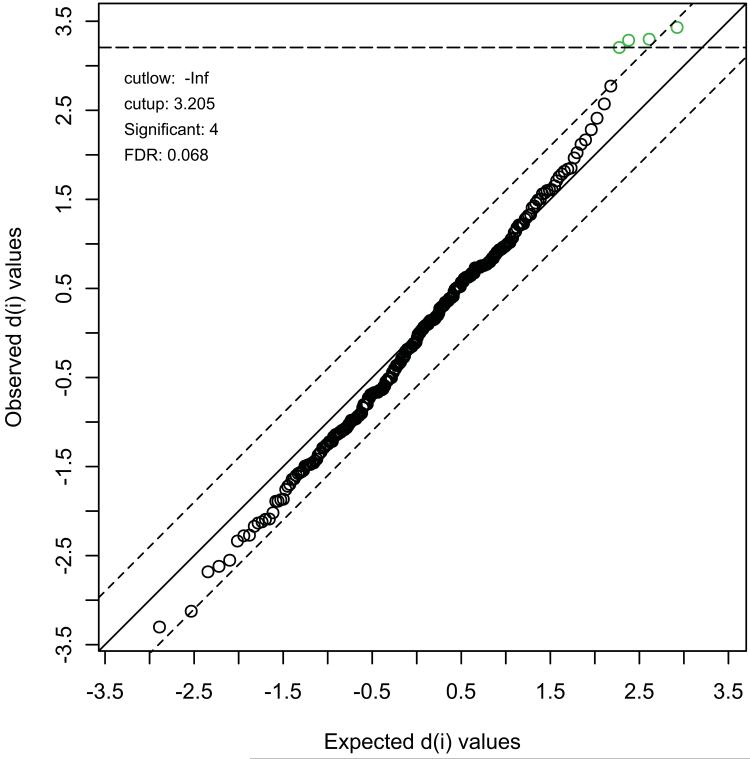
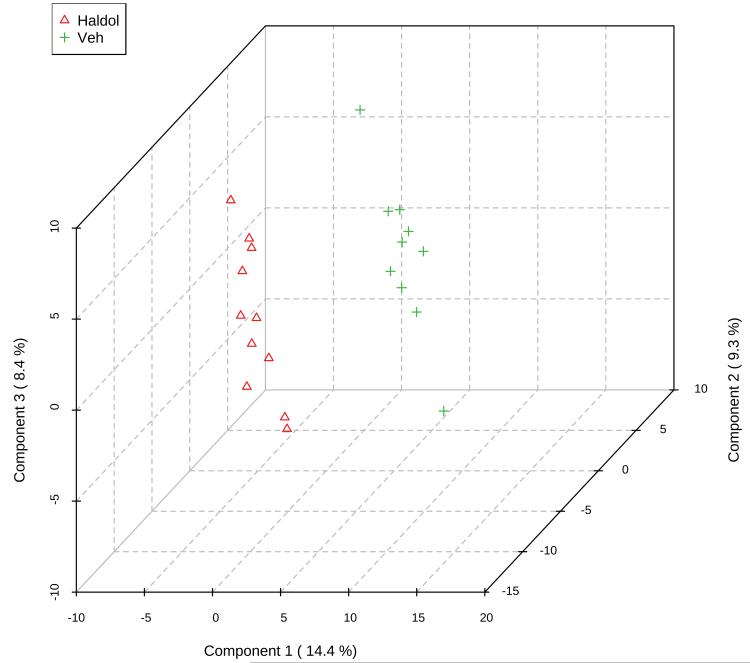
Haloperidol is an effective antipsychotic drug for treatment of schizophrenia, but prolonged use can lead to debilitating side effects. To better understand the effects of long-term administration, we measured global metabolic changes in mouse brain following 3 mg/kg/day haloperidol for 28 days. These conditions lead to movement-related side effects in mice akin to those observed in patients after prolonged use. Brain tissue was collected following microwave tissue fixation to arrest metabolism and extracted metabolites were assessed using both liquid and gas chromatography mass spectrometry (MS). Over 300 unique compounds were identified across MS platforms. Haloperidol was found to be present in all test samples and not in controls, indicating experimental validity. Twenty-one compounds differed significantly between test and control groups at the p < 0.05 level. Top compounds were robust to analytical method, also being identified via partial least squares discriminant analysis. Four compounds (sphinganine, N-acetylornithine, leucine and adenosine diphosphate) survived correction for multiple testing in a non-parametric analysis using false discovery rate threshold < 0.1. Pathway analysis of nominally significant compounds (p < 0.05) revealed significant findings for sphingolipid metabolism (p = 0.015) and protein biosynthesis (p = 0.024). Altered sphingolipid metabolism is suggestive of disruptions to myelin. This interpretation is supported by our observation of elevated N-acetyl-aspartyl-glutamate in the haloperidol-treated mice (p = 0.004), a marker previously associated with demyelination. This study further demonstrates the utility of murine neurochemical metabolomics as a method to advance understanding of CNS drug effects.
氟哌啶醇是一种治疗精神分裂症的有效抗精神病药物,但长期使用会导致使人虚弱的副作用。为了更好地了解长期给药的影响,我们测量了小鼠脑内的整体代谢变化,这些小鼠每天按3 mg/kg的剂量给予氟哌啶醇,持续28天。这些情况会导致小鼠出现与长期使用后患者所观察到的类似的与运动相关的副作用。在微波组织固定以停止代谢后收集脑组织,并使用液相色谱和气相色谱质谱联用(MS)对提取的代谢物进行评估。在各个MS平台上共鉴定出300多种独特的化合物。发现所有测试样品中都存在氟哌啶醇,而对照组中没有,表明实验有效。在p < 0.05水平时,测试组和对照组之间有21种化合物存在显著差异。顶级化合物对分析方法具有稳健性,也通过偏最小二乘判别分析得以鉴定。在使用错误发现率阈值< 0.1的非参数分析中,有4种化合物(鞘氨醇、N - 乙酰鸟氨酸、亮氨酸和二磷酸腺苷)在多重检验校正后仍具有统计学意义。对名义上具有显著性的化合物(p < 0.05)进行通路分析,发现鞘脂代谢(p = 0.015)和蛋白质生物合成(p = 0.024)有显著结果。鞘脂代谢改变提示髓鞘受到破坏。我们在氟哌啶醇治疗的小鼠中观察到N - 乙酰天冬氨酰谷氨酸升高(p = 0.004),这一结果支持了上述解释,N - 乙酰天冬氨酰谷氨酸是一种先前与脱髓鞘相关的标志物。本研究进一步证明了小鼠神经化学代谢组学作为一种推进对中枢神经系统药物作用理解的方法的实用性。