McClay Joseph L, Adkins Daniel E, Vunck Sarah A, Batman Angela M, Vann Robert E, Clark Shaunna L, Beardsley Patrick M, van den Oord Edwin J C G
Center for Biomarker Research and Personalized Medicine, School of Pharmacy, Medical College of Virginia Campus, Virginia Commonwealth University, McGuire Hall, 1112 East Clay Street, Richmond, VA 23298-0533, USA.
Metabolomics. 2013 Apr 1;9(2):392-402. doi: 10.1007/s11306-012-0456-y. Epub 2012 Aug 26.
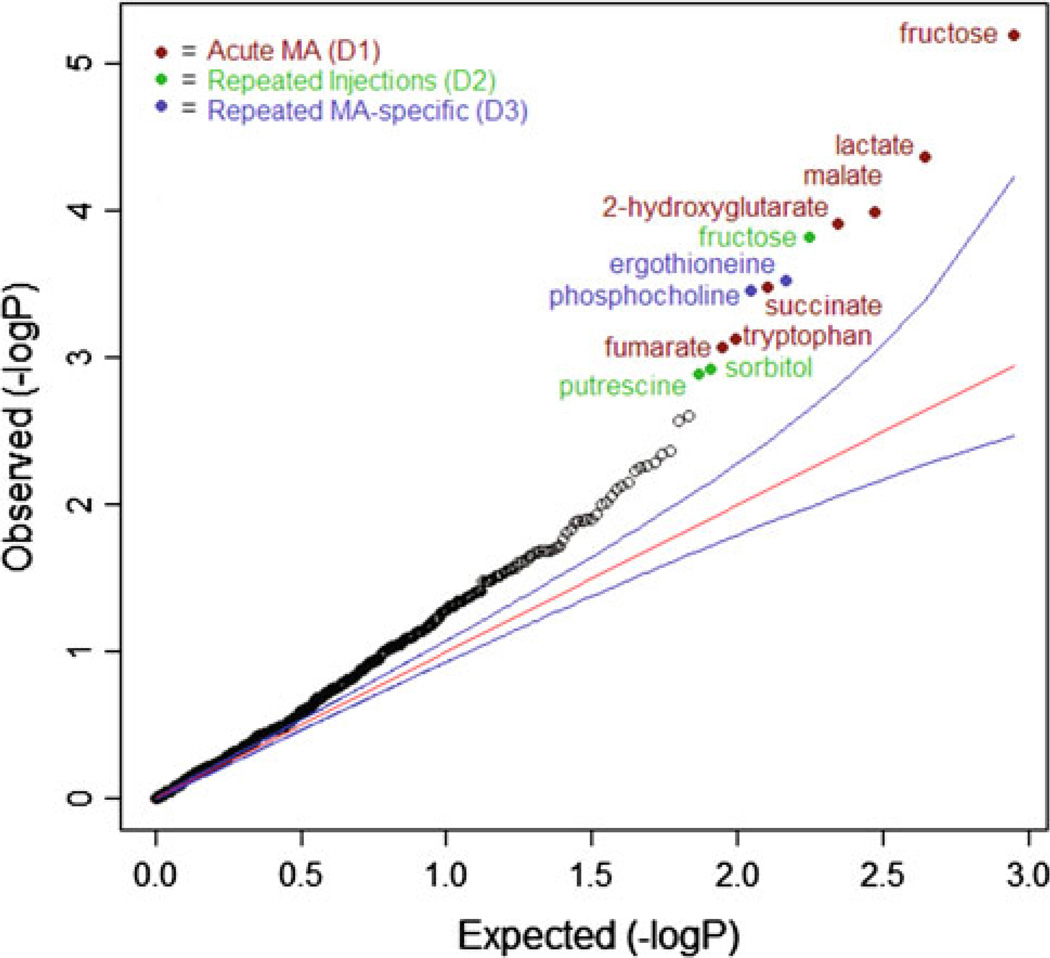
Methamphetamine (MA) is an illegal stimulant drug of abuse with serious negative health consequences. The neurochemical effects of MA have been partially characterized, with a traditional focus on classical neurotransmitter systems. However, these directions have not yet led to novel drug treatments for MA abuse or toxicity. As an alternative approach, we describe here the first application of metabolomics to investigate the neurochemical consequences of MA exposure in the rodent brain. We examined single exposures at 3 mg/kg and repeated exposures at 3 mg/kg over 5 days in eight common inbred mouse strains. Brain tissue samples were assayed using high-throughput gas and liquid chromatography mass spectrometry, yielding quantitative data on >300 unique metabolites. Association testing and false discovery rate control yielded several metabolome-wide significant associations with acute MA exposure, including compounds such as lactate ( = 4.4 × 10, = 0.013), tryptophan ( = 7.0 × 10, = 0.035) and 2-hydroxyglutarate ( = 1.1 × 10, = 0.022). Secondary analyses of MA-induced increase in locomotor activity showed associations with energy metabolites such as succinate ( = 3.8 × 10). Associations specific to repeated (5 day) MA exposure included phosphocholine ( = 4.0 × 10, = 0.087) and ergothioneine ( = 3.0 × 10, = 0.087). Our data appear to confirm and extend existing models of MA action in the brain, whereby an initial increase in energy metabolism, coupled with an increase in behavioral locomotion, gives way to disruption of mitochondria and phospholipid pathways and increased endogenous antioxidant response. Our study demonstrates the power of comprehensive MS-based metabolomics to identify drug-induced changes to brain metabolism and to develop neurochemical models of drug effects.
甲基苯丙胺(MA)是一种非法的滥用兴奋剂药物,会对健康造成严重负面影响。MA的神经化学效应已得到部分表征,传统上主要关注经典神经递质系统。然而,这些研究方向尚未带来针对MA滥用或毒性的新型药物治疗方法。作为一种替代方法,我们在此描述了代谢组学在研究啮齿动物大脑中MA暴露的神经化学后果方面的首次应用。我们在8种常见的近交系小鼠品系中,检测了3mg/kg的单次暴露以及连续5天每天3mg/kg的重复暴露。使用高通量气相色谱和液相色谱质谱法对脑组织样本进行分析,得出了300多种独特代谢物的定量数据。关联测试和错误发现率控制产生了几个在全代谢组范围内与急性MA暴露有显著关联的结果,包括乳酸(P = 4.4 × 10,FDR = 0.013)、色氨酸(P = 7.0 × 10,FDR = 0.035)和2-羟基戊二酸(P = 1.1 × 10,FDR = 0.022)等化合物。对MA诱导的运动活动增加的二次分析显示与琥珀酸等能量代谢物有关联(P = 3.8 × 10)。特定于重复(5天)MA暴露的关联包括磷酸胆碱(P = 4.0 × 10,FDR = 0.087)和麦角硫因(P = 3.0 × 10,FDR = 0.087)。我们的数据似乎证实并扩展了大脑中MA作用的现有模型,即能量代谢的初始增加与行为运动的增加相结合,随后是线粒体和磷脂途径的破坏以及内源性抗氧化反应的增加。我们的研究证明了基于质谱的综合代谢组学在识别药物诱导的大脑代谢变化以及建立药物效应的神经化学模型方面的强大作用。