Rojas Alicia, Rojas Diana, Montenegro Víctor M, Baneth Gad
Parasit Vectors. 2015 Mar 23;8:170. doi: 10.1186/s13071-015-0783-8.
Canine filarioids are important nematodes transmitted to dogs by arthropods. Diagnosis of canine filariosis is accomplished by the microscopic identification of microfilariae, serology or PCR for filarial-DNA. The aim of this study was to evaluate a molecular assay for the detection of canine filariae in dog blood, to compare its performance to other diagnostic techniques, and to determine the relationship between microfilarial concentration and infection with other vector-borne pathogens.
Blood samples from 146 dogs from Costa Rica were subjected to the detection of canine filarioids by four different methods: the microhematocrit tube test (MCT), Knott's modified test, serology and a high resolution melt and quantitative real-time PCR (HRM-qPCR). Co-infection with other vector-borne pathogens was also evaluated.
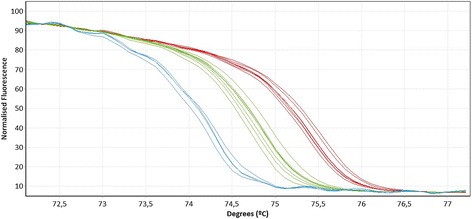
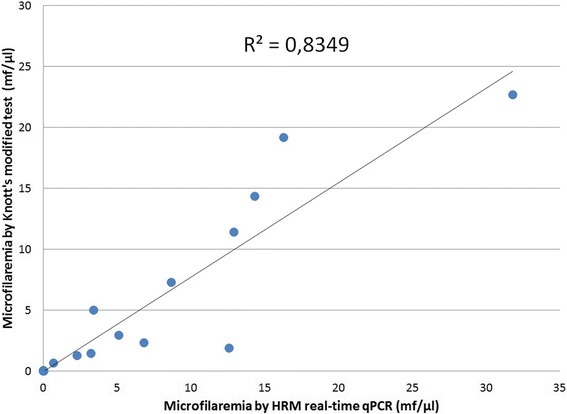
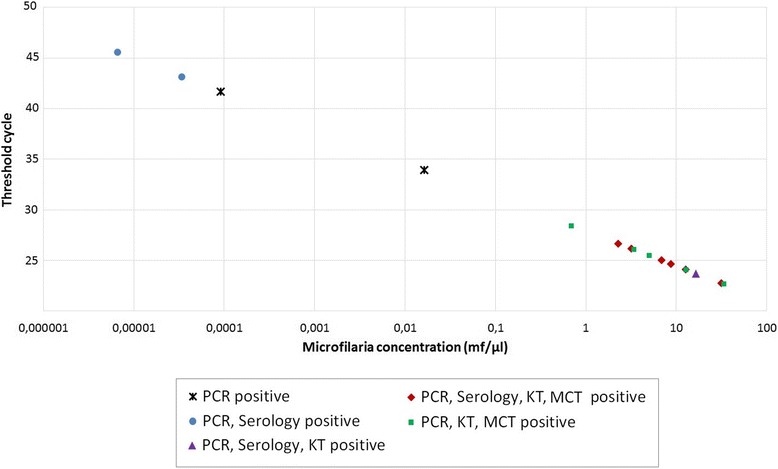
Fifteen percent of the dogs were positive to Dirofilaria immitis by at least one of the methods. The HRM-qPCR produced distinctive melting plots for the different filarial worms and revealed that 11.6% of dogs were infected with Acanthocheilonema reconditum. The latter assay had a limit of detection of 2.4x10⁻⁴ mf/μl and detected infections with lower microfilarial concentrations in comparison to the microscopic techniques and the serological assay. The MCT and Knott's test only detected dogs with D. immitis microfilaremias above 0.7 mf/μl. Nevertheless, there was a strong correlation between the microfilarial concentration obtained by the Knott's modified test and the HRM-qPCR (r = 0.906, p < 0.0001). Interestingly, one dog was found infected with Cercopithifilaria bainae infection. Moreover, no association was found between microfilaremia and co-infection and there was no significant difference in microfilarial concentration between dogs infected only with D. immitis and dogs co-infected with Ehrlichia canis, Anaplasma platys or Babesia vogeli.
This is the first report of A. reconditum and C. bainae in Costa Rica and Central America. Among the evaluated diagnostic techniques, the HRM-qPCR showed the most sensitive and reliable performance in the detection of blood filaroids in comparison to the Knott's modified test, the MCT test and a serological assay.
犬丝状虫是由节肢动物传播给犬类的重要线虫。犬丝虫病的诊断通过显微镜下识别微丝蚴、血清学检测或针对丝虫DNA的聚合酶链反应(PCR)来完成。本研究的目的是评估一种用于检测犬血液中犬丝状虫的分子检测方法,将其性能与其他诊断技术进行比较,并确定微丝蚴浓度与其他媒介传播病原体感染之间的关系。
对来自哥斯达黎加的146只犬的血液样本采用四种不同方法检测犬丝状虫:微量血细胞比容管试验(MCT)、改良诺氏试验、血清学检测以及高分辨率熔解曲线和定量实时PCR(HRM-qPCR)。还评估了与其他媒介传播病原体的共感染情况。
至少有一种方法检测到15%的犬感染了犬恶丝虫。HRM-qPCR为不同的丝虫产生了独特的熔解曲线,并显示11.6%的犬感染了隐匿棘唇线虫。与显微镜技术和血清学检测相比,后一种检测方法的检测限为2.4×10⁻⁴微丝蚴/微升,且能检测到微丝蚴浓度较低的感染。MCT和诺氏试验仅检测到犬恶丝虫微丝蚴血症高于0.7微丝蚴/微升的犬。然而,改良诺氏试验得到的微丝蚴浓度与HRM-qPCR之间存在很强的相关性(r = 0.906,p < 0.0001)。有趣的是,发现一只犬感染了拜氏猴丝状虫。此外,未发现微丝蚴血症与共感染之间存在关联,仅感染犬恶丝虫的犬与同时感染犬埃立希体、血小板无形体或伏格利巴贝斯虫的犬在微丝蚴浓度上没有显著差异。
这是在哥斯达黎加和中美洲首次报告隐匿棘唇线虫和拜氏猴丝状虫。在所评估的诊断技术中,与改良诺氏试验、MCT试验和血清学检测相比,HRM-qPCR在检测血液丝状虫方面表现出最灵敏和可靠的性能。