Jin Chunyan, Liu Ben, Lei Zhongxiang, Sun Jiaming
Key Laboratory of Weak Light Nonlinear Photonics, Ministry of Education, School of Physics, Nankai University, Weijin Road 94, Tianjin, 300071 China.
Air Force Aviation University, Nanhu Road No. 2222, Changchun, 130022 China.
Nanoscale Res Lett. 2015 Feb 28;10:95. doi: 10.1186/s11671-015-0790-x. eCollection 2015.
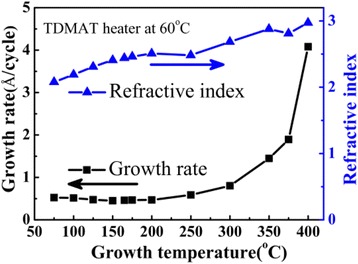
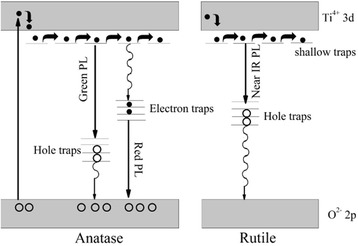
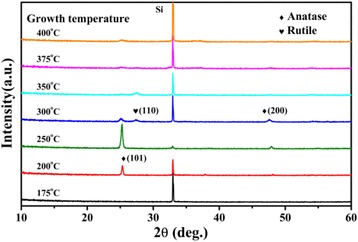
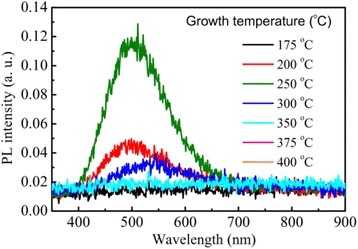
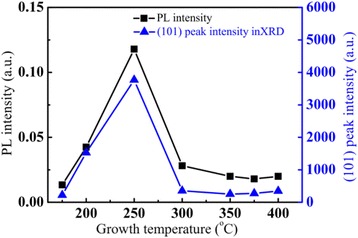
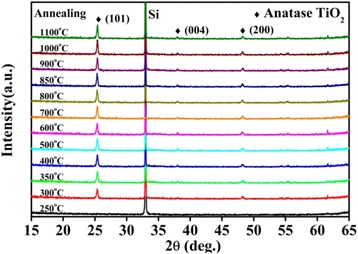
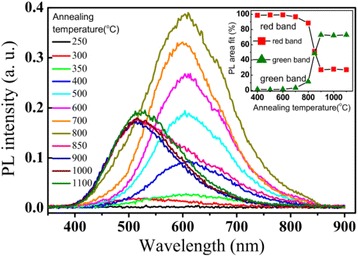
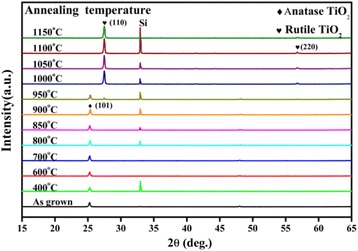
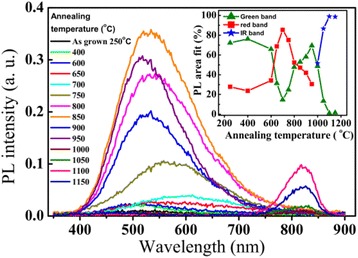
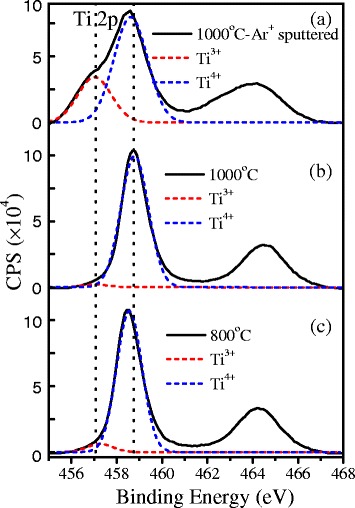
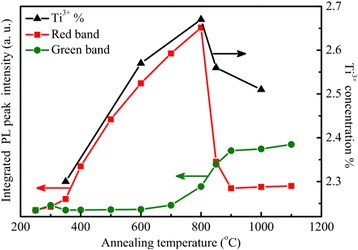
TiO2 films were grown on silicon substrates by atomic layer deposition (ALD) using tetrakis-dimethylamino titanium and ozone. Amorphous TiO2 film was deposited at a low substrate temperature of 165°C, and anatase TiO2 film was grown at 250°C. The amorphous TiO2 film crystallizes to anatase TiO2 phase with annealing temperature ranged from 300°C to 1,100°C in N2 atmosphere, while the anatase TiO2 film transforms into rutile phase at a temperature of 1,000°C. Photoluminescence from anatase TiO2 films contains a red band at 600 nm and a green band at around 515 nm. The red band exhibits a strong correlation with defects of the under-coordinated Ti(3+) ions, and the green band shows a close relationship with the oxygen vacancies on (101) oriented anatase crystal surface. A blue shift of the photoluminescence spectra reveals that the defects of under-coordinated Ti(3+) ions transform to surface oxygen vacancies in the anatase TiO2 film annealing at temperature from 800°C to 900°C in N2 atmosphere.
使用四(二甲基氨基)钛和臭氧通过原子层沉积(ALD)在硅衬底上生长TiO₂薄膜。在165°C的低衬底温度下沉积非晶TiO₂薄膜,并在250°C下生长锐钛矿TiO₂薄膜。非晶TiO₂薄膜在N₂气氛中于300°C至1100°C的退火温度下结晶为锐钛矿TiO₂相,而锐钛矿TiO₂薄膜在1000°C的温度下转变为金红石相。锐钛矿TiO₂薄膜的光致发光包含600nm处的红色带和515nm左右的绿色带。红色带与配位不足的Ti(3+)离子的缺陷有很强的相关性,绿色带与(101)取向的锐钛矿晶体表面上的氧空位密切相关。光致发光光谱的蓝移表明,在N₂气氛中于800°C至900°C退火的锐钛矿TiO₂薄膜中,配位不足的Ti(3+)离子的缺陷转变为表面氧空位。