Delvendahl Igor, Straub Isabelle, Hallermann Stefan
Medical Faculty, Carl-Ludwig Institute for Physiology, University of Leipzig Leipzig, Germany.
Front Cell Neurosci. 2015 Mar 19;9:93. doi: 10.3389/fncel.2015.00093. eCollection 2015.
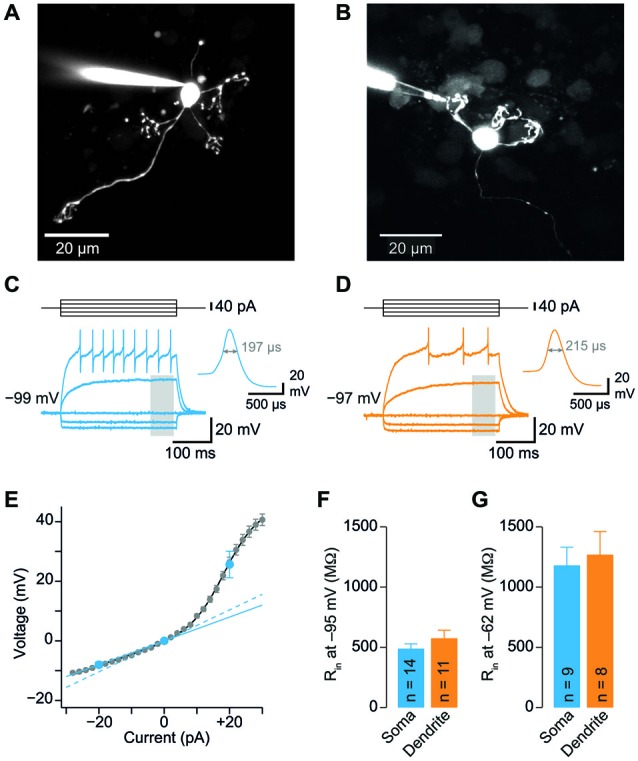
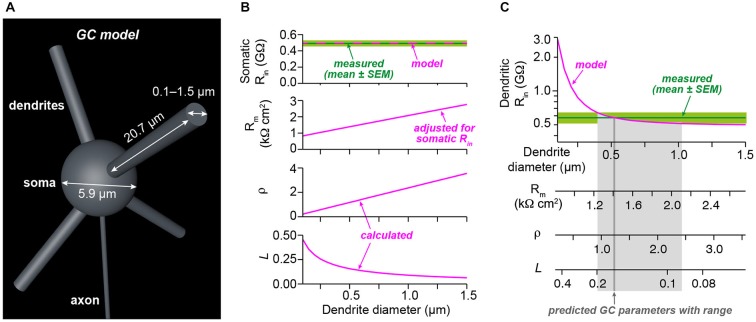
Cerebellar granule cells (GCs), the smallest neurons in the brain, have on average four short dendrites that receive high-frequency mossy fiber inputs conveying sensory information. The short length of the dendrites suggests that GCs are electrotonically compact allowing unfiltered integration of dendritic inputs. The small average diameter of the dendrites (~0.7 µm), however, argues for dendritic filtering. Previous studies based on somatic recordings and modeling indicated that GCs are electrotonically extremely compact. Here, we performed patch-clamp recordings from GC dendrites in acute brain slices of mice to directly analyze the electrotonic properties of GCs. Strikingly, the input resistance did not differ significantly between dendrites and somata of GCs. Furthermore, spontaneous excitatory postsynaptic potentials (EPSP) were similar in amplitude at dendritic and somatic recording sites. From the dendritic and somatic input resistances we determined parameters characterizing the electrotonic compactness of GCs. These data directly demonstrate that cerebellar GCs are electrotonically compact and thus ideally suited for efficient high-frequency information transfer.
小脑颗粒细胞(GCs)是大脑中最小的神经元,平均有四条短树突,接收传递感觉信息的高频苔藓纤维输入。树突的短长度表明GCs在电紧张方面较为致密,允许树突输入进行无滤波整合。然而,树突的平均直径较小(约0.7微米),这表明存在树突滤波。先前基于体细胞记录和建模的研究表明,GCs在电紧张方面极其致密。在这里,我们在小鼠急性脑切片中对GC树突进行膜片钳记录,以直接分析GCs的电紧张特性。令人惊讶的是,GCs树突和胞体之间的输入电阻没有显著差异。此外,在树突和体细胞记录部位,自发兴奋性突触后电位(EPSP)的幅度相似。根据树突和体细胞的输入电阻,我们确定了表征GCs电紧张致密性的参数。这些数据直接表明,小脑GCs在电紧张方面是致密的,因此非常适合高效的高频信息传递。