Rizos Emmanouil, Siafakas Nikolaos, Katsantoni Eleni, Skourti Eleni, Salpeas Vassilios, Rizos Ioannis, Tsoporis James N, Kastania Anastasia, Filippopoulou Anastasia, Xiros Nikolaos, Margaritis Demetrios, Parker Thomas G, Papageorgiou Charalabos, Zoumpourlis Vassilios
National and Kapodistrian University of Athens, Medical School, 2nd Department of Psychiatry, University "ATTIKON" General Hospital, Athens, Greece.
National and Kapodistrian University of Athens, Medical School, Microbiology Laboratory, University "ATTIKON" General Hospital, Athens, Greece.
PLoS One. 2015 Apr 9;10(4):e0123522. doi: 10.1371/journal.pone.0123522. eCollection 2015.
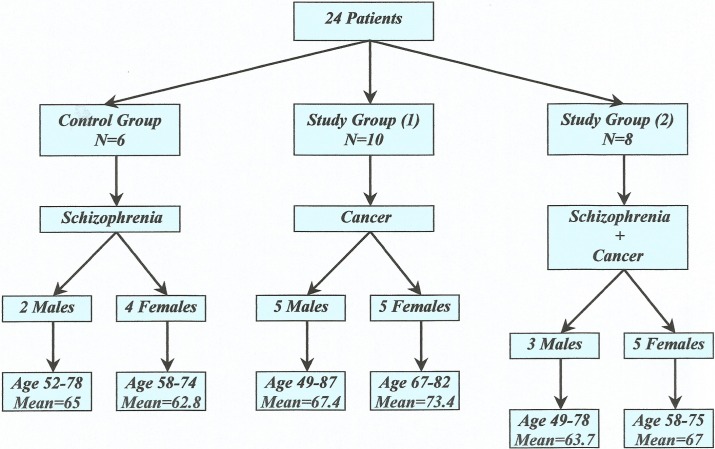
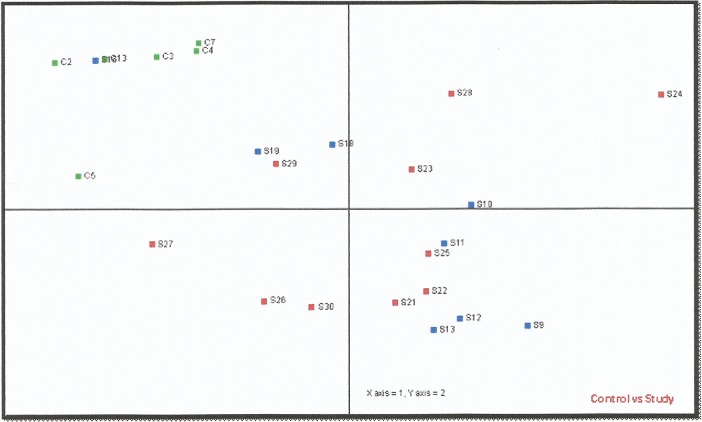
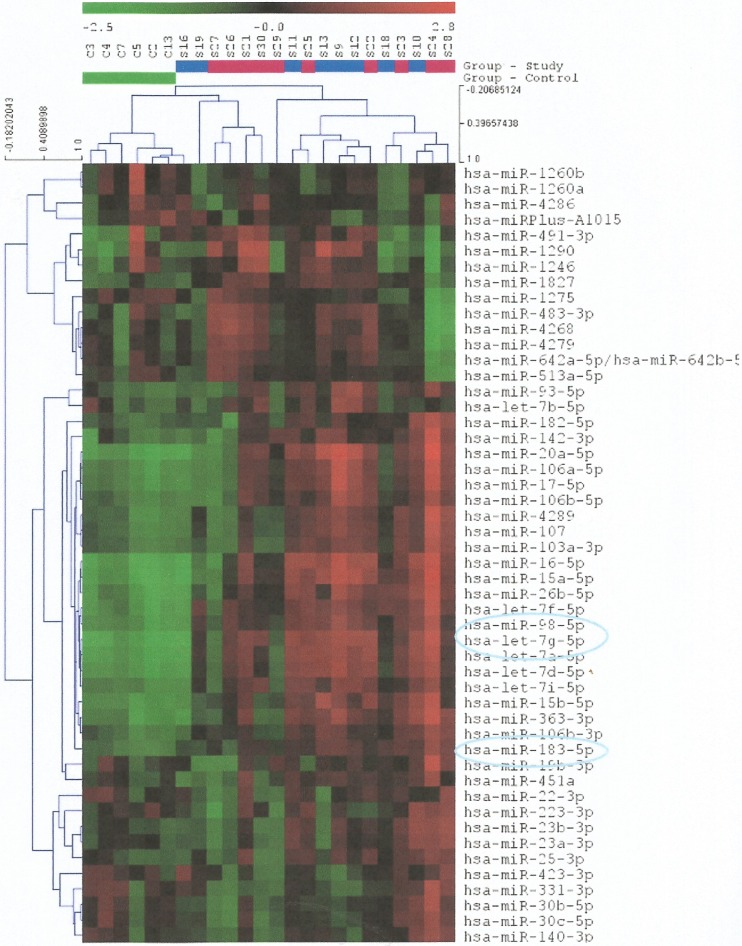
Recent evidence supports a role of microRNAs in cancer and psychiatric disorders such as schizophrenia and bipolar disorder, through their regulatory role on the expression of multiple genes. The rather rare co-morbidity of cancer and schizophrenia is an old hypothesis which needs further research on microRNAs as molecules that might exert their oncosuppressive or oncogenic activity in the context of their role in psychiatric disorders. The expression pattern of a variety of different microRNAs was investigated in patients (N = 6) suffering from schizophrenia termed control, patients with a solid tumor (N = 10) and patients with both schizophrenia and tumor (N = 8). miRNA profiling was performed on whole blood samples using the miRCURY LNA microRNA Array technology (6th & 7th generation). A subset of 3 microRNAs showed a statistically significant differential expression between the control and the study groups. Specifically, significant down-regulation of the let-7p-5p, miR-98-5p and of miR-183-5p in the study groups (tumor alone and tumorand schizophrenia) was observed (p<0.05). The results of the present study showed that let-7, miR-98 and miR-183 may play an important oncosuppressive role through their regulatory impact in gene expression irrespective of the presence of schizophrenia, although a larger sample size is required to validate these results. Nevertheless, further studies are warranted in order to highlight a possible role of these and other micro-RNAs in the molecular pathways of schizophrenia.
最近的证据支持微小RNA在癌症以及精神疾病(如精神分裂症和双相情感障碍)中发挥作用,这是通过它们对多个基因表达的调控作用实现的。癌症与精神分裂症相当罕见的共病现象是一个古老的假说,需要进一步研究微小RNA,因为它们可能在精神疾病背景下发挥抑癌或致癌活性。研究了6名精神分裂症患者(称为对照组)、10名实体瘤患者以及8名同时患有精神分裂症和肿瘤的患者中多种不同微小RNA的表达模式。使用miRCURY LNA微小RNA阵列技术(第6代和第7代)对全血样本进行微小RNA谱分析。3种微小RNA的一个子集在对照组和研究组之间显示出具有统计学意义的差异表达。具体而言,在研究组(仅肿瘤组以及肿瘤合并精神分裂症组)中观察到let-7p-5p、miR-98-5p和miR-183-5p有显著下调(p<0.05)。本研究结果表明,无论是否存在精神分裂症,let-7、miR-98和miR-183可能通过其对基因表达的调控作用发挥重要的抑癌作用,尽管需要更大的样本量来验证这些结果。然而,仍有必要进行进一步研究,以突出这些及其他微小RNA在精神分裂症分子途径中可能发挥的作用。