Baires-Campos Felipe-Eduardo, Jimbo Ryo, Bonfante Estevam-Augusto, Fonseca-Oliveira Maiolino-Thomaz, Moura Camila, Zanetta-Barbosa Darceny, Coelho Paulo-Guilherme
Department of Prosthodontics, Alameda Octávio Pinheiro Brisola, 9-75, Bauru, SP, Brasil, 17012-901,
Med Oral Patol Oral Cir Bucal. 2015 Jul 1;20(4):e471-9. doi: 10.4317/medoral.20557.
This study histologically evaluated two implant designs: a classic thread design versus another specifically designed for healing chamber formation placed with two drilling protocols.
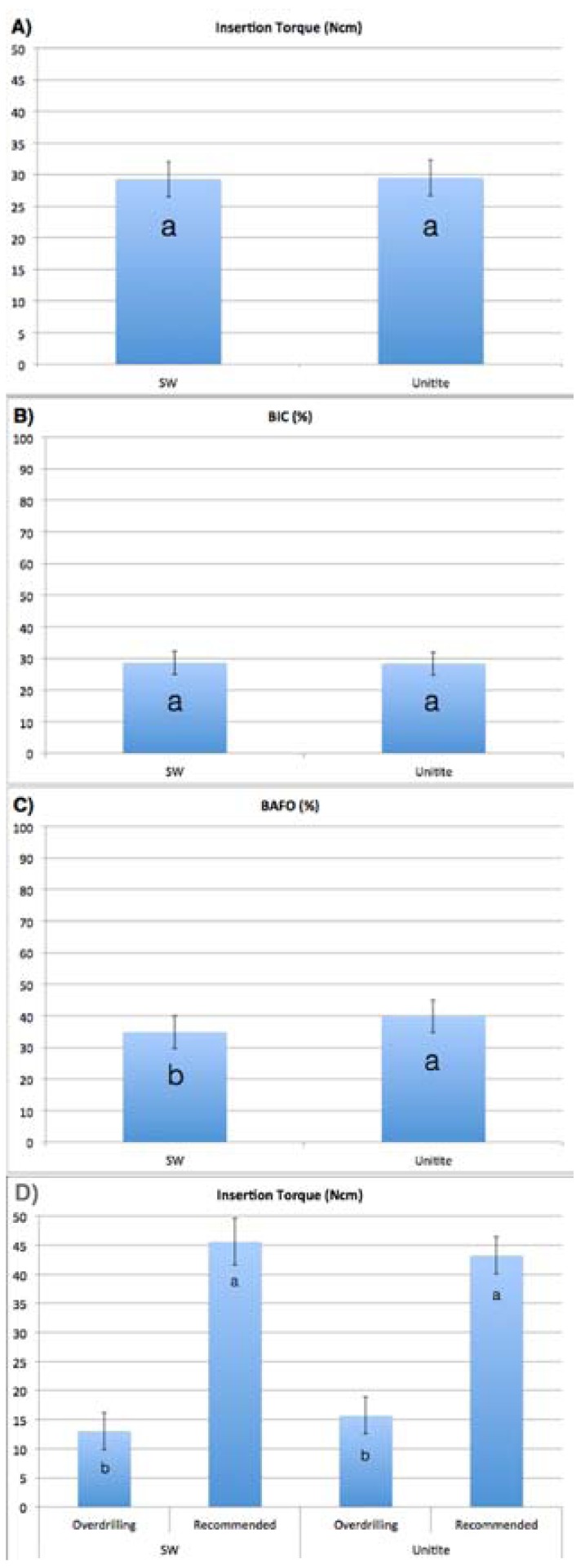
Forty dental implants (4.1 mm diameter) with two different macrogeometries were inserted in the tibia of 10 Beagle dogs, and maximum insertion torque was recorded. Drilling techniques were: until 3.75 mm (regular-group); and until 4.0 mm diameter (overdrilling-group) for both implant designs. At 2 and 4 weeks, samples were retrieved and processed for histomorphometric analysis. For torque and BIC (bone-to-implant contact) and BAFO (bone area fraction occupied), a general-linear model was employed including instrumentation technique and time in vivo as independent.
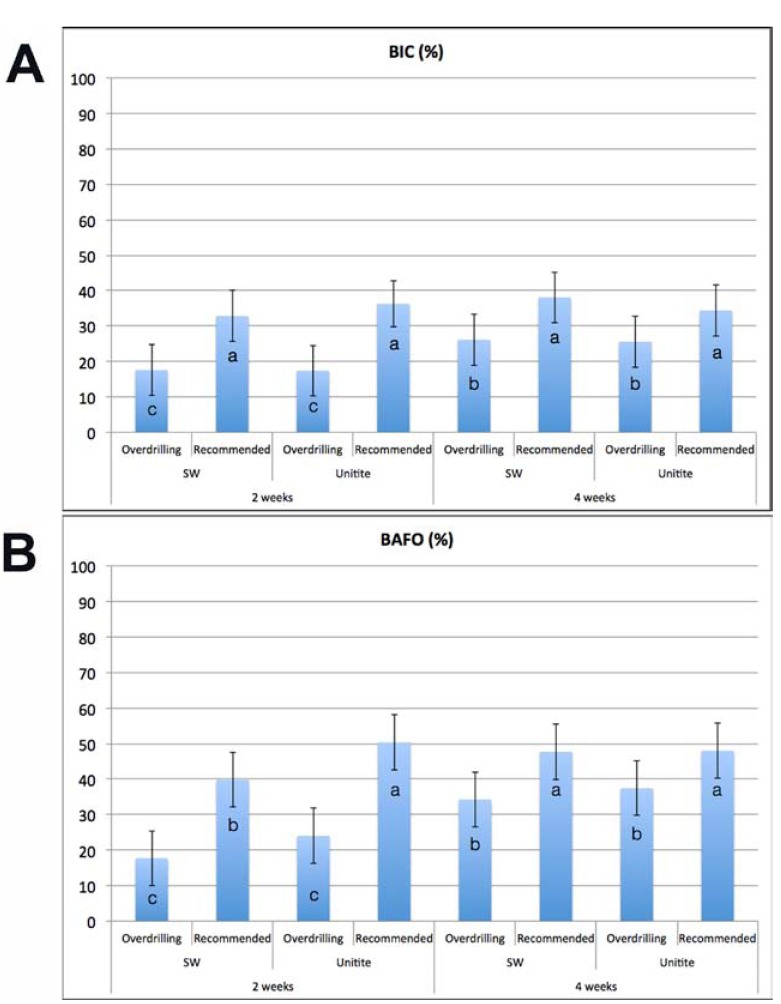
The insertion torque recorded for each implant design and drilling group significantly decreased as a function of increasing drilling diameter for both implant designs (p<0.001). No significant differences were detected between implant designs for each drilling technique (p>0.18). A significant increase in BIC was observed from 2 to 4 weeks for both implants placed with the overdrilling technique (p<0.03) only, but not for those placed in the 3.75 mm drilling sites (p>0.32).
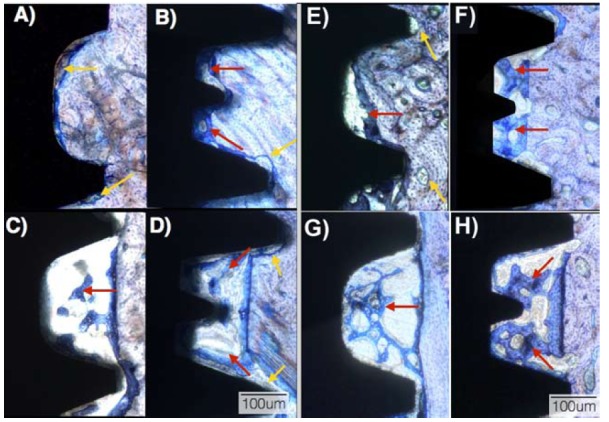
Despite the differences between implant designs and drilling technique an intramembranous-like healing mode with newly formed woven bone prevailed.
本研究通过组织学方法评估了两种种植体设计:经典螺纹设计与另一种专门为愈合腔形成而设计的种植体,采用两种钻孔方案植入。
将40颗具有两种不同宏观几何形状的牙种植体(直径4.1毫米)植入10只比格犬的胫骨中,并记录最大插入扭矩。两种种植体设计的钻孔技术分别为:钻至3.75毫米(常规组);钻至4.0毫米直径(过度钻孔组)。在2周和4周时,取出样本并进行组织形态计量学分析。对于扭矩、骨与种植体接触率(BIC)和骨面积分数占有率(BAFO),采用一般线性模型,将器械技术和体内时间作为自变量。
两种种植体设计的每个种植体设计和钻孔组记录的插入扭矩均随钻孔直径的增加而显著降低(p<0.001)。每种钻孔技术的种植体设计之间未检测到显著差异(p>0.18)。仅对于采用过度钻孔技术植入的两种种植体,从2周到4周观察到BIC显著增加(p<0.03),而对于植入3.75毫米钻孔部位的种植体则未观察到显著增加(p>0.32)。
尽管种植体设计和钻孔技术存在差异,但新形成的编织骨为主的膜内样愈合模式占主导。