Wang Ying Min, Lu Liangxing, Srinivasan Bharathi Madurai, Asbahi Mohamed, Zhang Yong Wei, Yang Joel K W
Institute of Materials and Research Engineering, A*STAR, Singapore 117602, Singapore.
Institute of High Performance Computing, A*STAR, Singapore 138632, Singapore.
Sci Rep. 2015 Apr 10;5:9654. doi: 10.1038/srep09654.
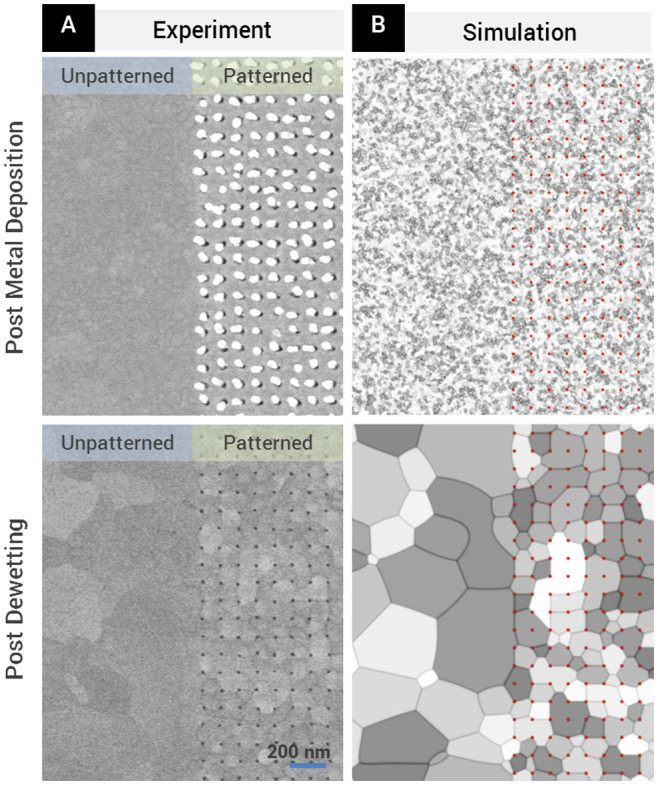
We introduce an approach to fabricate ordered arrays of 10-nm-scale silica-filled apertures in a metal film without etching or liftoff. Using low temperature (<400°C) thermal dewetting of metal films guided by nano-patterned templates, apertures with aspect ratios up to 5:1 are demonstrated. Apertures form spontaneously during the thermal process without need for further processing. Although the phenomenon of dewetting has been well studied, this is the first demonstration of its use in the fabrication of nanoapertures in a spatially controllable manner. In particular, the achievement of 10-nm length-scale patterning at high aspect ratio with thermal dewetting is unprecedented. By varying the nanotemplate design, we show its strong influence over the positions and sizes of the nanoapertures. In addition, we construct a three-dimensional phase field model of metal dewetting on nano-patterned substrates. The simulation data obtained closely corroborates our experimental results and reveals new insights to template dewetting at the nanoscale. Taken together, this fabrication method and simulation model form a complete toolbox for 10-nm-scale patterning using template-guided dewetting that could be extended to a wide range of material systems and geometries.
我们介绍了一种在不进行蚀刻或剥离的情况下,在金属薄膜中制造10纳米尺度的二氧化硅填充孔有序阵列的方法。利用由纳米图案模板引导的金属薄膜低温(<400°C)热去湿,展示了纵横比高达5:1的孔。孔在热过程中自发形成,无需进一步加工。尽管去湿现象已得到充分研究,但这是首次证明其可用于以空间可控的方式制造纳米孔。特别是,通过热去湿实现10纳米长度尺度的高纵横比图案化是前所未有的。通过改变纳米模板设计,我们展示了其对纳米孔位置和尺寸的强烈影响。此外,我们构建了纳米图案化衬底上金属去湿的三维相场模型。获得的模拟数据与我们的实验结果密切相符,并揭示了纳米尺度下模板去湿的新见解。综上所述,这种制造方法和模拟模型形成了一个完整的工具箱,用于使用模板引导的去湿进行10纳米尺度的图案化,可扩展到广泛的材料系统和几何形状。