Conti Eugenia, Calderoni Sara, Marchi Viviana, Muratori Filippo, Cioni Giovanni, Guzzetta Andrea
Department of Developmental Neuroscience, Stella Maris Scientific Institute, IRCCS Stella Maris Foundation Pisa, Italy ; Department of Clinical and Experimental Medicine, University of Pisa Pisa, Italy.
Department of Developmental Neuroscience, Stella Maris Scientific Institute, IRCCS Stella Maris Foundation Pisa, Italy.
Front Hum Neurosci. 2015 Mar 26;9:159. doi: 10.3389/fnhum.2015.00159. eCollection 2015.
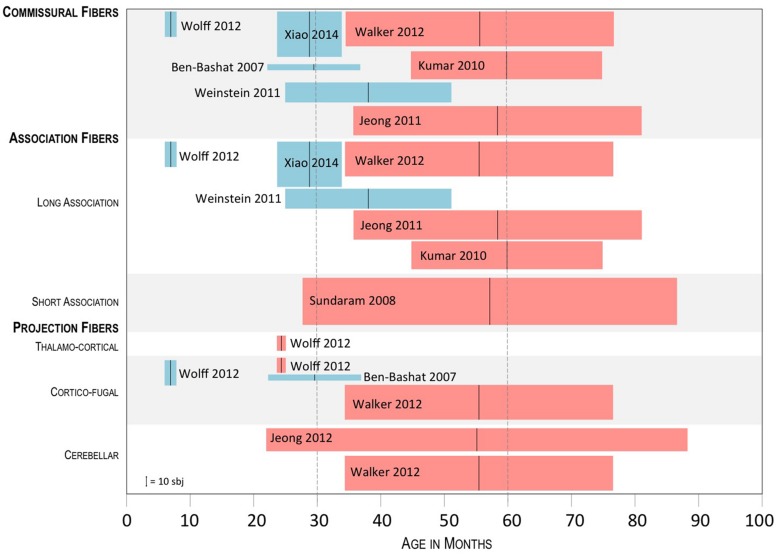
There is overwhelming evidence that autism spectrum disorder (ASD) is related to altered brain connectivity. While these alterations are starting to be well characterized in subjects where the clinical picture is fully expressed, less is known on their earlier developmental course. In the present study we systematically reviewed current knowledge on structural connectivity in ASD infants and toddlers. We searched PubMed and Medline databases for all English language papers, published from year 2000, exploring structural connectivity in populations of infants and toddlers whose mean age was below 30 months. Of the 264 papers extracted, four were found to be eligible and were reviewed. Three of the four selected studies reported higher fractional anisotropy values in subjects with ASD compared to controls within commissural fibers, projections fibers, and association fibers, suggesting brain hyper-connectivity in the earliest phases of the disorder. Similar conclusions emerged from the other diffusion parameters assessed. These findings are reversed to what is generally found in studies exploring older patient groups and suggest a developmental course characterized by a shift toward hypo-connectivity starting at a time between two and four years of age.
有大量证据表明,自闭症谱系障碍(ASD)与大脑连接性改变有关。虽然这些改变在临床表现充分显现的受试者中已开始得到很好的描述,但对于它们在早期发育过程中的情况却知之甚少。在本研究中,我们系统地回顾了当前关于ASD婴幼儿结构连接性的知识。我们在PubMed和Medline数据库中搜索了自2000年以来发表的所有英文论文,这些论文探讨了平均年龄低于30个月的婴幼儿群体的结构连接性。在提取的264篇论文中,发现有4篇符合条件并进行了综述。四项选定研究中的三项报告称,与对照组相比,ASD受试者在连合纤维、投射纤维和联合纤维中的分数各向异性值更高,这表明在该疾病的最早阶段大脑存在过度连接。从评估的其他扩散参数中也得出了类似的结论。这些发现与探索年龄较大患者群体的研究中通常发现的情况相反,表明其发育过程的特点是在两岁至四岁之间的某个时间开始向连接不足转变。