Petrova Mariya I, Lievens Elke, Malik Shweta, Imholz Nicole, Lebeer Sarah
Department of Bioscience Engineering, University of Antwerp Antwerp, Belgium ; Centre of Microbial and Plant Genetics, KU Leuven Leuven, Belgium.
Front Physiol. 2015 Mar 25;6:81. doi: 10.3389/fphys.2015.00081. eCollection 2015.
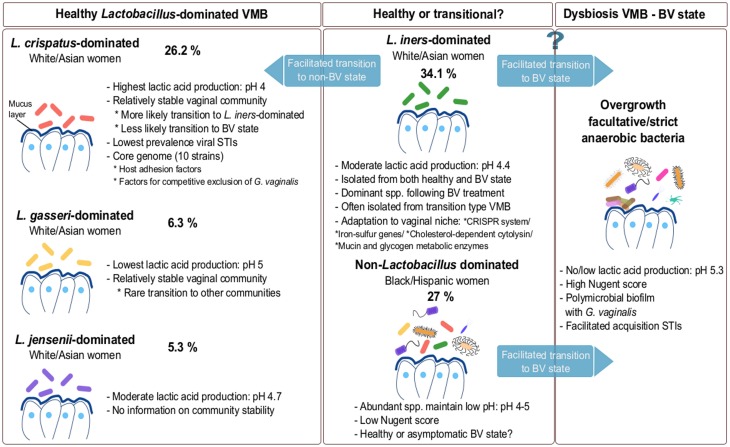
The human body is colonized by a vast number of microorganisms collectively referred to as the human microbiota. One of the main microbiota body sites is the female genital tract, commonly dominated by Lactobacillus spp., in approximately 70% of women. Each individual species can constitute approximately 99% of the ribotypes observed in any individual woman. The most frequently isolated species are Lactobacillus crispatus, Lactobacillus gasseri, Lactobacillus jensenii and Lactobacillus iners. Residing at the port of entry of bacterial and viral pathogens, the vaginal Lactobacillus species can create a barrier against pathogen invasion since mainly products of their metabolism secreted in the cervicovaginal fluid can play an important role in the inhibition of bacterial and viral infections. Therefore, a Lactobacillus-dominated microbiota appears to be a good biomarker for a healthy vaginal ecosystem. This balance can be rapidly altered during processes such as menstruation, sexual activity, pregnancy and various infections. An abnormal vaginal microbiota is characterized by an increased diversity of microbial species, leading to a condition known as bacterial vaginosis. Information on the vaginal microbiota can be gathered from the analysis of cervicovaginal fluid, by using the Nugent scoring or the Amsel's criteria, or at the molecular level by investigating the number and type of Lactobacillus species. However, when translating this to the clinical setting, it should be noted that the absence of a Lactobacillus-dominated microbiota does not appear to directly imply a diseased condition or dysbiosis. Nevertheless, the widely documented beneficial role of vaginal Lactobacillus species demonstrates the potential of data on the composition and activity of lactobacilli as biomarkers for vaginal health. The substantiation and further validation of such biomarkers will allow the design of better targeted probiotic strategies.
人体被大量微生物定殖,这些微生物统称为人类微生物群。女性生殖道是主要的微生物群身体部位之一,在大约70%的女性中通常由乳酸杆菌属主导。在任何个体女性中观察到的核型中,每个单独的物种可构成约99%。最常分离出的物种是卷曲乳酸杆菌、加氏乳酸杆菌、詹氏乳酸杆菌和惰性乳酸杆菌。阴道乳酸杆菌物种存在于细菌和病毒病原体的进入口,由于它们分泌到宫颈阴道液中的主要代谢产物可在抑制细菌和病毒感染中发挥重要作用,因此可以形成一道抵御病原体入侵的屏障。因此,以乳酸杆菌为主导的微生物群似乎是健康阴道生态系统的良好生物标志物。在月经、性活动、怀孕和各种感染等过程中,这种平衡可能会迅速改变。异常的阴道微生物群的特征是微生物种类多样性增加,导致一种称为细菌性阴道病的状况。可以通过使用 Nugent 评分或 Amsel 标准分析宫颈阴道液,或在分子水平上通过研究乳酸杆菌物种的数量和类型来收集有关阴道微生物群的信息。然而,当将其转化为临床情况时,应注意以乳酸杆菌为主导的微生物群的缺失似乎并不直接意味着患病状态或生态失调。尽管如此,阴道乳酸杆菌物种广泛记录的有益作用证明了乳酸杆菌组成和活性数据作为阴道健康生物标志物的潜力。此类生物标志物的证实和进一步验证将有助于设计更具针对性的益生菌策略。