Kim Ki Rim, Kim Hyun Jeong, Lee Sun Kyoung, Ma Gwang Taek, Park Kwang Kyun, Chung Won Yoon
Department of Dental Hygiene, Kyungpook National University, Sangju, 742-711, Korea; Department of Oral Biology, Oral Cancer Research Institute, BK21 PLUS project, Yonsei University College of Dentistry, Seoul, 120-752, Korea.
Department of Oral Biology, Oral Cancer Research Institute, BK21 PLUS project, Yonsei University College of Dentistry, Seoul, 120-752, Korea; Department of Applied Life Science, The Graduate School, Yonsei University, Seoul, 120-749, Korea.
PLoS One. 2015 Apr 10;10(4):e0122764. doi: 10.1371/journal.pone.0122764. eCollection 2015.
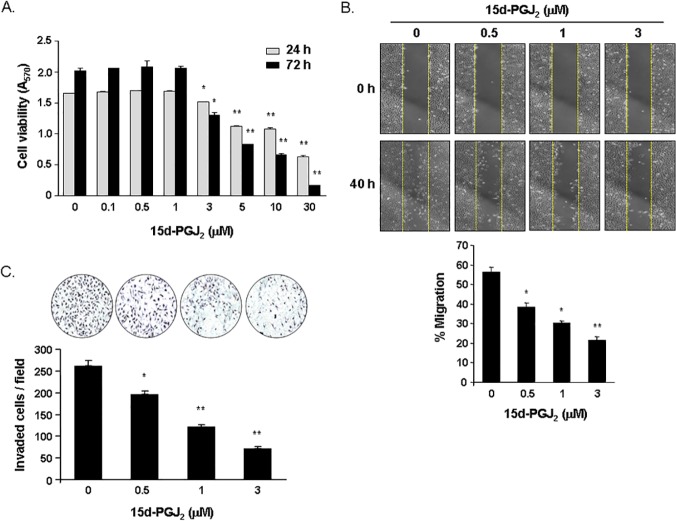
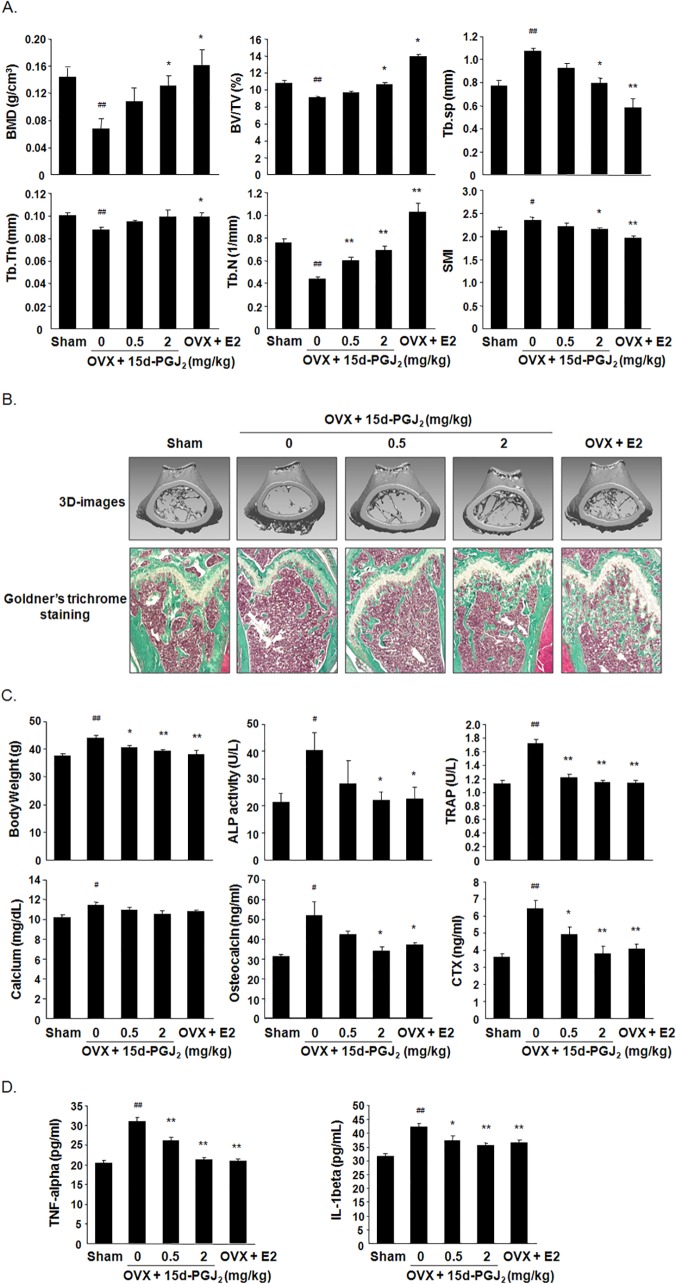
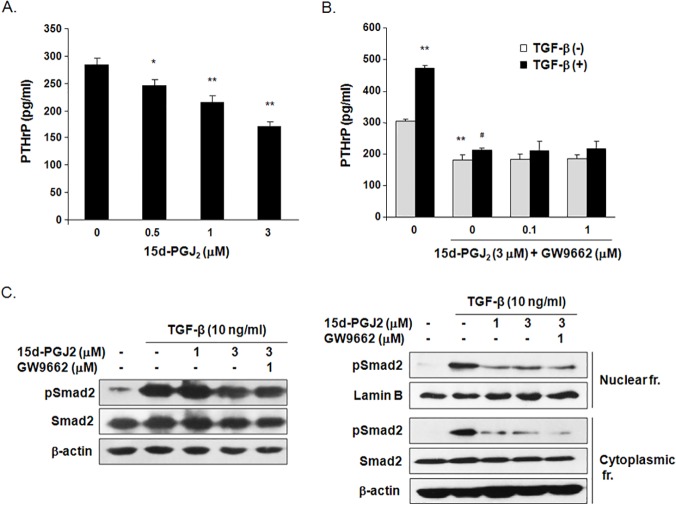
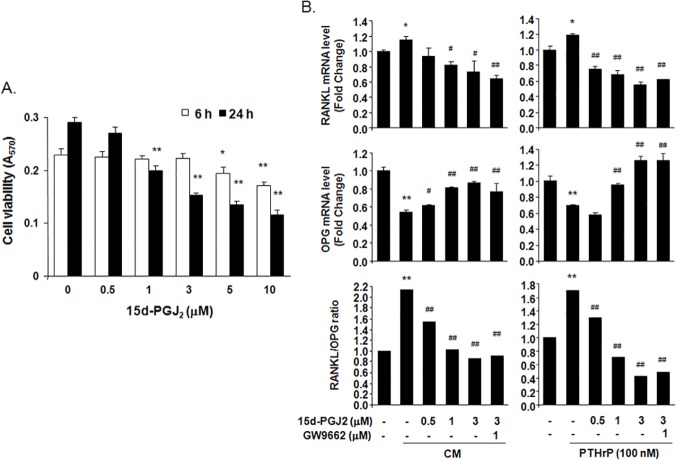
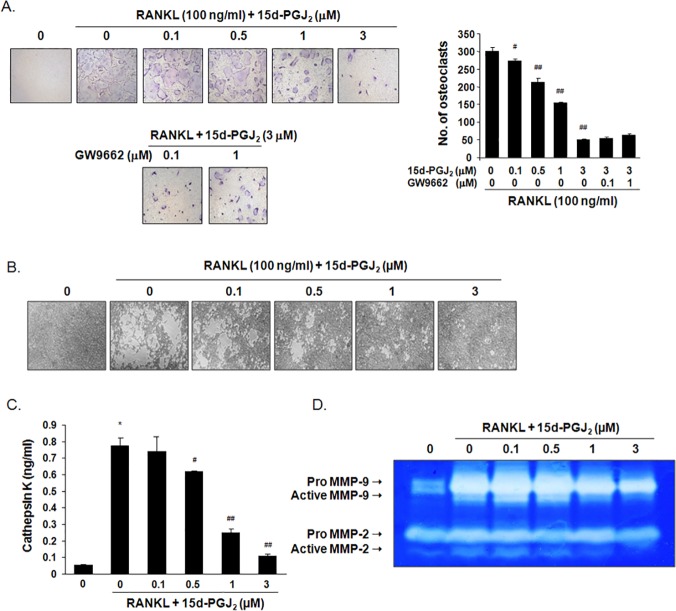
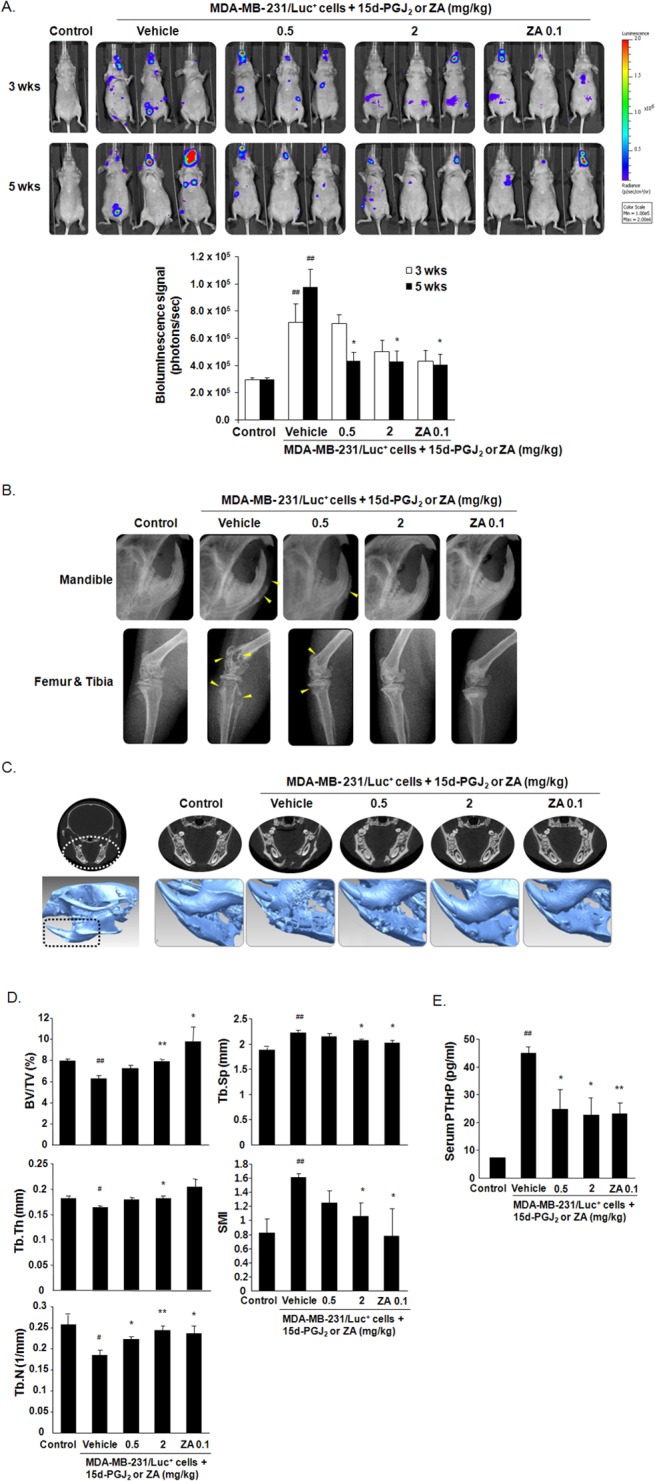
Breast cancer is the major cause of cancer death in women worldwide. The most common site of metastasis is bone. Bone metastases obstruct the normal bone remodeling process and aberrantly enhance osteoclast-mediated bone resorption, which results in osteolytic lesions. 15-deoxy-Δ12,14-prostaglandin J2 (15d-PGJ2) is an endogenous ligand of peroxisome proliferator-activated receptor gamma (PPARγ) that has anti-inflammatory and antitumor activity at micromolar concentrations through PPARγ-dependent and/or PPARγ-independent pathways. We investigated the inhibitory activity of 15d-PGJ2 on the bone loss that is associated with breast cancer bone metastasis and estrogen deficiency caused by cancer treatment. 15d-PGJ2 dose-dependently inhibited viability, migration, invasion, and parathyroid hormone-related protein (PTHrP) production in MDA-MB-231 breast cancer cells. 15d-PGJ2 suppressed receptor activator of nuclear factor kappa-B ligand (RANKL) mRNA levels and normalized osteoprotegerin (OPG) mRNA levels in hFOB1.19 osteoblastic cells treated with culture medium from MDA-MB-231 cells or PTHrP, which decreased the RANKL/OPG ratio. 15d-PGJ2 blocked RANKL-induced osteoclastogenesis and inhibited the formation of resorption pits by decreasing the activities of cathepsin K and matrix metalloproteinases, which are secreted by mature osteoclasts. 15d-PGJ2 exerted its effects on breast cancer and bone cells via PPARγ-independent pathways. In Balb/c nu/nu mice that received an intracardiac injection of MDA-MB-231 cells, subcutaneously injected 15d-PGJ2 substantially decreased metastatic progression, cancer cell-mediated bone destruction in femora, tibiae, and mandibles, and serum PTHrP levels. 15d-PGJ2 prevented the destruction of femoral trabecular structures in estrogen-deprived ICR mice as measured by bone morphometric parameters and serum biochemical data. Therefore, 15d-PGJ2 may be beneficial for the prevention and treatment of breast cancer-associated bone diseases.
乳腺癌是全球女性癌症死亡的主要原因。最常见的转移部位是骨骼。骨转移会阻碍正常的骨重塑过程,并异常增强破骨细胞介导的骨吸收,从而导致溶骨性病变。15-脱氧-Δ12,14-前列腺素J2(15d-PGJ2)是过氧化物酶体增殖物激活受体γ(PPARγ)的内源性配体,它通过PPARγ依赖性和/或PPARγ非依赖性途径在微摩尔浓度下具有抗炎和抗肿瘤活性。我们研究了15d-PGJ2对与乳腺癌骨转移和癌症治疗引起的雌激素缺乏相关的骨质流失的抑制活性。15d-PGJ2剂量依赖性地抑制MDA-MB-231乳腺癌细胞的活力、迁移、侵袭和甲状旁腺激素相关蛋白(PTHrP)的产生。15d-PGJ2抑制用MDA-MB-231细胞或PTHrP培养基处理的hFOB1.19成骨细胞中核因子κB受体激活剂配体(RANKL)的mRNA水平,并使骨保护素(OPG)的mRNA水平正常化,这降低了RANKL/OPG比值。15d-PGJ2通过降低成熟破骨细胞分泌的组织蛋白酶K和基质金属蛋白酶的活性,阻断RANKL诱导的破骨细胞生成并抑制吸收陷窝的形成。15d-PGJ2通过PPARγ非依赖性途径对乳腺癌和骨细胞发挥作用。在接受心内注射MDA-MB-231细胞的Balb/c nu/nu小鼠中,皮下注射15d-PGJ2可显著降低转移进程、癌细胞介导的股骨、胫骨和下颌骨的骨破坏以及血清PTHrP水平。通过骨形态计量学参数和血清生化数据测量,15d-PGJ2预防了雌激素缺乏的ICR小鼠股骨小梁结构的破坏。因此,15d-PGJ2可能对预防和治疗乳腺癌相关骨疾病有益。