D'Amour James, Magagna-Poveda Alejandra, Moretto Jillian, Friedman Daniel, LaFrancois John J, Pearce Patrice, Fenton Andre A, MacLusky Neil J, Scharfman Helen E
The Nathan Kline Institute for Psychiatric Research, 140 Old Orangeburg Rd., Bldg. 35, Orangeburg, NY 10962, USA; Cantonal Hospital of Basel, Land Institute of Pathology, Mühlemattstrasse 11, CH-4410 Liestal, Switzerland; Sackler Program in Biomedical Sciences, New York University Langone Medical Center, 550 First Ave., New York, NY 10016, USA.
Cantonal Hospital of Basel, Land Institute of Pathology, Mühlemattstrasse 11, CH-4410 Liestal, Switzerland.
Exp Neurol. 2015 Jul;269:102-19. doi: 10.1016/j.expneurol.2015.04.003. Epub 2015 Apr 10.
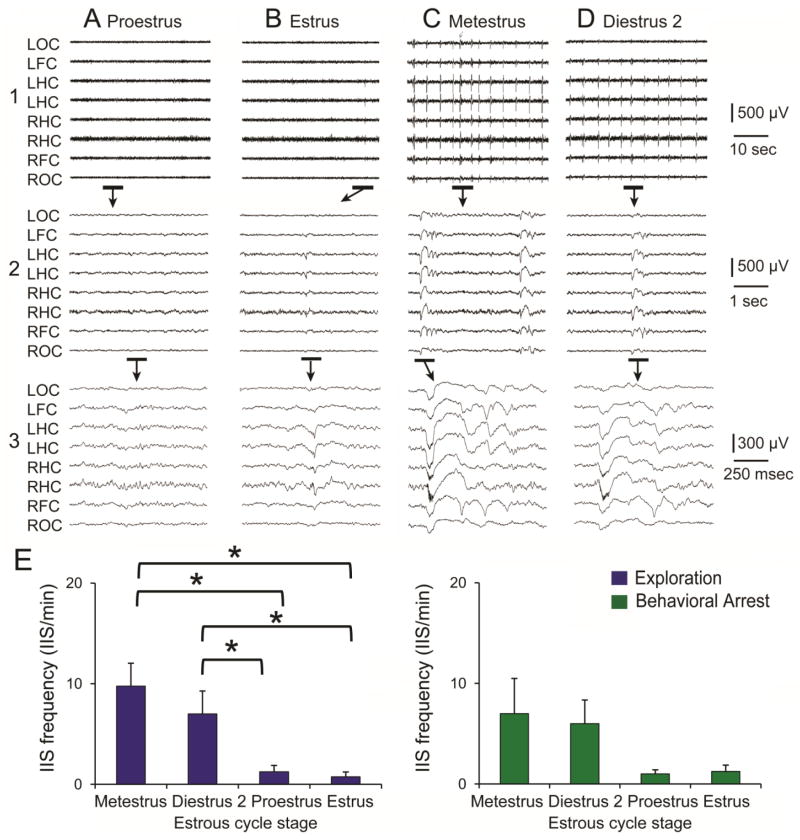
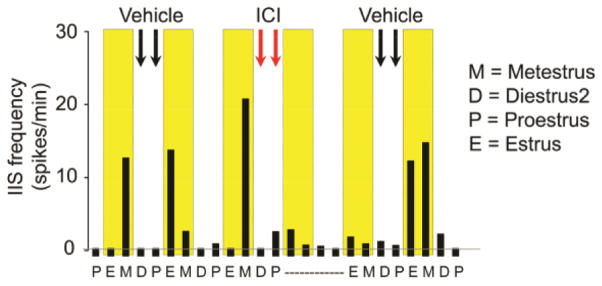
In catamenial epilepsy, seizures exhibit a cyclic pattern that parallels the menstrual cycle. Many studies suggest that catamenial seizures are caused by fluctuations in gonadal hormones during the menstrual cycle, but this has been difficult to study in rodent models of epilepsy because the ovarian cycle in rodents, called the estrous cycle, is disrupted by severe seizures. Thus, when epilepsy is severe, estrous cycles become irregular or stop. Therefore, we modified kainic acid (KA)- and pilocarpine-induced status epilepticus (SE) models of epilepsy so that seizures were rare for the first months after SE, and conducted video-EEG during this time. The results showed that interictal spikes (IIS) occurred intermittently. All rats with regular 4-day estrous cycles had IIS that waxed and waned with the estrous cycle. The association between the estrous cycle and IIS was strong: if the estrous cycles became irregular transiently, IIS frequency also became irregular, and when the estrous cycle resumed its 4-day pattern, IIS frequency did also. Furthermore, when rats were ovariectomized, or males were recorded, IIS frequency did not show a 4-day pattern. Systemic administration of an estrogen receptor antagonist stopped the estrous cycle transiently, accompanied by transient irregularity of the IIS pattern. Eventually all animals developed severe, frequent seizures and at that time both the estrous cycle and the IIS became irregular. We conclude that the estrous cycle entrains IIS in the modified KA and pilocarpine SE models of epilepsy. The data suggest that the ovarian cycle influences more aspects of epilepsy than seizure susceptibility.
在经期性癫痫中,癫痫发作呈现出与月经周期平行的周期性模式。许多研究表明,经期性癫痫发作是由月经周期中性腺激素的波动引起的,但在癫痫啮齿动物模型中很难对此进行研究,因为啮齿动物的卵巢周期(称为发情周期)会因严重癫痫发作而受到干扰。因此,当癫痫严重时,发情周期会变得不规则或停止。所以,我们对 kainic 酸(KA)和毛果芸香碱诱导的癫痫持续状态(SE)模型进行了改良,使癫痫发作在 SE 后的头几个月很少见,并在此期间进行视频脑电图监测。结果显示,发作间期棘波(IIS)间歇性出现。所有发情周期为 4 天规律周期的大鼠,其 IIS 都随发情周期而增减。发情周期与 IIS 之间的关联很强:如果发情周期暂时变得不规则,IIS 频率也会变得不规则,而当发情周期恢复为 4 天模式时,IIS 频率也会恢复。此外,当大鼠进行卵巢切除时,或者记录雄性大鼠时,IIS 频率没有呈现出 4 天的模式。全身给予雌激素受体拮抗剂会使发情周期暂时停止,同时伴有 IIS 模式的暂时不规则。最终,所有动物都发展为严重、频繁的癫痫发作,此时发情周期和 IIS 都变得不规则。我们得出结论,在改良的 KA 和毛果芸香碱 SE 癫痫模型中,发情周期带动 IIS。数据表明,卵巢周期对癫痫的影响比癫痫易感性的影响更为广泛。