Henderson Annette M E, Scott Jessica C
Early Learning Laboratory, School of Psychology, The University of Auckland , Auckland, New Zealand.
Front Psychol. 2015 Mar 27;6:332. doi: 10.3389/fpsyg.2015.00332. eCollection 2015.
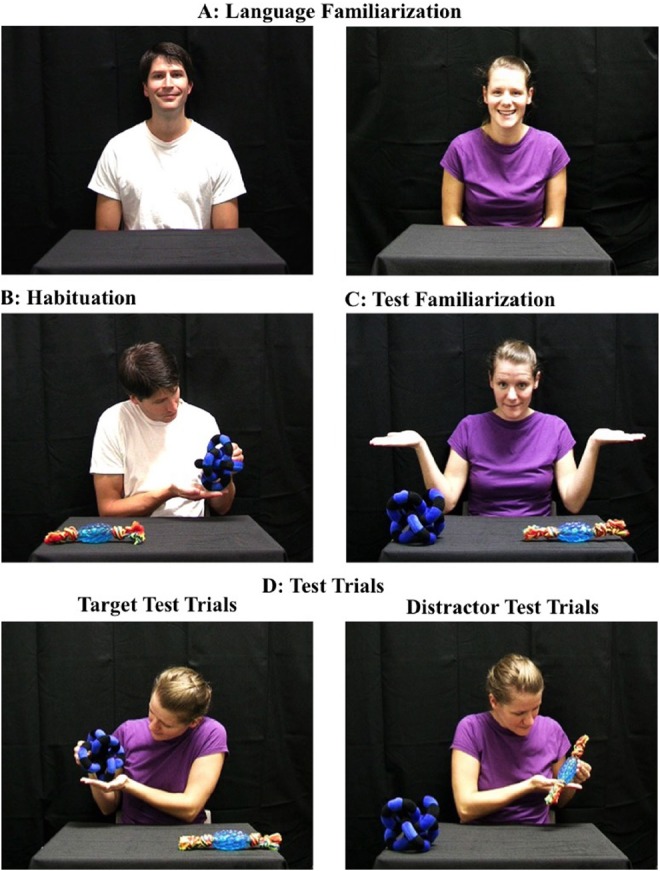
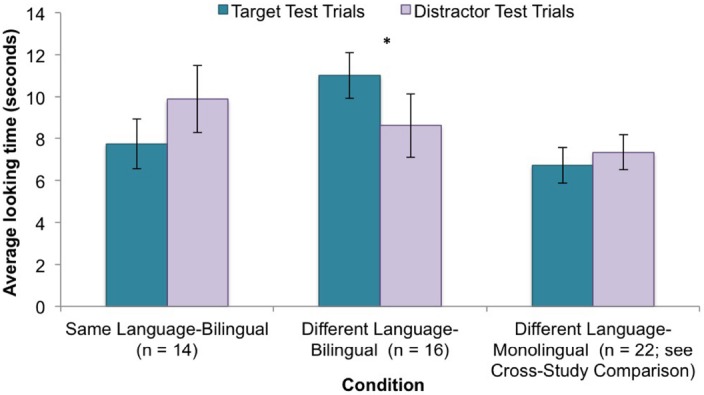
Words are powerful communicative tools because of conventionality-their meanings are shared among same language users. Although evidence demonstrates that an understanding of conventionality is present early in life, this work has focused on infants being raised in English-speaking monolingual environments. As such, little is known about the role that experience in multilingual environments plays in the development of an understanding of conventionality. We addressed this gap with 13-month-old infants regularly exposed to more than one language. Infants were familiarized to two speakers who either spoke the same (English), or different (French vs. English) languages. Next, infants were habituated to a video in which one of the speakers provided a new word and selected one of two unfamiliar objects. Infants were then shown test events in which the other speaker provided the same label and selected either the same object or a different object. Our results demonstrate that exposure to at least one other language influences infants' expectations about conventionality. Unlike monolinguals, bilingual infants do not assume that word meanings are shared across speakers who use the same language. Interestingly, when shown speakers who use different languages, bilingual infants looked longer toward the test trials in which the second speaker labeled the object consistently with the first speaker. This finding suggests that exposure to multiple languages enhances infants' understanding that speakers who use different languages should not use the same word for the same object. This is the first known evidence that experience in multilingual environments influences infants' expectations surrounding the shared nature of word meanings. An increased sensitivity to the constraints of conventionality represents a fairly sophisticated understanding of language as a conventional system and may shape bilingual infants' language development in a number of important ways.
由于语言的约定俗成性,词语是强大的交流工具——它们的含义在同一语言的使用者之间共享。尽管有证据表明,对约定俗成性的理解在生命早期就已存在,但这项研究一直聚焦于在英语单语环境中成长的婴儿。因此,对于多语言环境中的经历在约定俗成性理解发展中所起的作用,我们知之甚少。我们以经常接触不止一种语言的13个月大婴儿为对象,填补了这一空白。婴儿们熟悉了两位说话者,他们要么说同一种语言(英语),要么说不同的语言(法语和英语)。接下来,婴儿们观看一段视频并习惯其中的内容:一位说话者给出一个新单词,并从两个不熟悉的物体中选择一个。然后向婴儿展示测试场景,另一位说话者给出相同的标签,并选择同一个物体或不同的物体。我们的研究结果表明,接触至少一种其他语言会影响婴儿对约定俗成性的预期。与单语婴儿不同,双语婴儿不会假定使用同一语言的说话者共享词义。有趣的是,当向双语婴儿展示使用不同语言的说话者时,他们在第二位说话者与第一位说话者对物体的标注一致的测试试验中注视的时间更长。这一发现表明,接触多种语言能增强婴儿的理解,即使用不同语言的说话者不应该用同一个词来指代同一个物体。这是已知的首个证据,表明多语言环境中的经历会影响婴儿对词义共享性质的预期。对约定俗成性限制的更高敏感度代表了对作为一种约定俗成系统的语言相当复杂的理解,并且可能在许多重要方面塑造双语婴儿的语言发展。