Lakew Yihunie, Biadgilign Sibhatu, Haile Demewoz
Ethiopian Public Health Association, Addis Ababa, Ethiopia.
Independent Public Health Consultant, Addis Ababa, Ethiopia.
BMJ Open. 2015 Apr 14;5(4):e006001. doi: 10.1136/bmjopen-2014-006001.
To identify factors associated with anaemia in lactating mothers in Ethiopia.
A cross-sectional secondary analysis of data pooled from two rounds of the 2005 and 2011 Ethiopian Demographic and Health Survey (EDHS) was used. A multivariate logistic regression model was applied to determine the factors associated with anaemia.
A total of 7332 lactating mothers (2285 from EDHS 2005 and 5047 from EDHS 2011) were included from 11 administrative states of Ethiopia.
Lactating mothers considered anaemic if haemoglobin level <12 g/dL.
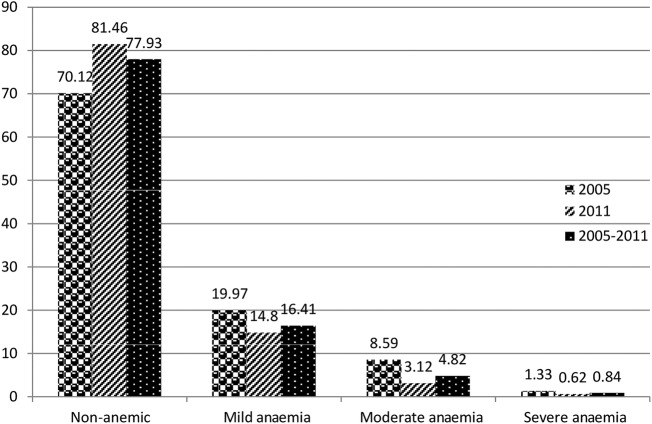
The overall prevalence of anaemia among lactating mothers was 22.1% (95% CI 21.13% to 23.03%). The highest prevalence was 48.7% (95% CI 40.80% to 56.62%) found in the Somali region, followed by 43.8% (95% CI 31.83% to 56.87%) in the Afar region. The multivariate statistical model showed that having a husband who had attended primary education (adjusted OR (AOR) 0.79; 95% CI 0.68 to 0.91), working during the 12 months preceding the survey (AOR 0.71; 95% CI 0.63 to 0.80), having a normal maternal body mass index (18.5-24.99 kg/m(2)) (AOR 0.78; 95% CI 0.68 to 0.89), being in the middle wealth quintile (AOR 0.83; 95% CI 0.71 to 0.98) or rich wealth quintile (AOR 0.83; 95% CI 0.70 to 0.98), having ever used family planning (AOR 0.68; 95% CI 0.57 to 0.80), having attended antenatal care (ANC) for the indexed pregnancy four times or more (AOR 0.73; 95% CI 0.59 to 0.91), having experienced time variation between the two surveys (AOR 0.73; 95% CI 0.64 to 0.85), and breastfeeding for 2 years (AOR 0.76; 95% CI 0.66 to 0.87) were factors associated with lower odds of having anaemia in lactating mothers.
Anaemia is highly prevalent among lactating mothers, particularly in the pastoralist communities of Somali and Afar. Promoting partner education, improving maternal nutritional status, and creating behavioural change to use family planning and ANC services at health facilities are recommended interventions to reduce the prevalence of anaemia among lactating mothers in Ethiopia.
确定埃塞俄比亚哺乳期母亲贫血的相关因素。
采用对2005年和2011年两轮埃塞俄比亚人口与健康调查(EDHS)汇总数据的横断面二次分析。应用多变量逻辑回归模型确定贫血的相关因素。
从埃塞俄比亚11个行政区纳入了总共7332名哺乳期母亲(2005年EDHS的2285名和2011年EDHS的5047名)。
血红蛋白水平<12 g/dL的哺乳期母亲被视为贫血。
哺乳期母亲贫血的总体患病率为22.1%(95%CI 21.13%至23.03%)。索马里地区患病率最高,为48.7%(95%CI 40.80%至56.62%),其次是阿法尔地区,为43.8%(95%CI 31.83%至56.87%)。多变量统计模型显示,丈夫接受过小学教育(调整后的比值比(AOR)0.79;95%CI 0.68至0.91)、在调查前12个月内工作(AOR 0.71;95%CI 0.63至0.80)、产妇体重指数正常(18.5 - 24.99 kg/m²)(AOR 0.78;95%CI 0.68至0.89)、处于中等财富五分位数(AOR 0.83;95%CI 0.71至0.98)或高财富五分位数(AOR 0.83;95%CI 0.70至0.98)、曾使用过计划生育(AOR 0.68;95%CI 0.57至0.80)、本次妊娠接受过4次或更多次产前检查(ANC)(AOR 0.73;95%CI 0.59至0.91)、两次调查期间经历过时间变化(AOR 0.73;95%CI 0.64至0.85)以及母乳喂养2年(AOR 0.76;95%CI 0.66至0.87)是哺乳期母亲贫血几率较低的相关因素。
贫血在哺乳期母亲中高度流行,尤其是在索马里和阿法尔的游牧社区。建议采取促进配偶教育、改善产妇营养状况以及促使人们改变行为以使用计划生育和在医疗机构接受产前检查服务等干预措施,以降低埃塞俄比亚哺乳期母亲的贫血患病率。