Kayina Vincent, Kyobe Samuel, Katabazi Fred A, Kigozi Edgar, Okee Moses, Odongkara Beatrice, Babikako Harriet M, Whalen Christopher C, Joloba Moses L, Musoke Philippa M, Mupere Ezekiel
Department of Paediatrics & Child Health, College of Health Sciences, Makerere University, Kampala, Uganda.
Department of Medical Microbiology, College of Health Sciences, Makerere University, Kampala, Uganda.
PLoS One. 2015 Apr 15;10(4):e0123240. doi: 10.1371/journal.pone.0123240. eCollection 2015.
We determined prevalence of pertussis infection and its associated host and environmental factors to generate information that would guide strategies for disease control.
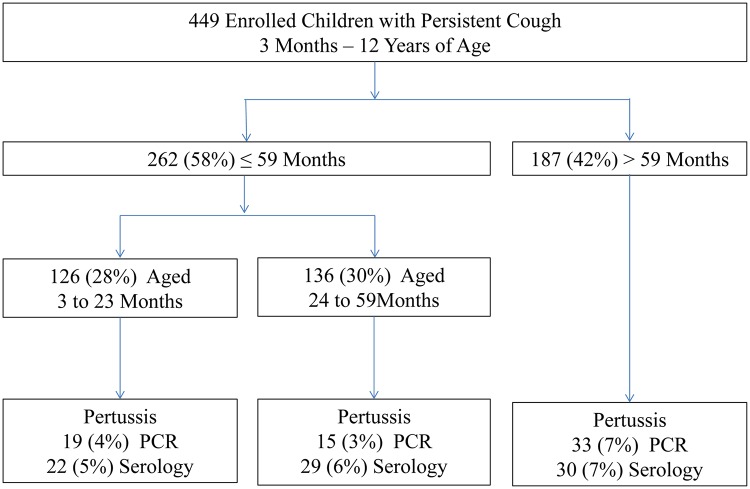
In a cross-sectional study, 449 children aged 3 months to 12 years with persistent cough lasting ≥14 days were enrolled and evaluated for pertussis using DNA polymerase chain reaction (PCR) and ELISA serology tests.
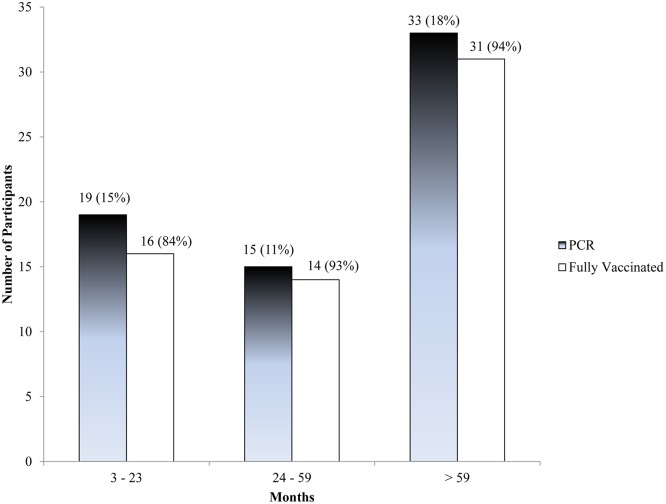
Pertussis prevalence was 67 (15% (95% Confidence Interval (CI): 12-18)) and 81 (20% (95% CI: 16-24)) by PCR and ELISA, respectively among 449 participating children. The prevalence was highest in children with >59 months of age despite high vaccination coverage of 94% in this age group. Study demographic and clinical characteristics were similar between pertussis and non-pertussis cases. Of the 449 children, 133 (30%) had a coughing household member and 316 (70%) did not. Among 133 children that had a coughing household member, sex of child, sharing bed with a coughing household member and having a coughing individual in the neighborhood were factors associated with pertussis. Children that had shared a bed with a coughing household individual had seven-fold likelihood of having pertussis compared to children that did not (odds ratio (OR) 7.16 (95% CI: 1.24-41.44)). Among the 316 children that did not have a coughing household member, age <23 months, having or contact with a coughing individual in neighborhood, a residence with one room, and having a caretaker with >40 years of age were the factors associated with pertussis. Age <23months was three times more likely to be associated with pertussis compared to age 24-59 months (OR 2.97 (95% CI: 1.07-8.28)).
Findings suggest high prevalence of pertussis among children with persistent cough at a health facility and it was marked in children >59 months of age, suggesting the possibility of waning immunity. The factors associated with pertussis varied by presence or absence of a coughing household member.
我们确定了百日咳感染的患病率及其相关的宿主和环境因素,以获取可指导疾病控制策略的信息。
在一项横断面研究中,纳入了449名年龄在3个月至12岁、持续咳嗽≥14天的儿童,并使用DNA聚合酶链反应(PCR)和ELISA血清学检测对其进行百日咳评估。
在449名参与研究的儿童中,通过PCR和ELISA检测得出的百日咳患病率分别为67例(15%(95%置信区间(CI):12 - 18))和81例(20%(95%CI:16 - 24))。尽管该年龄组疫苗接种率高达94%,但59个月以上儿童的患病率最高。百日咳病例和非百日咳病例的研究人口统计学和临床特征相似。在449名儿童中,133名(30%)有咳嗽的家庭成员,316名(70%)没有。在133名有咳嗽家庭成员的儿童中,儿童性别、与咳嗽家庭成员同床以及邻里中有咳嗽的人是与百日咳相关的因素。与未与咳嗽家庭成员同床的儿童相比,与咳嗽家庭成员同床的儿童患百日咳的可能性高7倍(优势比(OR)7.16(95%CI:1.24 - 41.44))。在316名没有咳嗽家庭成员的儿童中,年龄<23个月、邻里中有咳嗽的人或与之接触、居住在单间以及有年龄>40岁的照顾者是与百日咳相关的因素。与24 - 59个月的儿童相比,年龄<23个月的儿童患百日咳的可能性高2倍(OR 2.97(95%CI:1.07 - 8.28))。
研究结果表明,在一家医疗机构中,持续咳嗽儿童的百日咳患病率较高,且在59个月以上儿童中尤为明显,这表明存在免疫力下降的可能性。与百日咳相关的因素因是否有咳嗽的家庭成员而有所不同。