Zhao Li, Li Bei, Dian Ke, Ying Binwu, Lu Xiaojun, Hu Xuejiao, An Qi, Chen Chunxia, Huang Chunyan, Tan Bin, Qin Li
Department of Laboratory Medicine, West China Hospital, Sichuan University, Chengdu, P. R. China.
Department of Cardiothoracic Surgery, West China Hospital, Sichuan University, Chengdu, P.R. China.
PLoS One. 2015 Apr 13;10(4):e0123959. doi: 10.1371/journal.pone.0123959. eCollection 2015.
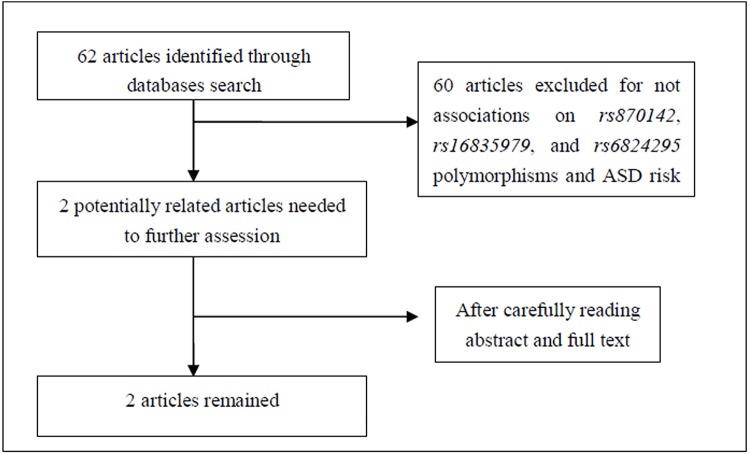
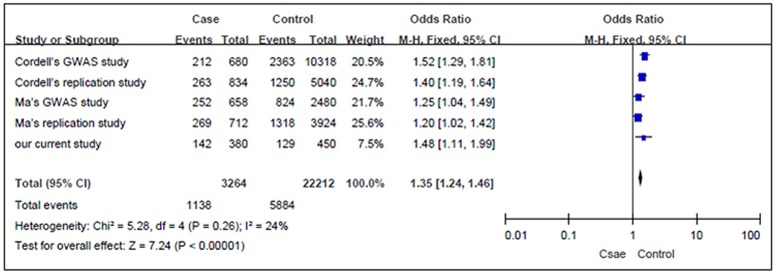
Atrial septal defect (ASD) is the third most frequent type of congenital heart anomaly, featuring shunting of blood between the two atria. Gene-environment interaction remains to be an acknowledged cause for ASD occurrence. A recent European genome-wide association study (GWAS) of congenital heart disease (CHD) identified 3 susceptibility SNPs at chromosome 4p16 associated with ASD: rs870142, rs16835979 and rs6824295. A Chinese-GWAS of CHD conducted in the corresponding period did not reveal the 3 susceptibility SNPs, but reported 2 different risk SNPs: rs2474937 and rs1531070. Therefore, we aimed to investigate the associations between the 3 European GWAS-identified susceptibility SNPs and ASD risk in the Han population in southwest China. Additionally, to increase the robustness of our current analysis, we conducted a meta-analysis combining published studies and our current case-control study. We performed association, linkage disequilibrium, and haplotype analysis among the 3 SNPs in 190 ASD cases and 225 age-, sex-, and ethnicity-matched healthy controls. Genotype and allele frequencies among the 3 SNPs showed statistically significant differences between the cases and controls. Our study found that individuals carrying the allele T of rs870142, the allele A of rs16835979, and the allele T of rs6824295 had a respective 50.1% (odds ratio (OR) = 1.501, 95% confidence interval (CI) = 1.122-2.009, PFDR-BH = 0.018), 48.5% (OR = 1.485, 95%CI = 1.109-1.987, PFDR-BH = 0.012), and 38.6% (OR = 1.386, 95%CI = 1.042-1.844, PFDR-BH = 0.025) increased risk to develop ASD than wild-type allele carriers in our study cohort. In the haplotype analysis, we identified a disease-risk haplotype (TAT) (OR = 1.540, 95%CI = 1.030-2.380, PFDR-BH = 0.016). Our meta-analysis also showed that the investigated SNP was associated with ASD risk (combined OR (95%CI) = 1.35 (1.24-1.46), P < 0.00001). Our study provides compelling evidence to motivate better understanding of the etiology of ASD.
房间隔缺损(ASD)是第三常见的先天性心脏异常类型,其特征是两个心房之间存在血液分流。基因-环境相互作用仍是ASD发生的一个公认原因。最近一项针对先天性心脏病(CHD)的欧洲全基因组关联研究(GWAS)在与ASD相关的4号染色体p16区域鉴定出3个易感单核苷酸多态性(SNP):rs870142、rs16835979和rs6824295。同期进行的一项中国CHD的GWAS未发现这3个易感SNP,但报告了2个不同的风险SNP:rs2474937和rs1531070。因此,我们旨在研究欧洲GWAS鉴定出的这3个易感SNP与中国西南汉族人群ASD风险之间的关联。此外,为增强我们当前分析的稳健性,我们进行了一项荟萃分析,将已发表的研究与我们当前的病例对照研究相结合。我们在190例ASD病例和225例年龄、性别和种族匹配的健康对照中对这3个SNP进行了关联、连锁不平衡和单倍型分析。这3个SNP的基因型和等位基因频率在病例组和对照组之间显示出统计学上的显著差异。我们的研究发现,在我们的研究队列中,携带rs870142的T等位基因、rs16835979的A等位基因和rs682429 的T等位基因的个体患ASD的风险分别比野生型等位基因携带者高50.1%(优势比(OR)=1.501,95%置信区间(CI)=1.122-2.009,错误发现率校正的Benjamini-Hochberg法(PFDR-BH)=0.018)、48.5%(OR =1.485,95%CI =1.109-1.987,PFDR-BH =0.012)和38.6%(OR =1.386,95%CI =1.042-1.来844,PFDR-BH =0.025)。在单倍型分析中,我们鉴定出一种疾病风险单倍型(TAT)(OR =1.540,95%CI =1.030-2.380,PFDR-BH =0.016)。我们的荟萃分析还表明,所研究的SNP与ASD风险相关(合并OR(95%CI)=1.35(1.24-1.46),P <0.00001)。我们的研究为更好地理解ASD的病因提供了有力证据。