Fattebert Julien, Balme Guy, Dickerson Tristan, Slotow Rob, Hunter Luke
Panthera, New York, New York, United States of America; School of Life Sciences, University of KwaZulu-Natal, Durban, South Africa.
Panthera, New York, New York, United States of America; Department of Biological Sciences, University of Cape Town, Cape Town, South Africa.
PLoS One. 2015 Apr 13;10(4):e0122355. doi: 10.1371/journal.pone.0122355. eCollection 2015.
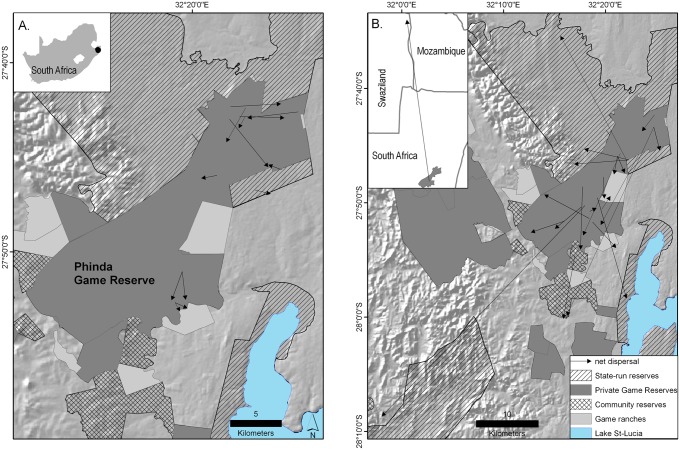
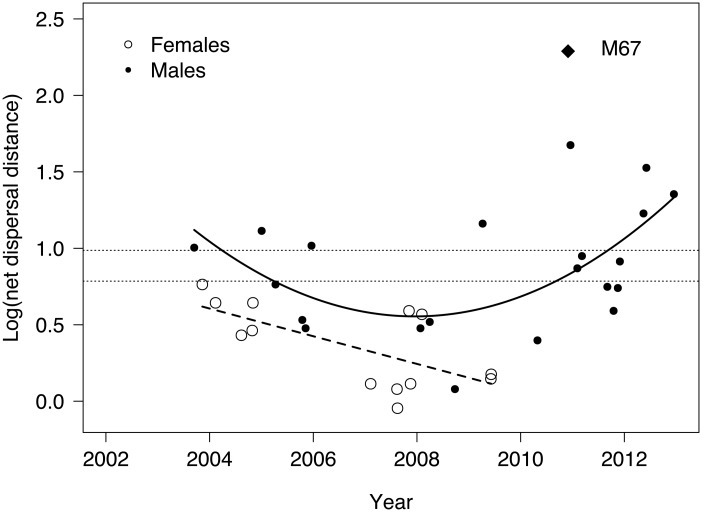
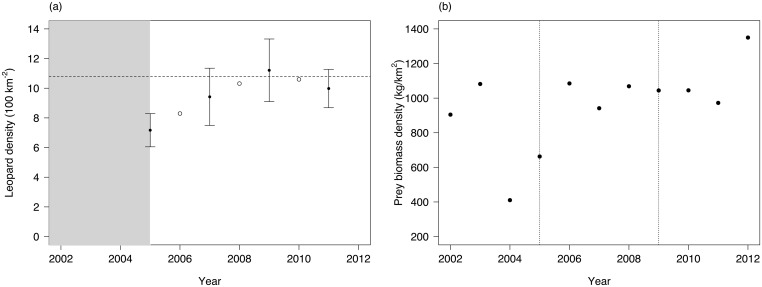
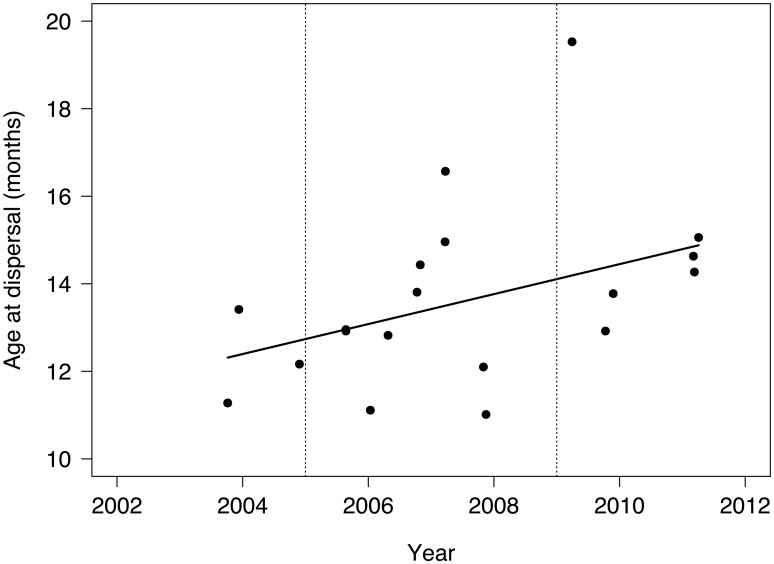
Natal dispersal enables population connectivity, gene flow and metapopulation dynamics. In polygynous mammals, dispersal is typically male-biased. Classically, the 'mate competition', 'resource competition' and 'resident fitness' hypotheses predict density-dependent dispersal patterns, while the 'inbreeding avoidance' hypothesis posits density-independent dispersal. In a leopard (Panthera pardus) population recovering from over-harvest, we investigated the effect of sex, population density and prey biomass, on age of natal dispersal, distance dispersed, probability of emigration and dispersal success. Over an 11-year period, we tracked 35 subadult leopards using VHF and GPS telemetry. Subadult leopards initiated dispersal at 13.6 ± 0.4 months. Age at commencement of dispersal was positively density-dependent. Although males (11.0 ± 2.5 km) generally dispersed further than females (2.7 ± 0.4 km), some males exhibited opportunistic philopatry when the population was below capacity. All 13 females were philopatric, while 12 of 22 males emigrated. Male dispersal distance and emigration probability followed a quadratic relationship with population density, whereas female dispersal distance was inversely density-dependent. Eight of 12 known-fate females and 5 of 12 known-fate male leopards were successful in settling. Dispersal success did not vary with population density, prey biomass, and for males, neither between dispersal strategies (philopatry vs. emigration). Females formed matrilineal kin clusters, supporting the resident fitness hypothesis. Conversely, mate competition appeared the main driver for male leopard dispersal. We demonstrate that dispersal patterns changed over time, i.e. as the leopard population density increased. We conclude that conservation interventions that facilitated local demographic recovery in the study area also restored dispersal patterns disrupted by unsustainable harvesting, and that this indirectly improved connectivity among leopard populations over a larger landscape.
出生扩散有助于种群连通性、基因流动和集合种群动态。在多配偶制哺乳动物中,扩散通常以雄性为主。传统上,“配偶竞争”“资源竞争”和“留居适合度”假说预测了密度依赖型扩散模式,而“避免近亲繁殖”假说则假定为密度独立型扩散。在一个因过度捕猎而正在恢复的豹(Panthera pardus)种群中,我们研究了性别、种群密度和猎物生物量对出生扩散年龄、扩散距离、迁出概率和扩散成功率的影响。在11年的时间里,我们使用甚高频和全球定位系统遥测技术追踪了35只亚成年豹。亚成年豹在13.6±0.4个月时开始扩散。扩散开始时的年龄呈正密度依赖关系。尽管雄性(11.0±2.5千米)通常比雌性(2.7±0.4千米)扩散得更远,但当种群数量低于承载能力时,一些雄性表现出机会性的留居行为。所有13只雌性都留居本地,而22只雄性中有12只迁出。雄性扩散距离和迁出概率与种群密度呈二次关系,而雌性扩散距离呈负密度依赖关系。12只已知命运的雌性中有8只、12只已知命运的雄性豹中有5只成功定居。扩散成功率并不随种群密度、猎物生物量而变化,对于雄性而言,在不同扩散策略(留居与迁出)之间也没有差异。雌性形成了母系亲属集群,支持了留居适合度假说。相反,配偶竞争似乎是雄性豹扩散的主要驱动因素。我们证明扩散模式随时间发生了变化,即随着豹种群密度的增加而变化。我们得出结论,促进研究区域内当地人口恢复的保护干预措施也恢复了因不可持续捕猎而被破坏的扩散模式,并且这间接改善了更大区域内豹种群之间的连通性。