Zhong Linlin, Yeh Tsung-Yin J, Hao Jun, Pourtabatabaei Nasim, Mahata Sushil K, Shao Jianhua, Chessler Steven D, Chi Nai-Wen
Research Service, VA San Diego Healthcare System, San Diego, CA 92161, United States of America; Department of Medicine, University of California San Diego, La Jolla, CA 92093, United States of America.
Department of Medicine, University of California San Diego, La Jolla, CA 92093, United States of America.
PLoS One. 2015 Apr 13;10(4):e0122948. doi: 10.1371/journal.pone.0122948. eCollection 2015.
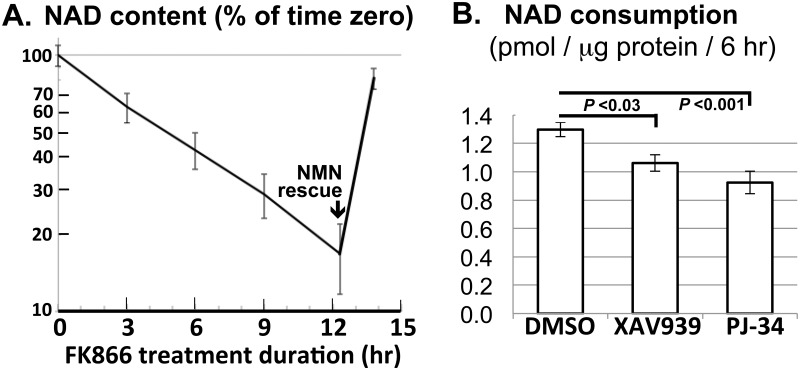
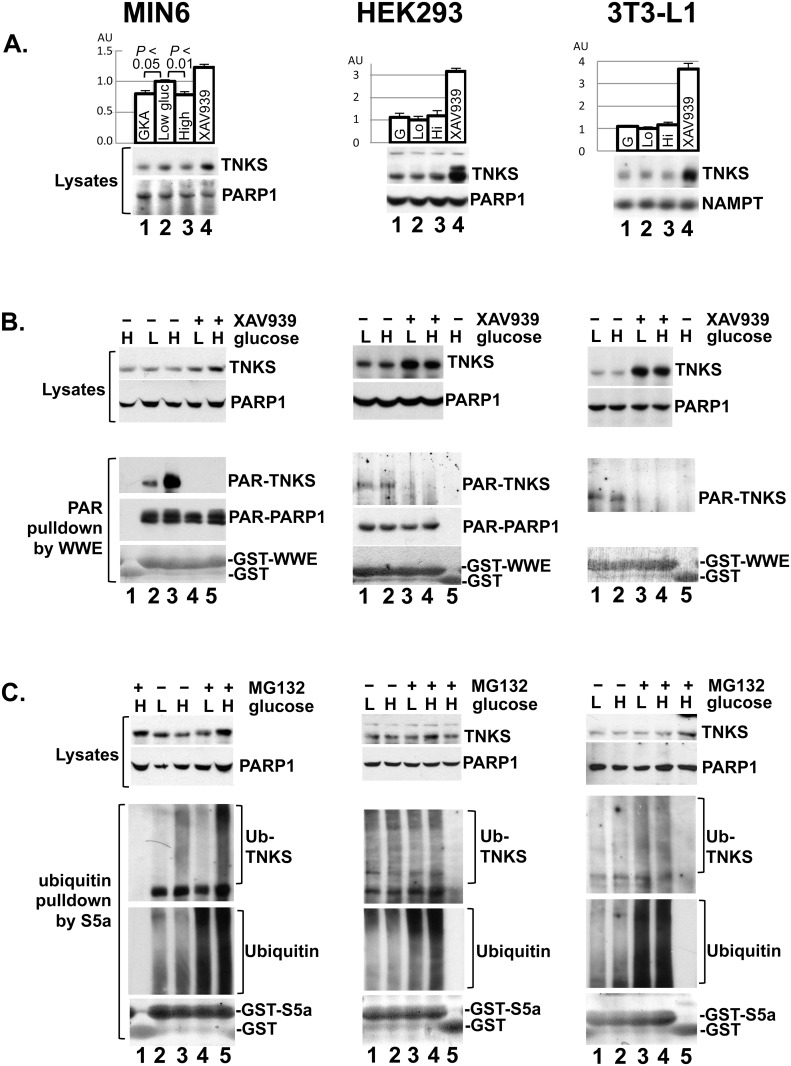
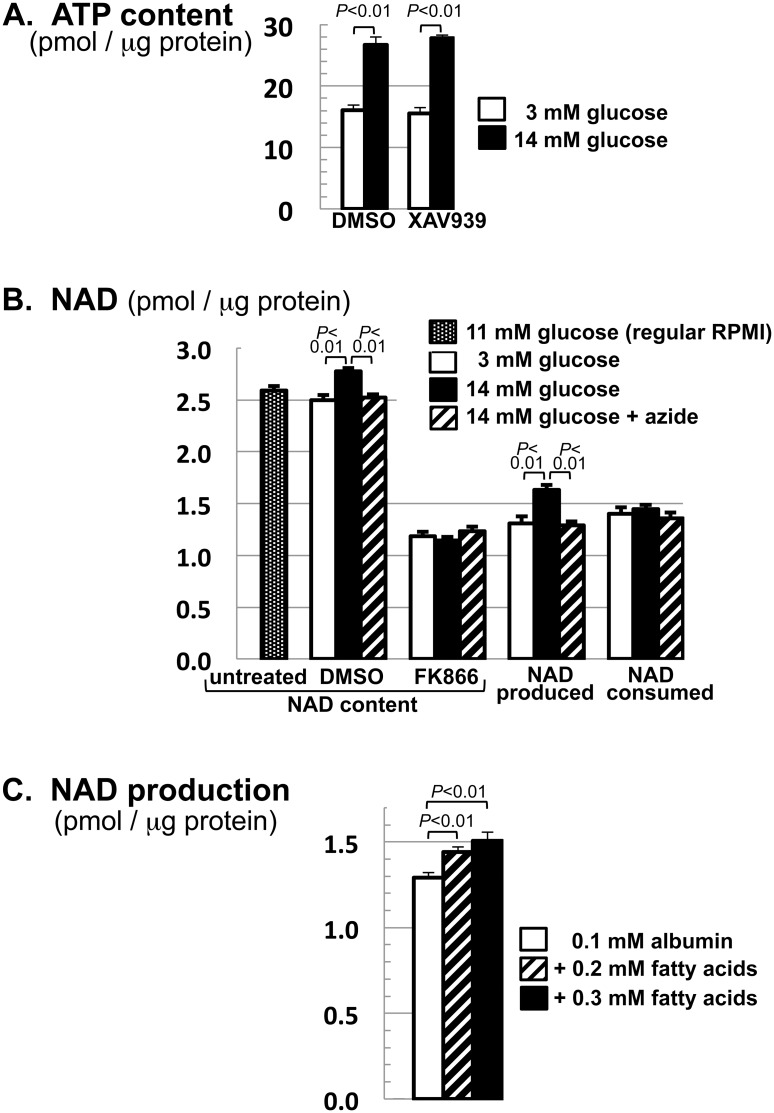
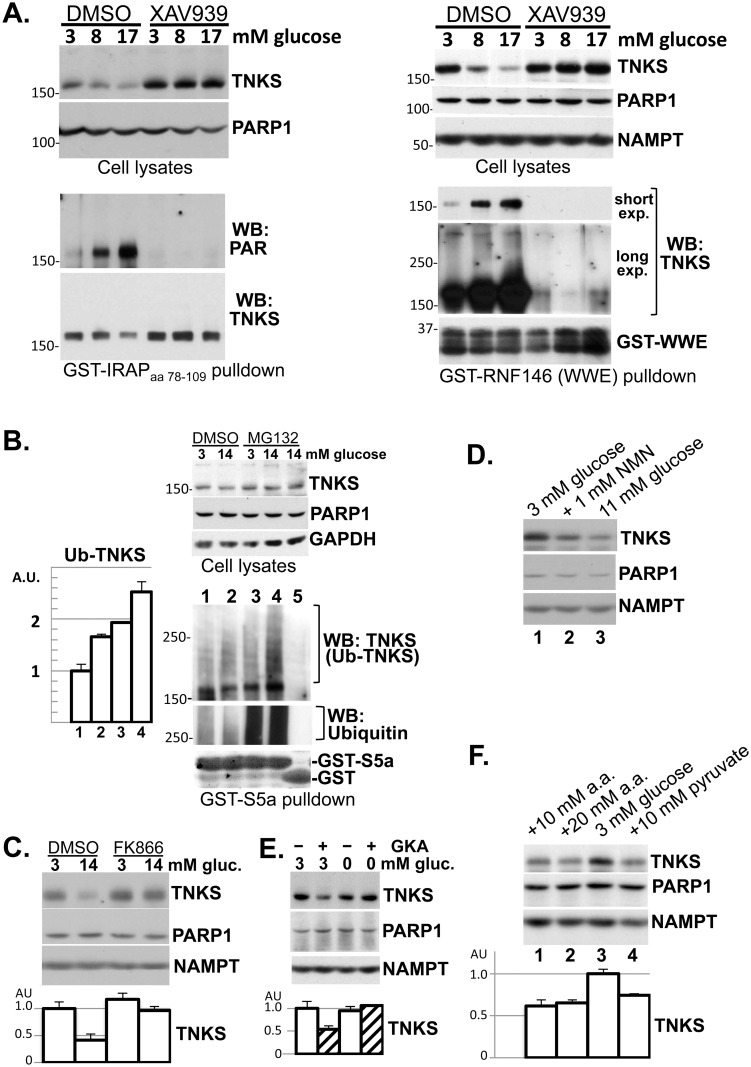
The poly-ADP-ribosylation (PARsylation) activity of tankyrase (TNKS) regulates diverse physiological processes including energy metabolism and wnt/β-catenin signaling. This TNKS activity uses NAD+ as a co-substrate to post-translationally modify various acceptor proteins including TNKS itself. PARsylation by TNKS often tags the acceptors for ubiquitination and proteasomal degradation. Whether this TNKS activity is regulated by physiological changes in NAD+ levels or, more broadly, in cellular energy charge has not been investigated. Because the NAD+ biosynthetic enzyme nicotinamide phosphoribosyltransferase (NAMPT) in vitro is robustly potentiated by ATP, we hypothesized that nutritional energy might stimulate cellular NAMPT to produce NAD+ and thereby augment TNKS catalysis. Using insulin-secreting cells as a model, we showed that glucose indeed stimulates the autoPARsylation of TNKS and consequently its turnover by the ubiquitin-proteasomal system. This glucose effect on TNKS is mediated primarily by NAD+ since it is mirrored by the NAD+ precursor nicotinamide mononucleotide (NMN), and is blunted by the NAMPT inhibitor FK866. The TNKS-destabilizing effect of glucose is shared by other metabolic fuels including pyruvate and amino acids. NAD+ flux analysis showed that glucose and nutrients, by increasing ATP, stimulate NAMPT-mediated NAD+ production to expand NAD+ stores. Collectively our data uncover a metabolic pathway whereby nutritional energy augments NAD+ production to drive the PARsylating activity of TNKS, leading to autoPARsylation-dependent degradation of the TNKS protein. The modulation of TNKS catalytic activity and protein abundance by cellular energy charge could potentially impose a nutritional control on the many processes that TNKS regulates through PARsylation. More broadly, the stimulation of NAD+ production by ATP suggests that nutritional energy may enhance the functions of other NAD+-driven enzymes including sirtuins.
端锚聚合酶(TNKS)的多聚ADP核糖基化(PARsylation)活性调节多种生理过程,包括能量代谢和Wnt/β-连环蛋白信号传导。这种TNKS活性利用NAD⁺作为共底物对包括TNKS自身在内的各种受体蛋白进行翻译后修饰。TNKS介导的PARsylation通常会标记受体蛋白以便进行泛素化和蛋白酶体降解。目前尚未研究这种TNKS活性是否受NAD⁺水平的生理变化调控,或者更广泛地说,是否受细胞能量状态的调控。由于体外NAD⁺生物合成酶烟酰胺磷酸核糖基转移酶(NAMPT)能被ATP强烈增强活性,我们推测营养能量可能刺激细胞中的NAMPT产生NAD⁺,从而增强TNKS的催化作用。以胰岛素分泌细胞为模型,我们发现葡萄糖确实能刺激TNKS的自身PARsylation,进而通过泛素-蛋白酶体系统促进其周转。葡萄糖对TNKS的这种作用主要由NAD⁺介导,因为NAD⁺前体烟酰胺单核苷酸(NMN)也有类似作用,而NAMPT抑制剂FK866能减弱这种作用。葡萄糖对TNKS的去稳定作用也存在于其他代谢燃料中,如丙酮酸和氨基酸。NAD⁺通量分析表明,葡萄糖和营养物质通过增加ATP来刺激NAMPT介导的NAD⁺生成,从而扩大NAD⁺储备。我们的数据共同揭示了一条代谢途径,即营养能量增加NAD⁺生成以驱动TNKS的PARsylating活性,导致TNKS蛋白依赖自身PARsylation的降解。细胞能量状态对TNKS催化活性和蛋白质丰度的调节可能会对TNKS通过PARsylation调控 的许多过程施加营养控制。更广泛地说,ATP对NAD⁺生成的刺激表明营养能量可能增强包括去乙酰化酶在内的其他NAD⁺驱动酶的功能。