Pelaia Girolamo, Vatrella Alessandro, Busceti Maria Teresa, Gallelli Luca, Calabrese Cecilia, Terracciano Rosa, Maselli Rosario
Department of Medical and Surgical Sciences, University "Magna Græcia" of Catanzaro, Viale Europa, Località Germaneto, 88100 Catanzaro, Italy.
Department of Medicine and Surgery, University of Salerno, Via Salvador Allende, Baronissi, 84081 Salerno, Italy.
Mediators Inflamm. 2015;2015:879783. doi: 10.1155/2015/879783. Epub 2015 Mar 23.
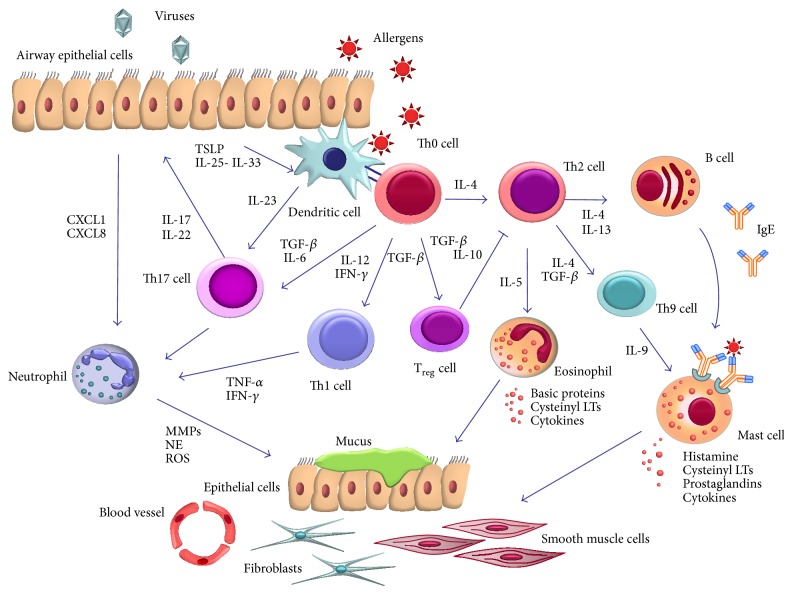
Asthma is a phenotypically heterogeneous chronic disease of the airways, characterized by either predominant eosinophilic or neutrophilic, or even mixed eosinophilic/neutrophilic inflammatory patterns. Eosinophilic inflammation can be associated with the whole spectrum of asthma severity, ranging from mild-to-moderate to severe uncontrolled disease, whereas neutrophilic inflammation occurs mostly in more severe asthma. Eosinophilic asthma includes either allergic or nonallergic phenotypes underlying immune responses mediated by T helper (Th)2 cell-derived cytokines, whilst neutrophilic asthma is mostly dependent on Th17 cell-induced mechanisms. These immune-inflammatory profiles develop as a consequence of a functional impairment of T regulatory (Treg) lymphocytes, which promotes the activation of dendritic cells directing the differentiation of distinct Th cell subsets. The recent advances in the knowledge of the cellular and molecular mechanisms underlying asthmatic inflammation are contributing to the identification of novel therapeutic targets, potentially suitable for the implementation of future improvements in antiasthma pharmacologic treatments.
哮喘是一种气道的表型异质性慢性疾病,其特征为主要是嗜酸性粒细胞性或中性粒细胞性炎症模式,甚至是嗜酸性粒细胞/中性粒细胞混合性炎症模式。嗜酸性粒细胞性炎症可与从轻度至中度到重度未控制疾病的整个哮喘严重程度范围相关,而中性粒细胞性炎症主要发生在更严重的哮喘中。嗜酸性粒细胞性哮喘包括由辅助性T(Th)2细胞衍生的细胞因子介导的免疫反应所潜在的过敏性或非过敏性表型,而中性粒细胞性哮喘主要依赖于Th17细胞诱导的机制。这些免疫炎症特征是由于调节性T(Treg)淋巴细胞的功能受损而产生的,这促进了指导不同Th细胞亚群分化的树突状细胞的激活。哮喘炎症潜在细胞和分子机制知识的最新进展有助于确定新的治疗靶点,这些靶点可能适合于未来改进抗哮喘药物治疗。