
用于评估脂肪来源基质细胞功效的小鼠压疮模型的特性分析
Characterization of a Murine Pressure Ulcer Model to Assess Efficacy of Adipose-derived Stromal Cells.
作者信息
Strong Amy L, Bowles Annie C, MacCrimmon Connor P, Lee Stephen J, Frazier Trivia P, Katz Adam J, Gawronska-Kozak Barbara, Bunnell Bruce A, Gimble Jeffrey M
机构信息
Center for Stem Cell Research and Regenerative Medicine, Tulane University School of Medicine, New Orleans, La.; Division of Plastic and Reconstructive Surgery, Department of Surgery, University of Florida, Gainesville, Fla.; Institute of Animal Reproduction and Food Research of Polish Academy of Sciences, Olsztyn, Poland; Department of Pharmacology, Tulane University School of Medicine, New Orleans, La.; LaCell LLC, New Orleans, La.; Department of Medicine, Tulane Health Sciences Center, New Orleans, La.; and Department of Surgery, Tulane Health Sciences Center, New Orleans, La.
出版信息
Plast Reconstr Surg Glob Open. 2015 Apr 7;3(3):e334. doi: 10.1097/GOX.0000000000000260. eCollection 2015 Mar.
BACKGROUND
As the world's population lives longer, the number of individuals at risk for pressure ulcers will increase considerably in the coming decades. In developed countries, up to 18% of nursing home residents suffer from pressure ulcers and the resulting hospital costs can account for up to 4% of a nation's health care budget. Although full-thickness surgical skin wounds have been used as a model, preclinical rodent studies have demonstrated that repeated cycles of ischemia and reperfusion created by exposure to magnets most closely mimic the human pressure ulcer condition.
METHODS
This study uses in vivo and in vitro quantitative parameters to characterize the temporal kinetics and histology of pressure ulcers in young, female C57BL/6 mice exposed to 2 or 3 ischemia-reperfusion cycles. This pressure ulcer model was validated further in studies examining the efficacy of adipose-derived stromal/stem cell administration.
RESULTS
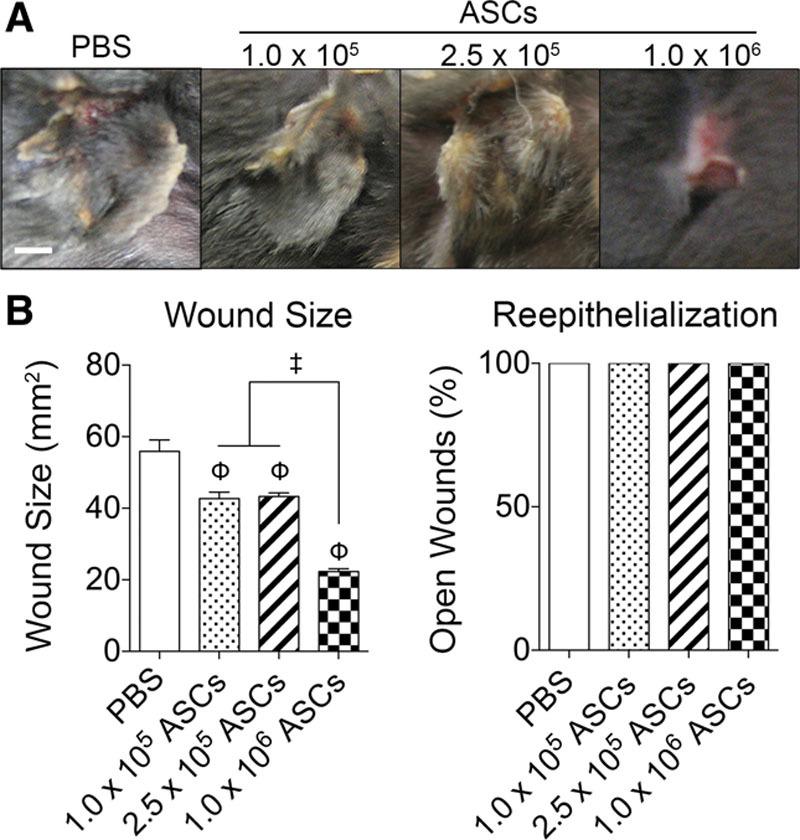
Optimal results were obtained with the 2-cycle model based on the wound size, histology, and gene expression profile of representative angiogenic and reparative messenger RNAs. When treated with adipose-derived stromal/stem cells, pressure ulcer wounds displayed a dose-dependent and significant acceleration in wound closure rates and improved tissue histology.
CONCLUSION
These findings document the utility of this simplified preclinical model for the evaluation of novel tissue engineering and medical approaches to treat pressure ulcers in humans.
背景
随着世界人口寿命延长,未来几十年中发生压疮风险的个体数量将大幅增加。在发达国家,高达18%的养老院居民患有压疮,由此产生的医院费用可占一个国家医疗保健预算的4%。尽管全层手术皮肤伤口已被用作模型,但临床前啮齿动物研究表明,暴露于磁体产生的反复缺血和再灌注周期最接近人类压疮情况。
方法
本研究使用体内和体外定量参数来表征暴露于2或3个缺血-再灌注周期的年轻雌性C57BL/6小鼠压疮的时间动力学和组织学。在研究脂肪来源的基质/干细胞给药效果的研究中进一步验证了该压疮模型。
结果
基于伤口大小、组织学以及代表性血管生成和修复信使RNA的基因表达谱,2周期模型获得了最佳结果。当用脂肪来源的基质/干细胞治疗时,压疮伤口显示出剂量依赖性且伤口闭合率显著加快,组织组织学得到改善。
结论
这些发现证明了这种简化的临床前模型在评估治疗人类压疮的新型组织工程和医学方法方面的实用性。


 Zotero 插件