Savolainen Jorma, Kautiainen Hannu, Niskanen Leo, Mäntyselkä Pekka
Institute of Public Health and Clinical Nutrition, Primary Health Care, School of Medicine, University of Eastern Finland, P.O. Box 1627, FI-70211, Kuopio, Finland.
Primary Health Care Unit, Kuopio University Hospital, P.O. Box 100, FI-72009 KYS, Kuopio, Finland.
BMC Fam Pract. 2015 Feb 28;16:29. doi: 10.1186/s12875-015-0240-y.
The Lapinlahti 2005-2010 study was carried out to explore cardiovascular disease risk factors and changes in lifestyle in Lapinlahti residents in eastern Finland. Our aim was to analyse factors influencing the level of cholesterol in the community.
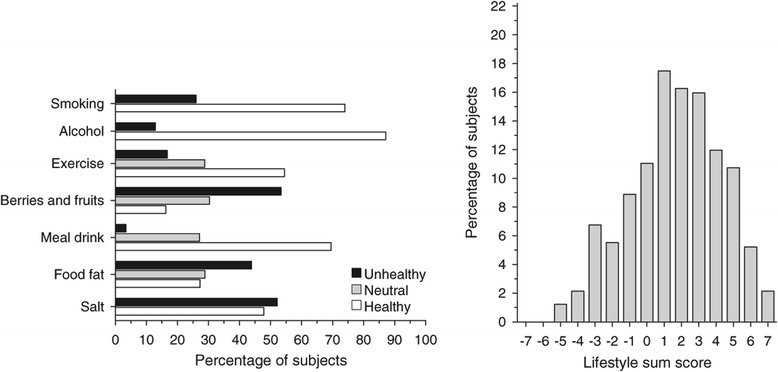
In 2005, 480 subjects aged 30-65 years underwent a complete health survey (baseline study) that consisted of a structured questionnaire and a health examination. The follow-up was carried out five years later in 2010. The present study population included 326 individuals who did not use lipid-lowering medication at the baseline. A trained research nurse measured weight, height, waist circumference and blood pressure at the baseline and follow-up. Respectively, lifestyle factors (nutrition, exercise, smoking and alcohol use) were examined with a structured questionnaire. Each lifestyle item was valued as -1, 0 or 1, depending on how closely it fitted to the recommendations. Cholesterol level analyses at the baseline and follow-up were performed according to the protocol of the Kuopio University Hospital's medical laboratory. Based on their baseline cholesterol levels, the participants were divided into tertiles. The age- and sex-adjusted linear trend between the tertiles was tested.
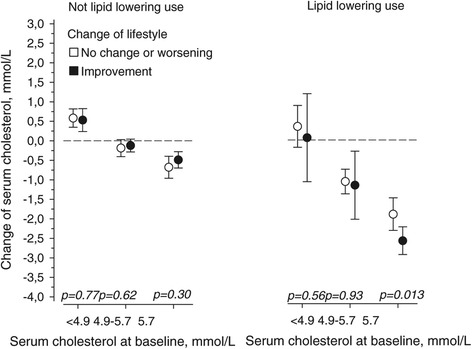
The change in cholesterol level was associated with lipid-lowering medication (P < 0.001). Lifestyle improvement was associated with the cholesterol level change but did not reach statistical significance (P = 0.061), although the interaction of lipid-lowering medication and lifestyle change was associated with the change in cholesterol level (P = 0.018). In multivariate analysis, a favourable change in fat consumption (P = 0.007) and lipid-lowering medication (P < 0.001) were associated with decreasing cholesterol levels.
At the population level, dyslipidaemia is one of the most easily modifiable risk factors of CHD. Lipid-lowering medication may have the most significant impact on cholesterol level in communities with primary health care with good coverage. On the other hand, the potential of health-promoting and population-based prevention strategies may be underused.
开展拉彭兰塔2005 - 2010年研究,以探索芬兰东部拉彭兰塔居民的心血管疾病危险因素及生活方式变化。我们的目的是分析影响该社区胆固醇水平的因素。
2005年,480名年龄在30 - 65岁的受试者接受了全面健康调查(基线研究),包括结构化问卷和健康检查。五年后的2010年进行了随访。本研究人群包括326名在基线时未使用降脂药物的个体。一名经过培训的研究护士在基线和随访时测量体重、身高、腰围和血压。分别通过结构化问卷检查生活方式因素(营养、运动、吸烟和饮酒)。每个生活方式项目根据其符合建议的程度被评定为-1、0或1。基线和随访时的胆固醇水平分析按照库奥皮奥大学医院医学实验室的方案进行。根据参与者的基线胆固醇水平,将他们分为三分位数。对三分位数之间的年龄和性别调整线性趋势进行了检验。
胆固醇水平的变化与降脂药物有关(P < 0.001)。生活方式改善与胆固醇水平变化有关,但未达到统计学意义(P = \alpha061),尽管降脂药物与生活方式改变的相互作用与胆固醇水平变化有关(P = \alpha018)。在多变量分析中,脂肪摄入量的有利变化(P = \alpha007)和降脂药物(P < \alpha001)与胆固醇水平降低有关。
在人群层面,血脂异常是冠心病最易于改变的危险因素之一。在初级卫生保健覆盖良好的社区,降脂药物可能对胆固醇水平有最显著影响。另一方面,促进健康和基于人群的预防策略的潜力可能未得到充分利用。