Chen Keping, Jia Runqing, Li Li, Yang Chuankun, Shi Yan
Zhongda Hospital, Southeast University, 87 Dingjiaqiao, Nanjing, 210009, Jiangsu, China.
College of Life Sciences and Bioengineering, Beijing University of Technology, 100 Ping Le Yuan, Beijing, 100022, China.
BMC Public Health. 2015 Feb 10;15:113. doi: 10.1186/s12889-015-1422-1.
Viral and atypical bacterial pathogens play an important role in respiratory tract infection. Using the Pneumoslide IgM test, the presented study explored the aetiology of community-acquired pneumonia and investigated further whether there was an association between age or season and aetiological organisms.
Serum samples, taken between August 2011 and August 2013, from patients with CAP were tested with the Pneumoslide IgM kit. The Pneumoslide IgM technology can simultaneously diagnose 9 viral and atypical bacterial pathogens: Legionella pneumophila serogroup 1 (LP1), Mycoplasma pneumoniae (MP), Coxiella burnetii (COX), Chlamydophila pneumonia (CP), Adenovirus (ADV), Respiratory syncytial virus (RSV), Influenza A (INFA), Influenza B (INFB), Parainfluenza 1, 2 and 3 (PIVs). The data was analyzed by using Statistical Package for the Social Sciences for Windows (SPSS, version 11.0).
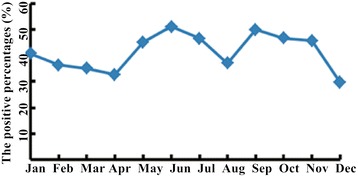
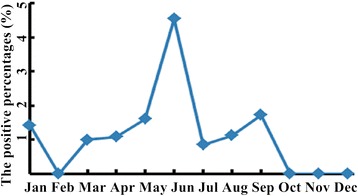
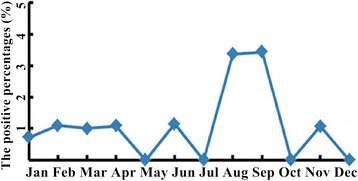
Of a total of 1204 serum samples tested, 624 samples were positive. M. pneumoniae was the dominant pathogen, with INFB, PIVs, and RSV ranking second to fourth, respectively. The positive percentages of MP, INFB, PIVs and RSV were found to be associated with age, especially MP, INFB and PIVs. The positive percentages of MP, PIVs and RSV were also found to be associated with season. The positive percentage of MP in autumn was the highest. The positive percentages of LP1 in August and September, ADV in June and INFB in March were relatively higher than that in other months.
The results show there were 4 main viral and atypical bacterial pathogens causing CAP in our study. Some pathogens were found to be associated with age and season. M. pneumoniae was the most predominant pathogen among these 9 pathogens. It is necessary to take preventative measures in order to prevent the spread of these pathogens in susceptible age groups during peak season.
病毒和非典型细菌病原体在呼吸道感染中起重要作用。本研究使用肺炎支原体IgM检测,探讨社区获得性肺炎的病因,并进一步研究年龄或季节与病原体之间是否存在关联。
2011年8月至2013年8月期间采集的社区获得性肺炎患者的血清样本,用肺炎支原体IgM检测试剂盒进行检测。肺炎支原体IgM技术可同时诊断9种病毒和非典型细菌病原体:嗜肺军团菌血清1型(LP1)、肺炎支原体(MP)、贝纳柯克斯体(COX)、肺炎衣原体(CP)、腺病毒(ADV)、呼吸道合胞病毒(RSV)、甲型流感病毒(INFA)、乙型流感病毒(INFB)、副流感病毒1、2和3型(PIVs)。数据采用社会科学统计软件包(SPSS,版本11.0)进行分析。
在总共检测的1204份血清样本中,624份样本呈阳性。肺炎支原体是主要病原体,乙型流感病毒、副流感病毒和呼吸道合胞病毒分别位居第二至第四。发现肺炎支原体、乙型流感病毒、副流感病毒和呼吸道合胞病毒的阳性率与年龄有关,尤其是肺炎支原体、乙型流感病毒和副流感病毒。还发现肺炎支原体、副流感病毒和呼吸道合胞病毒的阳性率与季节有关。秋季肺炎支原体的阳性率最高。8月和9月嗜肺军团菌血清1型的阳性率、6月腺病毒的阳性率和3月乙型流感病毒的阳性率相对高于其他月份。
结果表明,本研究中有4种主要病毒和非典型细菌病原体导致社区获得性肺炎。发现一些病原体与年龄和季节有关。肺炎支原体是这9种病原体中最主要的病原体。有必要采取预防措施,以防止这些病原体在高发季节在易感年龄组中传播。