Wang Fuyan, Di Haibo, Hu Xiaohua, Jing Shan, Thibaut Aurore, Di Perri Carol, Huang Wangshan, Nie Yunzhi, Schnakers Caroline, Laureys Steven
International Vegetative State and Consciousness Science Institute, Hangzhou Normal University, Hangzhou, China.
Department of Radiology, The Affiliated Hospital of Hangzhou Normal University, Hangzhou, China.
BMC Med. 2015 Apr 15;13:83. doi: 10.1186/s12916-015-0330-7.
Previous studies have shown the prognostic value of stimulation elicited blood-oxygen-level-dependent (BOLD) signal in traumatic patients in vegetative state/unresponsive wakefulness syndrome (VS/UWS). However, to the best of our knowledge, no studies have focused on the relevance of etiology and level of consciousness in patients with disorders of consciousness (DOC) when explaining the relationship between BOLD signal and both outcome and signal variability. We herein propose a study in a large sample of traumatic and non-traumatic DOC patients in order to ascertain the relevance of etiology and level of consciousness in the variability and prognostic value of a stimulation-elicited BOLD signal.
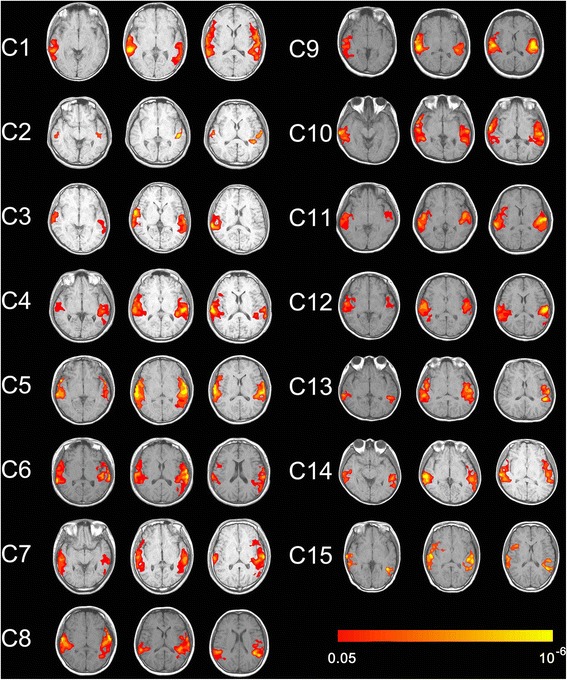
66 patients were included, and the response of each subject to his/her own name said by a familiar voice (SON-FV) was recorded using fMRI; 13 patients were scanned twice in the same day, respecting the exact same conditions in both cases. A behavioral follow-up program was carried out at 3, 6, and 12 months after scanning.
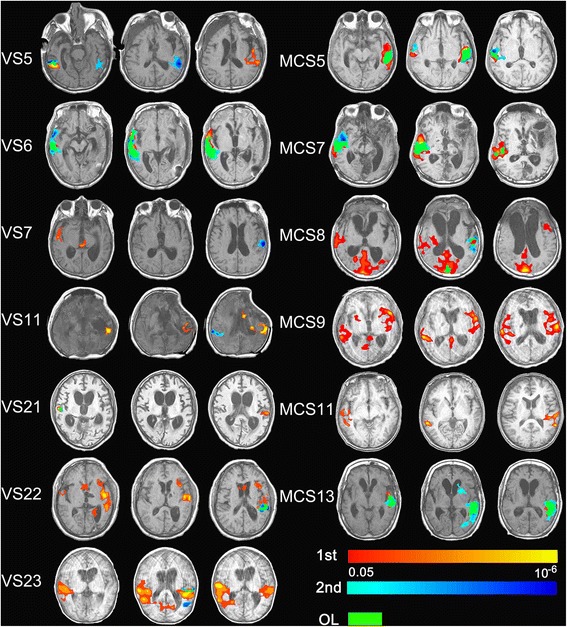
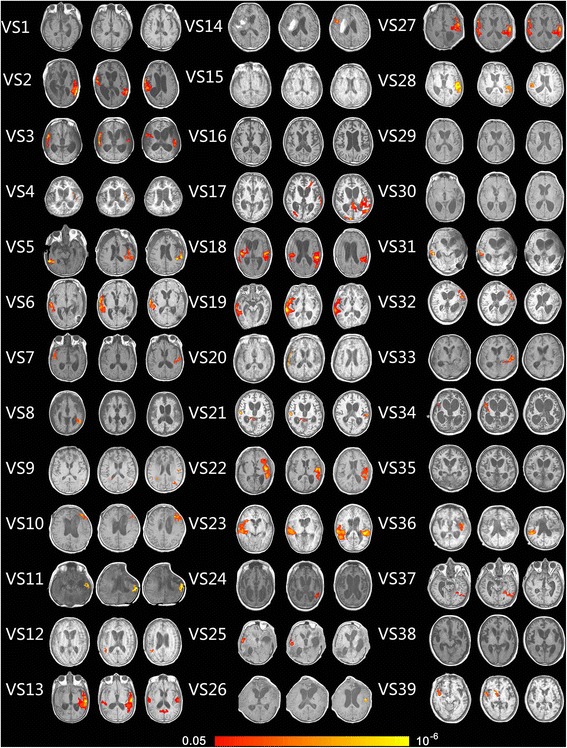
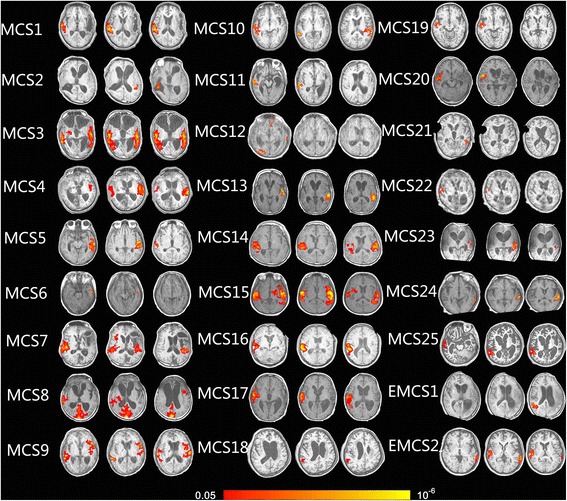
Of the 39 VS/UWS patients, 12 (75%) out of 16 patients with higher level activation patterns recovered to minimally conscious state (MCS) or emergence from MCS (EMCS) and 17 (74%) out of 23 patients with lower level activation patterns or no activation had a negative outcome. Taking etiology into account for VS/UWS patients, a higher positive predictive value was assigned to traumatic patients, i.e., up to 92% (12/13) patients with higher level activation pattern achieved good recovery whereas 11 out of 13 (85%) non-traumatic patients with lower level activation or without activation had a negative clinical outcome. The reported data from visual analysis of fMRI activation patterns were corroborated using ROC curve analysis, which supported the correlation between auditory cortex activation volume and VS/UWS patients' recovery. The average brain activity overlap in primary and secondary auditory cortices in patients scanned twice was 52%.
The activation type and volume in auditory cortex elicited by SON-FV significantly correlated with VS/UWS patients' prognosis, particularly in patients with traumatic etiology, however, this could not be established in MCS patients. Repeated use of this simple fMRI task might help obtain more reliable prognostic information.
先前的研究已表明,刺激诱发的血氧水平依赖(BOLD)信号在植物状态/无反应觉醒综合征(VS/UWS)创伤患者中的预后价值。然而,据我们所知,在解释BOLD信号与结局及信号变异性之间的关系时,尚无研究关注意识障碍(DOC)患者的病因和意识水平的相关性。我们在此提出一项针对大量创伤性和非创伤性DOC患者的研究,以确定病因和意识水平在刺激诱发的BOLD信号变异性及预后价值中的相关性。
纳入66例患者,使用功能磁共振成像(fMRI)记录每个受试者对熟悉声音说出其名字(SON-FV)的反应;13例患者在同一天进行了两次扫描,两次扫描条件完全相同。在扫描后3、6和12个月进行了行为随访。
在39例VS/UWS患者中,16例激活模式较高的患者中有12例(75%)恢复到最小意识状态(MCS)或从MCS中苏醒(EMCS),23例激活模式较低或无激活的患者中有17例(74%)预后不良。考虑到VS/UWS患者的病因,创伤患者的阳性预测值更高,即13例激活模式较高的患者中有12例(92%)实现了良好恢复,而13例激活模式较低或无激活的非创伤患者中有11例(85%)临床预后不良。使用ROC曲线分析证实了fMRI激活模式视觉分析报告的数据,该分析支持听觉皮层激活量与VS/UWS患者恢复之间的相关性。两次扫描患者初级和次级听觉皮层的平均脑活动重叠率为52%。
SON-FV诱发的听觉皮层激活类型和激活量与VS/UWS患者的预后显著相关,特别是创伤性病因患者,但在MCS患者中无法确定。重复使用这种简单的fMRI任务可能有助于获得更可靠的预后信息。